Will UNC basketball search break tradition? Inside the Tar Heels coaching legacy.
Published in Basketball
CHAPEL HILL, N.C. — When Bill Belichick was introduced as North Carolina’s football coach in December 2024, athletic director Bubba Cunningham opened his news conference remarks with a brief quip.
“Over the last four or five years, anytime there’s been a search anywhere in the country, they thought the first two people you should call are Brad Stevens and Jay Wright,” Cunningham said. “So that’s who I called first.”
At most programs, that line would land as the familiar truth about the modern coaching carousel — wide-ranging searches, big-name targets and aspirational phone calls.
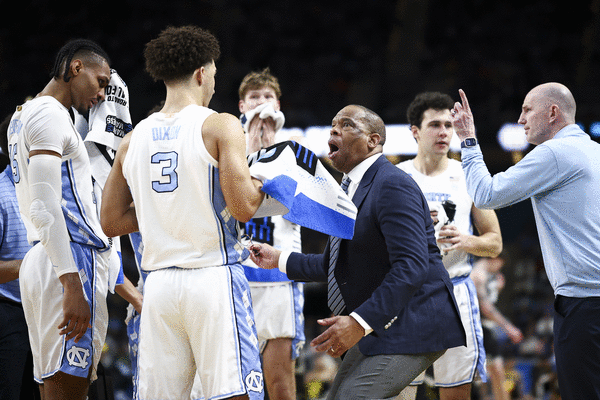
But that’s not how North Carolina has traditionally operated when it comes to its men’s basketball program. For decades, the Tar Heels have promoted from within a tight coaching lineage that traces from Dean Smith to Bill Guthridge to Roy Williams and, most recently, Hubert Davis.
Now, that model is being tested.
North Carolina officially parted ways with Davis on Tuesday night, the school announced, truly opening up one of college basketball’s premier jobs for the first time in decades and setting the stage for a search that will likely look fundamentally different from those that came before it.
With no clear successor who fits the traditional “Carolina family” mold, the university is casting a wider net. Cunningham, incoming AD Steve Newmark and university chancellor Lee Roberts are leading the search, which will include assistance from executive firm TurnkeyZRG and consultant Chad Chatlos. The school said it will also rely on an advisory group of former players, coaches and key stakeholders.
“A lot of people say, ‘Well, you should know all the coaches, and you should be able to do that,’” Cunningham said in a recent episode of UNC’s Carolina Insider podcast. “When a job like this comes open, there are so many requests, and you really want to get back to people and have respect for what they’re trying to bring to you. And so it does help us filter that.”
“Certainly we’ve talked about, and we’ll continue to talk about potential candidates and a timeline in the entire process,” Cunningham continued, “but having an outside firm be a shelter or shield to really screen a lot of the calls that are coming will be very helpful for us.”
Both Cunningham and Newmark emphasized they will lean on the legacy of UNC basketball — such as former players and coaches — as they navigate the process in the coming days. Neither has provided a timeline on when a new coach will be hired.
“We want to get the right person,” Cunningham said in the podcast. “And if it takes a couple of days, great. If it takes a little bit longer than that, then that’s what it’s going to have to take.”
Both Cunningham and Newmark were present at a Wednesday meeting of UNC’s Board of Trustees at the Rizzo Center at Chapel Hill. They went into a closed session with the board and, after the session concluded, could be seen speaking with multiple members of the board.
Cunningham declined to provide much further comment when approached by the News & Observer, but confirmed the Trustees’ sole role in the hiring process will be approving the eventual hire. UNC’s Board of Trustees came under fire for reported meddling in the hiring of Belichick.
As North Carolina begins a search that could redefine its identity, it’s worth revisiting how we got here. Here’s a look back at the program’s coaching transitions (in reverse chronological order):
April 5, 2021: The next in line
If Williams’ retirement marked the end of an era, the hiring of Davis reinforced what North Carolina had long valued: continuity.
Four days after Williams announced he was stepping down, Cunningham named Davis the program’s next head coach, extending a lineage that stretched back decades.
That announcement came on Monday, April 5. On Tuesday, April 6, Davis was introduced as the head coach in a press conference held at the Dean E. Smith Center. That day, he looked up at the rafters — where his uncle, Walter Davis, is enshrined — and took in the weight of it all. He stood by his father as video boards flashed his name as head coach.
“I’m an emotional guy,” Davis said that day.
But his path to that stage had been anything but guaranteed.
As a recruit, Davis once had to convince Smith he belonged at North Carolina at all. Smith initially suggested Davis consider a smaller school before ultimately offering a scholarship — a turning point that Davis seized immediately.
From there, Davis developed into a standout guard, finishing his career as one of the program’s most efficient perimeter shooters. He went on to play 12 seasons in the NBA and serve as a college basketball analyst for ESPN before returning to Chapel Hill in 2012 as an assistant under Williams.
That unconventional path — from player to broadcaster to coach — made his hiring something of a departure in experience, but certainly not in philosophy.
Davis was steeped in the culture UNC sought to preserve.
April 1, 2021: The end of an era
Nearly two decades after coming home, Williams faced a different kind of decision.
Williams announced his retirement on April 1, 2021. The choice, he said, had been building for months, shaped by a realization he was no longer capable of doing the job.
In a deeply emotional news conference at the Dean E. Smith Center, Williams took responsibility for a season that fell short of his own expectations, saying he “didn’t get the team where I wanted them to go,” and “didn’t push the right buttons,” and “just didn’t get it done.”
Williams, then 70, acknowledged the toll of recent seasons and the uncertainty ahead.
“I don’t know what’s in the future,” he said. “I know I won’t coach again.”
The retirement marked the end of one of college basketball’s most accomplished careers. Williams retired with three national championships and more than 900 wins overall.
April 7-14 2003: A reversal and a return
Sometimes, seven days can change everything in a coaching search.
On April 7, 2003, Williams made headlines at the Final Four when, moments after Kansas’ loss to Syracuse in the national championship game, he was asked about Matt Doherty’s departure and a potential opening for him at UNC.
“I haven’t thought about that for one second … I could give a (expletive) about North Carolina right now,” Williams said. “I’ve got 13 kids in that locker room that I love.”
But, within a week, North Carolina had its coach.
On April 14, 2003, Williams stood inside the Dean E. Smith Center flanked by Smith and Guthridge, formally introduced as the Tar Heels’ next head coach.
Williams acknowledged the difficulty of leaving Kansas, where he had spent 15 seasons and led a national contender. Only a death or serious illness in his family, he said, would have been harder than telling his players he was leaving.
“I was a Tar Heel born,” Williams said that day. “When I die, I’ll be a Tar Heel dead. But in the middle I have been Tar Heel and Jayhawk bred, and I am so, so happy and proud of that.”
For North Carolina, the hire restored order after a turbulent three-year stretch and reestablished its preferred model: a coach with deep ties to the program, chosen not through an expansive search, but through persistence and patience.
April 1, 2003: Doherty steps down
After three turbulent seasons, Matt Doherty stepped down as North Carolina’s head coach on April 1, 2003.
Doherty, who had taken over following Bill Guthridge’s departure in 2000, guided the Tar Heels through a roller-coaster stretch that included an ACC regular season title and AP Coach of the Year honors in 2000-01, a historically poor 8-20 season in 2001-02 and a rebound to 19-16 in 2002-03. Injuries to key players, such as freshman center Sean May, and clashes over Doherty’s intense coaching style added strain.
Then-UNC athletic director Dick Baddour called Doherty’s resignation “an agonizing decision” and emphasized it was made with the program’s best interests in mind.
Doherty’s exit left recruits in limbo — mainly JamesOn Curry, who had committed to UNC largely because of Doherty, his high school coach said at the time.
July 2000: Doherty hired as UNC head coach
Matt Doherty returned to North Carolina as head coach in 2000, with his introductory news conference on July 11, 2000, after one season at Notre Dame and seven years as an assistant at Kansas. A player at UNC (1980–84) and 1982 national champion, Doherty emphasized continuity within the coaching tree.
“I got my undergraduate degree at North Carolina under Dean Smith,” Doherty said. “My graduate work was at Kansas under Roy Williams. I learned from some pretty good folks. The philosophy is in place.”
He brought in a new staff including Doug Wojcik, Fred Quartlebaum, David Cason and Bob MacKinnon. Doherty’s six-year contract paid $145,000 yearly in base salary plus $180,000 in media deals.
June 2000: Guthridge steps down
On June 30, 2000, a news conference was called to announce Guthridge’s retirement. His departure left UNC in a predicament, as there was no clear-cut heir from within the program, unlike when Smith retired.
The Guthridge Era began with an 84-56 home win against Middle Tennessee State on November 14, 1997. He led the Tar Heels to the Final Four twice and achieved 34 wins in his first campaign — marking a record at the time for the most ever by a first-year head coach. His last victory was on March 26, 2000, beating Tulsa 59-55. That brought his winning total to 80 games in three seasons.
Oct. 9, 1997: Smith steps down, Guthridge takes over
Smith retired after 36 seasons as UNC’s head coach on Oct. 9, 1997. The news of his retirement was met with widespread emotion and disbelief among fans, players — and maybe even Mother Nature. A thick fog shrouded Chapel Hill on the morning of the announcement. Students on campus were seen crying, with others reporting feeling “queasy” or “dazed” according to Charlotte Observer archives.
“It’s all the little things that wore Dean out,” Guthridge said. “Sign this autograph. Make this appearance. Call here. Do this. Do that. I think he still loves basketball, but he’s not going to do anything halfway.”
Leading UNC from 1961 to 1997, Smith retired as the winningest coach in college basketball with 879 victories and two NCAA titles. His teams compiled an 879-254 record (a 77.6 winning percentage), 17 ACC regular season titles, 13 ACC tournament championships and recorded 33 straight years of finishing in the conference’s top three and 20 years among the top two. He advanced UNC to 11 NCAA Final Fours and five national title games.
Guthridge, who served as Smith’s assistant coach at North Carolina for 30 years, was named North Carolina’s 16th head coach on Oct. 9, 1997 — the day Smith announced his retirement. He signed a five-year contract, joking that he might coach until he was 70.
This appointment came weeks after Guthridge had initially stated he wouldn’t want to replace Smith.
The news of Smith’s retirement and Guthridge’s appointment led to plenty of emotional reactions. Many players, though emotional about Smith’s departure, expressed confidence in Smith. Junior forward Antawn Jamison said there wasn’t a better person to replace Smith than Guthridge. Junior swingman Vince Carter acknowledged the idea of Guthridge as head coach would be weird at first, and predicted more demanding practices due to Guthridge’s enthusiasm and work ethic.
Williams, thought to be a favorite as successor, endorsed Guthridge.
“I would have been disappointed at the University of North Carolina if they hadn’t given Coach Guthridge the opportunity,” Williams said. “I have to answer (those rumors) every year. I was extremely happy when I learned that Coach Guthridge won’t be an interim … there’s no doubt in my mind that Coach Guthridge is the best coach for North Carolina.”
1961: Smith is hired
Smith took over for Frank McGuire in 1961 after McGuire left for the pro ranks, taking a job with the Philadelphia Warriors.
“Carolina is fortunate in getting Dean Smith as my successor,” McGuire said in Philadelphia on Aug. 3, 1961. “He has all the contacts I ever had. Technically, he knows as much basketball as anyone. He will do a fine job.”
____
©2026 Raleigh News & Observer. Visit newsobserver.com. Distributed by Tribune Content Agency, LLC.





Comments