John Romano: Rays. Brewers. World Series. So, who has the edge? We have thoughts
Published in Baseball
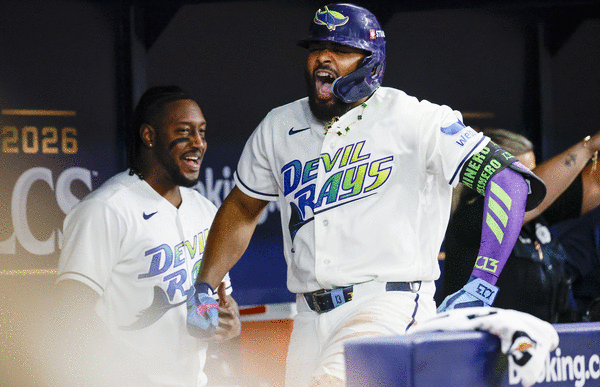
So, this is a new experience for Tampa Bay.
In their previous two World Series appearances, the Rays had not seen their opponent in the regular season. In fact, there was little history between the Rays and Phillies in 2008 (three games in the previous five seasons) or the Rays and Dodgers in 2020 (eight games in the previous five seasons).
That’s not the case with the Rays and Brewers. They have met in every one of the last five seasons.
And the results are not terribly reassuring.
Tampa Bay is 6-10 against Milwaukee since 2021, including 1-2 this season. Even worse, the Rays have been outscored by a whopping 69-45 margin.
Of course, there have been lots of changes on both rosters in that time which means the outcomes aren’t exactly predictive.
So before you start pacing in the hallway and carrying on conversations with the pets, let’s go over the rosters and get a better sense of what to expect in the coming days.
Offense
When you break them down individually, these lineups are incredibly similar.
By now, you’re familiar with Tampa Bay’s big three at the top of the order. In reality, since Liam Hicks was acquired from Miami in early August, it’s more like the big four with Yandy Diaz, Jonathan Aranda, Junior Caminero and Hicks.
Milwaukee has a similar look to its lineup. The combination of Jackson Chourio, Brice Turang, William Contreras and Jake Bauers was at the top of the lineup for six of Milwaukee’s eight postseason games. In the other two games, they were sprinkled in the top five of the batting order.
So who has the edge up top? Tampa Bay’s top four has more power (104 homers versus 90) but that’s almost entirely due to Caminero’s 42 homers. When it comes to OPS, there is scant difference. Milwaukee’s top four averages an .821 OPS and Tampa Bay’s is .820.
How about the rest of the lineup? Also very similar. Tampa Bay’s Victor Mesa Jr. and Milwaukee’s Garrett Mitchell have quality bats, but the scoring possibilities go downhill quickly.
If there’s a difference between the offenses, it’s this:
The Brewers have more strikeouts (22% of all plate appearances compared to 18.8% for the Rays) but also draw more walks (10.6% to 8.4%). Bottom line is the Brewers put more runners on base, which led to a lot more runs (832 to 736) in the regular season.
Advantage: Milwaukee.
Starting pitching
The Brewers have star power with potential Cy Young Award winner and 100-mph machine Jacob Misiorowski, but the Rays have a deeper rotation.
Misiorowski and Logan Henderson are a pretty formidable 1-2 punch, but it’s a steep fall after that. Tampa Bay, on the other hand, has a stronger 1-2-3 lineup of Drew Rasmussen, Freddy Peralta and Nick Martinez. And when it comes to a No. 4 starter, Griffin Jax is probably more appealing than anyone Milwaukee has.
To drive that point home, the Brewers got 32.1 innings out of starters/bulk pitchers in eight postseason games. The Rays got 50 innings in eight games. Maybe some of that was because Cleveland is a pretty mediocre hitting team, but the regular-season numbers also back up Tampa Bay’s superiority.
Advantage: Tampa Bay.
Bullpens
It’s been even better in the playoffs.
The combo of closer Trevor Megill, multi-inning specialist Aaron Ashby, Abner Uribe, DL Hall and JoJo Romero have thrown 35 innings (more than the rotation) with a 0.77 ERA in the postseason. In other words, you do not want to find yourself trailing the Brewers in the sixth inning.
Tampa Bay’s bullpen has been a strength for most of the season, with closer Bryan Baker leading the way. Baker has not blown a save since May 11, which means he’s 35-of-35 including the playoffs. Cam Booser, Kevin Kelly and Tyler Wells for the most part have been reliable, but don’t have many multi-inning appearances.
One potential concern? Baker has a high number of walks (3.2 per nine innings), and the Brewers are extremely patient. For that reason, the Rays may drop rookie Brody Hopkins from the postseason roster. Hopkins has exceptional stuff, but shaky command.
Advantage: Milwaukee.
Defense
Admittedly, this one is guesswork. While there are websites with defensive metrics available, their numbers vary wildly so it’s difficult to come to a consensus.
(For example, Statcast has always been very meh when it comes to Taylor Walls at shortstop. If you poll managers, I’d bet most would consider him an elite defender, possibly the best in the game.)
With that caveat in mind, here’s a look at what Statcast, Fangraphs and the Fielding Bible suggest about the two clubs.
Brewers second baseman Turang and Walls are two of the best defenders in the game, full stop. Milwaukee leftfielder Chourio and Tampa Bay’s Chandler Simpson are both Gold Glove finalists in leftfield, although Chourio seems to be ranked higher.
Both teams are above average in centerfield, Tampa Bay’s Mesa has the edge in rightfield (Milwaukee’s Luis Lara is excellent, but doesn’t get a lot of playing time), the combo of Joey Ortiz and David Hamilton is probably a little better at third base, and both teams are weak at first base and average at catcher.
Fangraphs has Milwaukee’s team defense slightly better than Tampa Bay, while the Fielding Bible says Tampa Bay has the more accomplished defense.
Advantage: Neither. Or both.
_____
©2026 Tampa Bay Times. Visit at tampabay.com. Distributed by Tribune Content Agency, LLC.






Comments