Bill Shaikin: Are we living in the Dodgers' golden era? The answer may not be so simple.
Published in Baseball
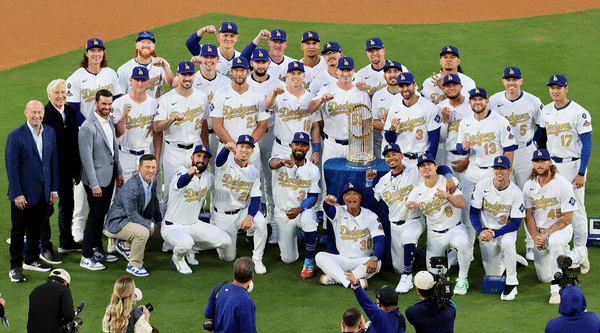
ATLANTA — For the better part of a decade, Andrew Friedman and Stan Kasten have talked about a shared goal of making this the golden era of Dodgers baseball.
No team in major league history has more consecutive postseason appearances than these Dodgers. No National League team has won three consecutive World Series championships, but the Dodgers could complete that trifecta this month.
So, Mr. Friedman, mission accomplished?
"I don't think I'm qualified to answer the question," said Friedman, the Dodgers' president of baseball operations, "but also, I don't think I have the perspective for it right now. Look forward to after I get fired or whatever, and being able to look back on it and the specialness of this time."
Who, I asked him, might be qualified to answer the question?
"Bill," he said, "I'd like you to answer that question, please."
I will, but not without soliciting opinions first. Mr. Kasten, what say you?
"I'm not a historian," said Kasten, the team president. "A historian, 10 years from now. That's who you should ask. Go find someone."
I don't have 10 years to wait, plus artificial intelligence might kill us all by then. But I liked Kasten's idea of finding a historian, so I found two, and I asked them each the same question: Do the Dodgers need to three-peat to clinch this time as the golden era of Dodger baseball?
Mark Langill, the Dodgers' historian for the past 33 years, said he was "cracking up" when he heard Friedman's words. He pointed to the 14 consecutive postseason appearances.
"What people don't realize is," Langill said, "the previous record was two.
"So, before, you'd have maybe the team of a generation: the Kirk Gibson year, the year of Fernando, the year of Drysdale and Koufax. But you never had the sustained part."
And what did Langill find so funny about what Friedman said?
"Obviously, he's just being modest, but this is one of the greatest executives you will ever see in the sport," Langill said. "He's doing the 'aw shucks' and everything like that. He may not feel comfortable saying this, but I'm feeling comfortable saying it's one of the most amazing streaks, not only in the history of the Dodgers, but in the history of sports."
So, with or without a three-peat, is this the Dodgers' golden era?
"It's definitely the golden era," Langill said.
The reply from John Thorn, the official historian of Major League Baseball, was far less conclusive.
"I do believe this is a golden era for Dodger baseball," Thorn said.
A golden era, not the golden era, at least not yet.
Before Friedman and Kasten arrived, there was little dispute about the Dodgers' golden era. It took place in Brooklyn, and it was immortalized in the book "The Boys of Summer."
The 1955 Brooklyn Dodgers, the first World Series championship team in franchise history, featured eight Hall of Famers: infielders Jackie Robinson, Pee Wee Reese and Gil Hodges, outfielder Duke Snider, catcher Roy Campanella and manager Walter Alston, plus cameo appearances from rookie pitchers Sandy Koufax and Tommy Lasorda.
The Dodgers of this era feature almost certain Hall of Famers in pitcher Clayton Kershaw, first baseman Freddie Freeman, shortstop and right fielder Mookie Betts, pitcher and designated hitter Shohei Ohtani and manager Dave Roberts, plus perhaps closer Kenley Jansen and emerging candidate Yoshinobu Yamamoto.
What makes the Dodgers' three championships in this era stand out is that they navigated multiple postseason rounds each time. In the Brooklyn era, the league champion advanced directly to the World Series. Those Dodgers won five National League titles within 10 years and lost two others on the final day of the regular season. These Dodgers are trying to win their sixth NL title in 10 years.
And, had the current percentage of teams that make the postseason been in effect in Brooklyn times, the Boys of Summer would have made the playoffs in every year from 1945 to 1957 — that is, 13 consecutive postseason appearances. That would have meant eight additional chances at a championship.
"I think this would be — with a third consecutive World Series — THE Golden Era for the Dodgers," Thorn said. "Otherwise, if the Dodgers do not win it all, I would tilt to the Boys of Summer."
My tiebreaker: The mythology and romance of the Boys of Summer live on to this day, and the annual Jackie Robinson Day celebrations help keep the memory of those Brooklyn teams alive. However, these Dodgers are global celebrities in a way that would not be possible without modern technology and, of course, Ohtani.
They win, relentlessly and unapologetically. Love them or love to hate them, these Dodgers smash attendance records home and away, drive their sport forward here and abroad, and stir passion beyond the eastern half of the United States, the only place that major league teams called home until the Dodgers moved west.
For me, this already is the golden age of the Dodgers, whatever happens this October notwithstanding. What say you?
©2026 Los Angeles Times. Visit latimes.com. Distributed by Tribune Content Agency, LLC.






Comments