David Stearns takes responsibility for disastrous Mets season
Published in Baseball
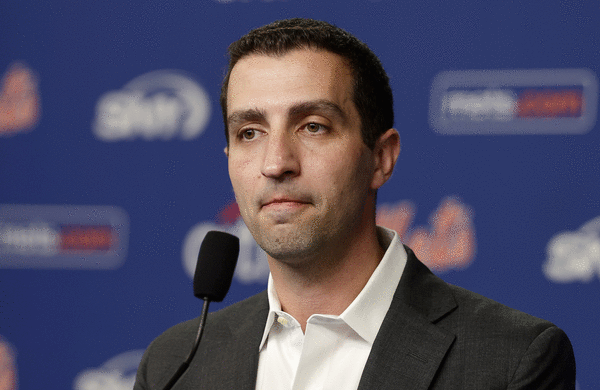
NEW YORK — At the conclusion of a disastrous season, David Stearns was faced with two options: Move forward without acknowledging the mess of 2026, or take responsibility for it.
The Mets president of baseball operations chose the latter option, showing a more human side Monday at Citi Field.
Admitting failure isn’t easy, especially when you preside over a baseball team with an annual payroll north of $350 million. In doing so, it showed fans what he learned from the mistakes of 2026, and how the club plans to address them this winter.
“I think as we reflected on how the start of the season went the way it did, we and I made a number of decisions that created the potential for almost like an uncapped downside scenario,” Stearns said. “We had a lot of change. We’ve talked about that. I think change in New York is probably different than change in other markets.”
The Mets finished 74-88, last place in the NL East. Their -32 run differential was the fourth-worst in the National League. A perfect storm of forces brought the Mets down, but these weren’t exactly outside elements. The Mets weren’t prepared for injuries and underperformance.
There was a sweeping overhaul of the coaching staff and the roster. The Mets let key clubhouse leaders go and replaced them with players who were unproven in the game’s toughest market. His free agent signings didn’t work out the way he thought they would.
“I think we’ve had some that have worked out well, and clearly we’ve missed, and I’ve missed,” he said. “If we look at last offseason, we missed too much. I certainly understand that.”
It took longer than expected for the team to find any sort of spark, and the roster wasn’t flexible enough to withstand injuries to stars like Juan Soto and Francisco Lindor, and the team crumbled under the weight of expectations.
“We weren’t able to get ourselves out of it the way we should have or could have,” Stearns said, “[Or] in a way that would have allowed us to, frankly, have a more productive entirety of the season.”
The team played at a mostly .500 pace after firing manager Carlos Mendoza and replacing him with farm director Andy Green. The Mets showed real progress in the second half of the season, capitalizing on the parts of their game where they were already strong. They got great production out of key rookies, and the production of several veterans increased as well. Finally, the team came together.
Everyone got better and played better in the second half with the goal of laying the foundation for a more successful 2027 campaign.
The question now becomes: how can Stearns be sure that second-half surge wasn’t just an aberration?
“One, you have the prospect pedigree that backs it up. Two, a lot of them, in my opinion, were doing it, frankly, under sort of extreme pressurized situation in the first half of the year when things were spinning sideways on us a little bit, and they were still showing up to the park every single day and performing,” Stearns said. “So I do think it’s real.”
Stearns admitted he missed on too many free agents last winter, including at first base, where the Mets had steady production for years with Pete Alonso, and got almost none from Jorge Polanco. Alonso, the most beloved player to wear a Mets jersey since David Wright, hit his 300th home run at Citi Field against the Mets earlier in the month.
In a scene that was equal parts stunning and embarrassing for the Mets, fans were cheering for an opposing player, following them up with chants of “Fire Stearns.”
“The truth is, in this job, I don’t get mulligans,” Stearns said. “I also recognize Pete had a tremendous year, and the totality of our production at first base wasn’t good enough, and so now it’s my job to ensure that we’ve got better success across our roster, but for the entire season, better production at first base as well.”
The ever-analytical Stearns still doesn’t seem to grasp that it wasn’t strictly about production, but about what Alonso meant to the fanbase in an emotional capacity as well as the historic homers. But to be fair, if Polanco had hit 30 home runs and played plus-defense, the fans probably wouldn’t have reacted the way they did to Alonso’s return with the Baltimore Orioles.
Though Stearns played coy about pursuing free-agent ace Tarik Skubal, he was open about his intention to add starting pitching this winter. He has long believed free agency isn’t the way to build a team, and he still does, saying the Mets will be selective in free agency.
An aggressive overhaul isn’t the goal this winter, and there will be no fancy buzzwords.
“I think I’ll retire the phrase run prevention,” he joked. “I don’t know that that one worked perfectly well.”
The theme of the offseason seems to be making measured changes to help foster growth of the young core and maximize the talents of the veterans. Going into his fourth season leading the Mets, the pressure isn’t lessening. Much like the team on the field, Stearns has to execute under the weight of those expectations.
____
©2026 New York Daily News. Visit nydailynews.com. Distributed by Tribune Content Agency, LLC.






Comments