Cubs starter Edward Cabrera exits early with a right hand cramp -- and offensive woes persist
Published in Baseball
CHICAGO — Pete Crow-Armstrong’s scorching offensive stretch is approaching a must-watch level.
Coming off hitting for the cycle, a feat accomplished by just 11 other players in the franchise’s history, Crow-Armstrong didn’t wait long Tuesday to again make an impact for the Chicago Cubs. The 24-year-old center fielder took Colorado Rockies starter Ryan Feltner deep four pitches into the bottom of the first inning for his third leadoff home run in the last four games.
Monday’s feat was even a first for president of baseball operations Jed Hoyer. He had never seen a player hit for the cycle until Crow-Armstrong pulled it off.
“He’s playing such incredible baseball right now,” Hoyer said before Tuesday’s game. “I mean, obviously on paper one of the best players in the league and kind of showing it every night. He’s had three or four nights this year already he just kind of put us on his back, and last night was another one. This is fun to watch when he gets locked in like this.”
The good vibes didn’t last long Tuesday at Wrigley Field.
Crow-Armstrong’s 14th home run of the season was arguably the lone highlight in the Cubs’ 5-2 loss to the Rockies. The Cubs (38-36) again squandered opportunities, finishing 0 for 8 with runners in scoring position and left nine on base.
For as rough as the lineup continued to look, the injuries are yet again piling up on the pitching side.
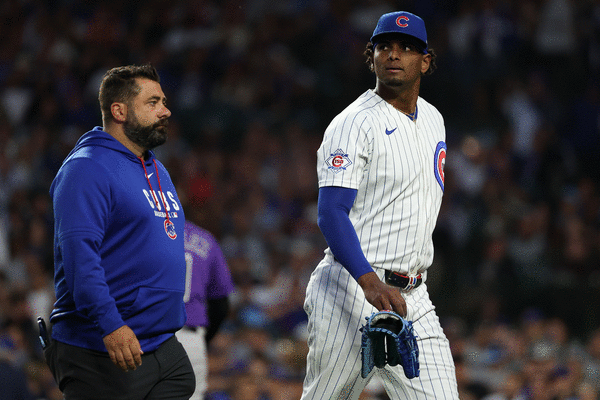
Hours after closer Daniel Palencia landed on the 15-day injured list with right elbow inflammation, right-hander Edward Cabrera walked off the field with a trainer mid-inning Tuesday due to a right hand cramp. Cabrera walked the first two batters of the fifth inning, spraying uncompetitive pitches all around the zone, then got Colorado’s Edouard Julien to strike out looking.
That ended Cabrera’s night, however.
Manager Craig Counsell and head trainer Nick Frangella came out to the mound to check out Cabrera, who departed following a brief discussion. Cabrera’s velocity cratered in the fifth, especially on his changeup, which lost 3 mph from the first inning. He took the loss, allowing five runs in 4 1/3 innings — two of those scored after he left the game.
Cabrera was in his third start back from a minimum IL stint because of a blister, something he’s dealt with throughout his career. He entered Tuesday’s start coming off a strong outing at the hitter-friendly Coors Field, where he allowed two runs and five hits in 5 2/3 innings.
The starting pitcher injuries are getting to a point where the Cubs might be white-knuckling survival until the trade deadline at the beginning of August to acquire external reinforcements.
They desperately need to get healthy with four starters on the IL, though one (Cade Horton) is done for the year. Right-hander Jameson Taillon (hamstring strain) is throwing plyo balls but isn’t expected back until sometime after the mid-July All-Star break. Left-hander Justin Steele (flexor strain) joined the team Tuesday and is slated to begin his throwing progression Monday. But he’s still weeks away from the Cubs having a better grasp on his timeline. The Cubs’ closest returning starter, Matthew Boyd, threw an up-down bullpen pregame Tuesday that went well. His next step will be another rehab start to fully ensure the shoulder soreness he experienced in his return from a meniscus surgery is behind him.
The rotation, with a 27th-ranked 4.73 ERA this season, doesn’t have great internal options to potentially bolster their performance. The lack of stability in their starters’ performance — beyond Ben Brown’s production over the last month and the solid stretches from Shota Imanaga — is not a reliable formula for success.
“Injuries are part of the game, they’re part of the challenge,” Hoyer said Tuesday. “Some seasons you maybe skate through a little bit, and some seasons you don’t. We haven’t, but we have to fight through it, and we have to find different ways and be creative, and this is part of it. It wasn’t through a lack of preparation. We thought we had real numbers there, but a bunch of injuries took care of that, and now we have to be creative and ask for a lot out of certain guys.”
“External rotation additions are a possibility, not as much now as they are later, but yeah that part of our team struggling is something that I think, honestly, it’s kind of logical given what we’re missing, and some guys have stepped up, but we’re going to need more of that, even if the offense starts clicking, we’re going to need more consistency out of that group.”
Given the pitching injuries the Cubs have sustained over the last few weeks, Hoyer expected that would be a popular topic at this point in the season. The Cubs’ offense woes, though, remain a confounding situation that even Hoyer struggled to explain. For the past five weeks, the Cubs have internally discussed how to attack the offensive problems.
The challenge becomes when multiple key players are slumping, with each player’s issues varying. Figuring out how to shake things up becomes difficult, whether it means doing too much or too little work, or even looking at ways to switch things up.
“These are all the conversations you go through, and it is nice with this group that it’s never too little, like, this is such a diligent group, they work so hard,” Hoyer said. “I think there are times you wonder, could be overly serious, they’re doing too much, and so we’ve asked all those questions.
Maybe the Cubs will feel compelled to make a more drastic lineup or roster move if these team-wide offensive issues persist into July when the sample size gets too big to ignore. They aren’t at the point of fully benching someone like Dansby Swanson because of his plus defense at shortstop and the Cubs’ emphasis on run prevention. But late-game at-bats in important spots are no longer guaranteed for Swanson, as seen by rookie Pedro Ramírez pinch hitting for him Monday and Tuesday.
But without lineup-wide improvement, nothing should be considered off limits for a club expecting to play October baseball. There is no simple fix when the Cubs show they can put runners into scoring position yet turn into one of the worst offensive groups in the majors when those situational hitting moments arrive.
The Cubs are stuck in a maddening loop of offensive futility.
“The idea that this thing is a holistic thing is not really what it is,” Hoyer said. “It’s really a collection of a lot of individual guys, and sometimes they all hit at once and you feel like the offense is incredible, and then sometimes they don’t. And, unfortunately, it’s not as much of a collective as you wish so what might work for one struggling player might not work for another.”
____
©2026 Chicago Tribune. Visit at chicagotribune.com. Distributed by Tribune Content Agency, LLC.






Comments