Mariners fan navigating grief finds comfort in strangers and baseball
Published in Baseball
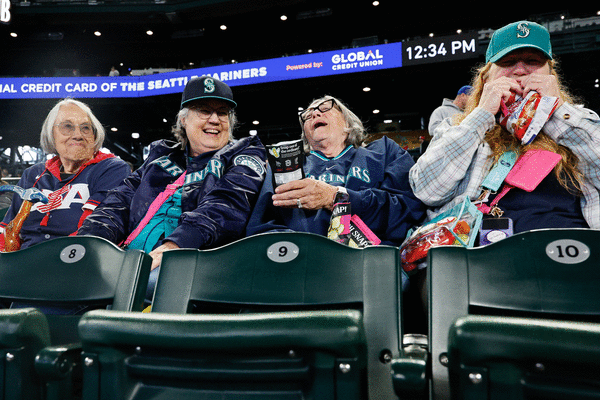
SEATTLE — Less than an hour before Logan Gilbert threw out the first pitch in a midday game against the Athletics, laughter erupted from a group of four women sitting in section 120 at T-Mobile Park. The noise drew backward glances from the kids standing against the rail a few rows down, hoping to get their gloves signed.
From the outside, it looked like a gathering of longtime friends. In reality, it was only the second time that Rhenda Strub, 70-year-old grandmother who had organized the outing, had met the women sitting in the seats beside her.
The new friendships were a byproduct of a Facebook post Strub made at the start of this year’s season. Her post explained she was struggling to fill her second seat and was wondering if any fellow fans would join her for a game.
When Strub’s family saw the post, they were worried that people would think they didn’t want to spend time with her. (In reality, Strub said her husband hates crowds, and her children and grandchildren have busy schedules, especially during the week, so they can’t make it to every game.)
To address the concerns, Strub went back into her post and updated it with her “why.”
In 2023, Strub lost her son Wyatt to muscular dystrophy. His death marked the start of a lifelong grieving process, during which she began watching the Mariners on TV. After three seasons of watching at home, Strub decided to take a leap.
“This season-ticket adventure is part of me finding my way back out — getting out of the house, being around people, and doing something that brings a little joy again,” the update to Strub’s Facebook post read. “Baseball helps me heal.”
Strub’s “why” resonated with thousands of people. The comments filled with hundreds of stories about loss and people expressing interest in attending a game with her. So far, she’s taken five strangers to games. In the plastic seats at T-Mobile, Strub has found joy and relief in watching a game with strangers who often have a story of loss to share themselves. While the outings have facilitated a unique form of healing for Strub, the joy of baseball must coexist with the loss of her son and the accompanying grief.
“It’s a little like being in a dark place and then stepping into the bright sunshine,” Strub said. “The sun feels wonderful, but it also hurts my eyes a little. And I’m just trying to navigate it.”
An afternoon at the ballpark
On a rainy Wednesday in April, Strub started up her car in Olympia and headed north toward T-Mobile Park. Her younger sister Shirlene Hippensteel, who had arrived from Missouri for a monthlong visit earlier that week, sat in the passenger seat.
Strub had purchased two additional tickets to that Wednesday’s game, to bring her sister along with two repeat guests. On her way toward the ballpark, she made two stops in Tacoma, picking up Joan Staples-Morin, 83, and Sheila Cook, 74. Staples-Morin was the first stranger Strub had gone to a game with and Cook was the third.
They arrived at their seats, located in section 120 a few rows back from the first-base line around 12:30 p.m. The women placed their bags of Cracker Jacks and pickle-flavored potato chips on the ground and cracked open their cans of Coors Light and Twisted Tea.
“To see her joy come back, and to see other people see in her the joy that we always knew was there, it’s amazing,” Hippensteel said, looking two seats down at her older sister.
In the first inning, the group turned to each other with confused expressions, trying to decipher how a ball had ended up in Gilbert’s shirt. Staples-Morin and Cook laughed throughout the game as the two sisters chanted “put a little knuckle in it” when the Mariners were up to bat.
They also traded stories about their passion for sports, and lack of opportunities for girls to play when they were growing up, and occasionally they mentioned a memory of the people they had lost.
“Joan (Staples-Morin) lost her husband three years ago, the same year I lost my Wyatt,” Strub said. “And Sheila (Cook) lost her wife two years ago.”
It was unknown to Strub and Cook when they made the plan to attend their first game together, but Strub’s son and Cook’s wife had passed away from the same condition, Duchenne muscular dystrophy. Like Wyatt, Cook’s wife had also been told she wasn’t eligible for a heart transplant.
Cook said the doctors never helped her and her wife understand why, leaving them angry and confused.
“(Strub) could explain all of these things to me that nobody ever had … it was a beautiful thing and it gave me so much peace to have met Rhenda,” Cook said.
The women made brief eye contact, trading smiles that reflected the gratitude and pain of being able to understand each other.
‘That was my boy’
The natural assumption might be that Strub and her son Wyatt had a shared love of baseball. In reality, Wyatt wasn’t all that interested in the sport. Strub said she found “the peace of watching baseball” after she lost her son.
Strub has been sewing for more than six decades, and after her son died in early March of 2023, she turned his room into a sewing room. She would spend hours in the room alone, grieving her son. A few weeks later, the Mariners’ season started and Strub decided to put a game on the TV.
“It soothed my damaged soul,” she said. “It was sometimes difficult to compare those healthy, strong young men to my weak, struggling Wyatt. But, I came to love them and be happy for their mothers.”
Strub’s love for the players has grown stronger over the last three years. Her favorites are Gilbert, Josh Naylor and Cal Raleigh. All three are close in age to Wyatt. Getting to know the players is what made her fall in love with the team.
Strub described her son as a talented performer, avid gamer, lover of various hot sauces and a fierce friend. Growing up, he took part in theater productions put on by the now-gone Capitol Playhouse in Olympia until he was 18. Not long after his 18th birthday as Wyatt’s condition progressed, he ended up in a wheelchair.
“Wyatt was a gentle, loving soul,” Strub said. “He loved me completely and I loved him completely. He was funny, clever and was always the natural leader of any group he was a part of.”
Wyatt was angry after his diagnosis, especially with God. He didn’t want to hear the suggestion that what was happening to him was “God’s will.” Strub explained that her son had declined visits from the hospital pastor when he was in the hospital dying.
On the day the doctors told him he wasn’t eligible for a heart transplant and there was nothing more they could do, Wyatt asked a nurse for the pastor. When he arrived, Wyatt was silent, leaving his mother and the pastor confused as to why he had requested the pastor’s presence.
“He opened his eyes and looked at the pastor and said, ‘You’re not here for me. You’re here for my mom,'” Strub said. “I need to be sure that she will be all right when I’m gone.’”
“That was my boy,” Strub said, finishing the story with a sob.
Strub said she had carried anger, not just since the loss of her son, but since Wyatt’s diagnosis in 2008. There’s no way to rid the feeling of loss and gut-wrenching sadness. But she had to find a way to let go of the anger.
“I had to, or I was going to ruin the rest of my life,” Strub said, adding that health problems including high blood pressure put her in the emergency room after her son’s death. “After three years I said I just can’t. I can’t stay in this cave. I can’t stay in this shadow or it will kill me.”
Strub decided after three seasons of watching the Mariners at home on TV, it was time to call herself up to the big leagues. She knew the next step was to go and consistently watch games in person and it would serve a dual purpose of helping her get out of the house.
So, she went all in and bought tickets to all 81 home games.
“It’s such a tremendous gift,” Strub said. “I didn’t realize what a gift I was giving myself when I bought those tickets.”
Carrying the grief forward
Strub hadn’t planned to share her grief with others. But when she did, others responded. Her comments and direct messages have flooded with stories of loss.
“There are a lot of people sharing their pain in private and saying, I would just like to come and sit with you at a game,” Strub said. “There’s something there that people seek connection and seek healing inside the temple of baseball.”
She also has plenty of supporters who simply look forward to seeing her post updates about her trips to the ballpark. It’s a wonderful thing to have the support of a community. But it also bears a weight that Strub is not sure she feels ready for.
“I was telling my sister this morning that it feels like I have a lot of people watching me and wanting me to feel joy,” Strub said. “But sometimes I won’t and sometimes I can’t. I don’t want to let anyone down, but sometimes I miss him so much. It comes over me and I have to just pause and live with it and be in the grief for a while.”
Strub’s reality is that no number of happy moments will take the grief away. It can only make it more manageable. Strub’s interactions with strangers have shown her that circumstances are individual but the experience of grief after loss is universal.
“I find that when people share their grief with me, it helps me carry mine,” Strub said. “Knowing other people are feeling what I’m feeling and there’s a universal reaction to losing someone and it’s powerful and devastating.”
After the final out of the third inning, Hippensteel watched as the Mariners made their way back to the dugout. Two seats over, her sister was laughing with her new friends.
“It’s a big difference,” Hippensteel said. “She’s more excited about things. We can talk about Wubs, that’s what we called (Wyatt) … (losing Wyatt) is still the worst thing that has ever happened to her but it’s like we have permission to live again.”
____
© 2026 The Seattle Times. Visit www.seattletimes.com. Distributed by Tribune Content Agency, LLC.






Comments