John Romano: Figuring out strategies for robot umpires will be a work in progress
Published in Baseball
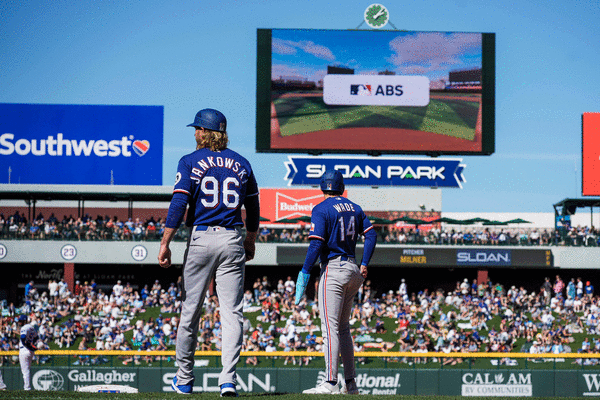
PORT CHARLOTTE, Fla. — Numbers were crunched. Video was studied. Players, managers and coaches were interrogated.
And once all the data was collected, parsed and analyzed for baseball’s new video system for reviewing balls and strikes, we came up with this rather technical description:
Um, kinda funky?
In an absolutely charming way, of course.
The idea behind the Automated Ball-Strike (ABS) challenge system is to use science and technology to ensure a more orderly and precise outcome on critical calls, but there’s still a human element that makes it more of a wild card than other video-review mechanisms.
For instance, the players are the ones deciding which calls to review. And the decision to review must be made almost instantly with no help from the dugout, which is completely different from other video reviews where managers and NFL coaches get a brief amount of time to check with staffers monitoring video feeds.
All of which makes it more difficult for teams to employ an organizational philosophy, because now you’re dealing with hitters, pitchers and catchers having to quickly decide whether it’s the right moment to risk one of their two challenges per game. And whether to risk the wrath of teammates and coaches by whiffing on a review.
“We had a discussion about it two days ago with our (research and development) group who studied other teams’ behavior and what they’ve done with it,” Rays manager Kevin Cash said. “The way we handled it early in spring was to treat the first five innings like they were innings 5-9, because that’s when more of our (major-league) guys are in the game.
“I think how we’re looking at it now is we want guys to be aggressive with it. And if you happen to lose a challenge early, then you want to use common sense. You want to assess the leverage of the game, the leverage of the situation. Challenge pitches that will define an at-bat. So, two-strike pitches, pitches with guys on base or deeper in the game. Ideally, you want to end every game without any challenges remaining.
“What we may need to do as a staff is, when the seventh inning rolls around, throw out some reminders that we’ve still got one or two challenges left so they don’t slip by.”
Based on conversations with players, that might be necessary. Particularly with veterans who didn’t come up through Triple A when ABS was first being tested.
Nobody wants to be the guy who unnecessarily burns a review.
“I don’t see myself challenging a lot of pitches, unless it’s right down the middle, and those are rarely missed anyway,” said starting pitcher Nick Martinez. “I try to work the edges, and so it’s such a gamble if a lot of my pitches might have nicked the edge or just missed. I’ll let the catcher decide that. As a starting pitcher, you don’t want to use it. If these calls can swing games, you want to save it for the 7th, 8th and 9th.”
At least through the first few weeks of spring training, Rays pitchers and catchers have been decidedly unaggressive in challenging pitches. They are 26th in the league in the number of defensive challenges. They’ve also been one of the least successful on defensive challenges, winning 53%. League-wide, pitchers and catchers are winning 59% of challenges in the spring, which makes sense because catchers have the best vantage point in the ballpark.
Rays hitters, on the other hand, have been not been afraid to tap their helmets and initiate a challenge. With 27 challenges through 20 games, Rays hitters are sixth in MLB in asking for reviews. Their success rate of 48% is also above the average rate of 44% of calls overturned by hitter reviews.
Shortstop Carson Williams, who has experience with ABS in Triple A, leads the Rays with four challenges (he’s 2-2). MLB took new measurements of every hitter this spring to determine the high/low point of individual strike zones, and Williams said using challenges gave him a better idea of what his particular strike zone will look like in 2026.
“The team gave us the green light to see what it looks like and where pitches might be strikes in certain spots, and so I wanted to take advantage of that in the spring,” Williams said. “I’m sure, as the season goes on, we’ll start getting super strategic on how we want to use this.”
Hitters and pitchers are not the only ones using spring training to learn how strike zones may be affected and adjusted by ABS. Catcher Hunter Feduccia said home plate umpires have been wearing ear pieces and will often ask for a video review on pitches that weren’t challenged just so they have a better idea of what the new era of strike zone looks like.
Feduccia does something similar, going into the dugout at the end of the inning and checking an iPad to get a better sense of how close a pitch missed or whether it should have been challenged. He tends to get more aggressive after one trip through the lineup, when he has a better sense of every hitter’s baseline strike zone.
So is it hard to hold onto a challenge if a pitcher is annoyed by a call?
“Yeah, it can be tough at times. You want to help your pitcher out as much as you can, but we’ve got a better view and we know how much we moved our glove,” Feduccia said. “I don’t think the pitchers are going to be challenging too much, but we’ll see how that works out as the season goes on.”
____
©2026 Tampa Bay Times. Visit tampabay.com. Distributed by Tribune Content Agency, LLC.





Comments