Is the nuclear waste at San Onofre safe from high tides and El Niño?
Published in Weather News
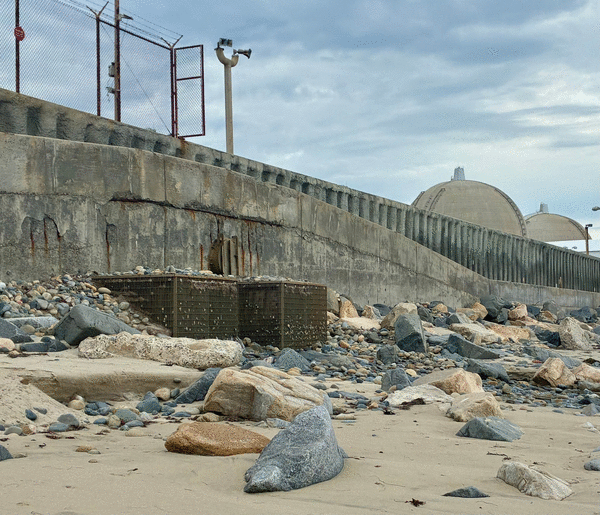
SAN DIEGO — Forecasters warn of coastal flooding and high tides in Southern California, but officials at Southern California Edison say dozens of stored canisters containing nuclear waste at the now-shuttered San Onofre Nuclear Generating Station pose no public safety threats — even if rainfall in the coming months is heavier than expected.
But long-time critics of the plant, which is in the midst of an eight-year dismantlement project, say they are not reassured.
The National Weather Service has issued a Coastal Flood Advisory for San Diego and Orange counties through noon Friday, with high tides expected to crest near 7.25 feet.
“It’s definitely seasonal,” said Adam Roser, meteorologist at the San Diego office of the weather service. “We see these higher tides every late fall into winter, but this year we have warmer than average water temperatures.”
Showers are expected through Saturday morning, with heavier rainfall expected Saturday afternoon or evening and lingering into Sunday.
The precipitation is part of a larger El Niño weather pattern that meteorologists expect to see for the rest of this fall and into winter.
“Ocean temperatures in the Pacific near the equator are very warm, much above average,” Roser said. “That in turn can create a rainier atmosphere over the ocean, so the southern tier of the United States usually sees a more wet winter.”
But Roser was quick to add that sometimes — as was the case at the end of 2015 and beginning of 2016 — a strong El Niño can result in dry conditions across Southern California.
Some 3.55 million pounds of nuclear waste at the former San Onofre power plant, known as SONGS for short, have been deposited into a pair of storage facilities located at the north end of the site.
One storage facility contains 73 stainless steel canisters containing radioactive spent fuel that have been lowered into vertical cavities. The other holds 50 canisters that are stacked horizontally.
An additional 13 canisters of material from the dismantlement efforts, which are classified as greater than Class C waste, sit in the horizontal storage site.
The canisters rest a little more than 100 feet from the Pacific, protected by a seawall 28 feet high, as measured at average low tide at San Onofre Beach.
The prospect of what some have called a “Super El Niño,” along with a succession of high tides, makes lifelong Del Mar resident Alice McNally worried about the waste stored at SONGS.
The seawall “is not very thick and it’s also in bad shape and it’s crumbling,” she said, adding, “I don’t think the seawall is any protection at all.”
McNally is also concerned about what would happen to the canisters if water seeps into or floods the SONGS storage facilities, as well as the impacts of long-term coastal erosion in and around San Onofre Beach.
“The problem is when the canisters get wet, it’s not just water, it’s sand and debris, seaweed and little rocks. Those are gonna go down in there,” McNally said.
Manuel Camargo, principal manger for strategic planning for Southern California Edison, insists the facility and the spent nuclear fuel stored there are safe from the elements.
“The SONGS plant is a relatively unique structure along the coastline,” Camargo said. “It was designed to protect the plant itself and, of course, by extension, the spent nuclear fuel. It is in fact designed to withstand very extreme climate events.”
Camago said the spent fuel canisters in both the horizontal and vertical systems are designed to protect them from being submerged in 50 feet or more of water and withstand velocity of up to 15 feet per second.
He said the seawall, which goes down below the water level and safeguards against erosion, is robust and “has protected and will continue to protect the site (from coastal conditions) like Kelvin waves, El Niño processes, all that.”
Kelvin waves are slow-moving, warm-water waves that can stretch thousands of miles. During an El Niño event, they often form as a series of successive waves that can occur over the span of months.
Camargo said SONGS officials receive an annual assessment of sea level rise that is then reviewed by an engineering team to confirm that the facility’s design analysis of critical components remains sound. The most recent report, delivered earlier this year, was produced by an independent environmental consulting firm based in La Jolla.
At the same time, Edison officials have long said that the canisters need to find another home.
“SONGS was never intended to be a permanent facility for the storage of spent nuclear fuel,” Camargo said.
Nuclear waste at SONGS is not unique.
Roughly 95,000 metric tons of spent fuel that has accumulated over the years by commercial nuclear power plants in 35 states are stored in similar fashion at plants across the country.
That’s because the federal government has not found a place for the waste to go.
Yucca Mountain in Nevada had been slated as a permanent waste site but the Obama administration cut off funding for Yucca in 2010, after years of protests from lawmakers in the Silver State who had long opposed the project.
SONGS stopped producing electricity after a leak in a steam generator in 2012 led to the plant’s closure and subsequent decommissioning efforts.
According to Edison’s most recent figures regarding the dismantlement project, 54 of 66 structures at SONGS have been removed. Crews have shipped more than 750 million pounds of waste offsite and more than 3,200 rail cars have transported waste and materials offsite since demolition began.
As for the two distinctive containment domes that stand out prominently and have become a landmark for drivers on Interstate 5, exterior demolition is expected to begin in the early part of next year, starting with Unit 3 to the south.
_____
©2026 The San Diego Union-Tribune. Visit sandiegouniontribune.com. Distributed by Tribune Content Agency, LLC.






Comments