Gargantuan hail, destructive tornadoes: Climate change making Illinois storms more severe
Published in Weather News
CHICAGO — For a fleeting moment, as his hand cradled a hailstone just shy of 5 inches, Victor Gensini thought he had found a new record-breaker for the state of Illinois, surpassing a 4.75-inch stone found near the village of Minooka 11 years ago.
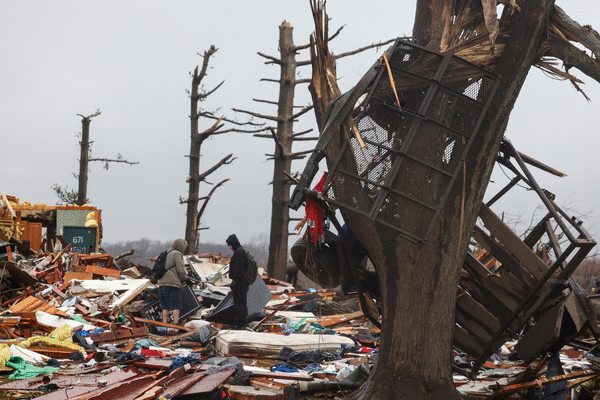
The atmospheric scientist was chasing thunderstorms near Kankakee Tuesday night that swept across northern Illinois and northwest Indiana — producing destructive tornadoes that razed houses and farmland, and pelting hail that pounded roofs and smashed car windows. Reports of larger stones between 6 and 7 inches soon flooded social media.
“I told somebody yesterday that I had the record-breaking hail for about five minutes until somebody else broke it,” said the Northern Illinois University professor, who has been researching hail for over a decade. “Once it gets that big, we call it gargantuan. And that’s, like, a scientific term: gargantuan hail.”
As climate change warms average global temperatures, hailstones larger than pingpong or golf balls will become more frequent — likely worsening the weather hazard’s already billions of dollars in annual property damage across the country, according to a study led by Gensini and published a couple of years ago in the scientific journal npj Climate and Atmospheric Science.
“It is exceptional to get that large of hail (this) far east,” Gensini said. “We do see a lot of hail like that every year, in Texas and Oklahoma and Kansas. To get it in Illinois, you have to have a perfect setup. And we definitely had that yesterday.”
In the NIU study, researchers found that days with severe hailstorms with larger stones will increase most significantly in the Midwest, Ohio Valley and Northeast by at least five days from mid- to late-century.
Since Tuesday evening, a nonstop saga of anecdotal, possible record-breaking one-upmanship among storm chasers and residents has developed — on Wednesday, someone claimed on social media to have found an 8-inch hailstone in Kankakee. If confirmed, that would shatter the state record and even rival the national record set when an 8-inch, almost 2-pound stone fell in 2010 in South Dakota.
As of early Wednesday, the National Weather Service had received at least six reports of potential record-breaking hailstones for Illinois, ranging from 4.8 to 6 inches, in and around Kankakee, southwest suburban Darien and the villages of Buckingham and Campus some 60 to 80 miles southwest of Chicago. According to the local weather service office’s website, there is a process to verify these reports, which are “considered unofficial at this time.”
“It’s really clear that we have a number of reports of potential stones that would, if confirmed, break and set a new record,” said Trent Ford, the Illinois State Climatologist, who will put together a committee to verify these reports following confirmation from the weather service.
Barbara and Maynard Denault, residents of Kankakee, picked up one of the potential record-breaking samples from their front yard after it pelted the windshield of their parked car. They measured it at around 6.5 inches. As of Wednesday afternoon, it was safely stored away in their freezer to prevent it from melting before NIU researchers visit them later in the week.
The hailstones fell for only a few minutes, Barbara Maynard recalled. “There were quite a few of those,” her husband said.
The storm caught them by surprise while they ate supper and watched television. The couple, who have lived in the area for eight decades, said they can’t remember ever seeing something like it.
Gensini’s research has taken him across the Midwest, South and Mountain West, but when asked if he had ever experienced this kind of hailstorm in Illinois, like the Denaults, he said, “Never.”
“We’re expecting more large hail and less small hail, and we certainly saw that yesterday,” Gensini said. “Obviously, it’s only one event, and we need to continue to monitor things. But you know, this is at least consistent with (our) recent research.”
He explained Tuesday’s atmospheric conditions, which were “incredibly favorable” for a prolific storm producing large hail, are more common in late May and early June, and “certainly not early March.”
“So the fact that we saw that type of environment that early in the year is — it wasn’t just anomalous, it was obviously, now we’re learning, going to be record-breaking,” he said.
During severe thunderstorms, rising air shoots icy pellets the size of Dippin’ Dots ice cream into the bitter cold of upper atmospheric layers. There, supercooled water freezes onto the small particles to form hail, which then falls when it gets too heavy for the storm’s upward draft.
“It’s hard to believe that it could grow that size, just falling through the sky,” said Barbara Denault of the around 6.5-inch hailstone she and her husband found.
It might seem incredible, but it’s likely going to become more frequent. According to Gensini, a warmer climate concentrates more water vapor in the atmosphere, which in turn fuels thunderstorms and makes them more robust — with stronger updrafts that can suspend bigger hailstones.
“Take a hair dryer and turn it up on end, so it’s blowing air straight up,” he said. “It’s pretty easy to suspend a pingpong ball right above that hair dryer. But now, what if you wanted to suspend a grapefruit or a soccer ball? You’re going to need a much stronger updraft.”
Warmer temperatures in the lower atmosphere would also melt smaller hailstones that fall at a slower speed, while really big stones would remain relatively unaffected.
Monday was the warmest March 9 on record in the Chicago area with a high of 73 degrees, according to weather service data. Normal temperatures for this time sit around 44 degrees. That same day, the Kankakee area had a high of 62 degrees, compared to a normal of 46.
Tuesday temperatures in Kankakee were in the 80s, Gensini said, which is not normal — but also not impossible — to have in March.
“What was really anomalous, though, was the coupled moisture, so the amount of humidity in the air,” he said. “It was very warm and also very humid downstate. And that was really the initial kind of breeding ground for the storm that produced all the hail and tornadoes.”
Trends in recent decades point to an overall warming of average temperatures in Chicago across all seasons, most rapidly in winter, due to human activities such as fossil-fuel burning that release heat-trapping gases into the atmosphere.
“Depending on how hard you press the gas pedal — the gas pedal being human emissions of CO2 — that has a really big impact on hail that we see and, ultimately, where it occurs,” Gensini said in a previous interview. “On average, we see bigger hail, more frequent bigger hail, and we actually see less small hail.”
The model used in the study indicated a more than 25% increase in the frequency of large hailstones of at least 1.8 inches if planet-warming greenhouse gas emissions from human activities do not significantly reduce by mid-century. In that same scenario, stones larger than 2 inches could increase by over 75% by the end of the century, and there would be fewer hailstones smaller than a golf ball, or 1.7 inches.
Insurance companies are already reporting rising hail damage claims from homeowners due to severe storms. In 2024, roof repair and replacement costs totaled nearly $31 billion across the country, up almost 30% from 2022, according to an April report from Verisk, a risk assessment and data analytics firm. Hail and wind accounted for more than half of all residential claims.
While tornadoes are very destructive, cause more fatalities — an elderly couple were reported killed in Lake Villa, Indiana, Tuesday — and usually receive the most attention, the widespread effects of hail cannot be discounted. The tornado that hit Kankakee affected a small region, Gensini said, and the number of tornado reports was overshadowed by hail reports coming in from Chicago all the way to central Illinois of stones 2 inches or greater in diameter.
As insurance claims start adding up from Tuesday’s storms, Gensini said, it’ll show it was a “pricey day” in Illinois — with damages possibly reaching millions of dollars.
“The tornado is only going to be a small part of that, when you look at the overall aggregate impact,” he said. “But there were cars damaged (Tuesday), no doubt homes — shingles, siding, windows busted out in some.”
Thinking about the canteloupe-sized stones that hit their car and their home, including the potential record-breaking one, Barbara Denault said it was shocking to her and her husband that it didn’t do more damage.
“It was awesome to look at,” she said. “At the same time, we’re thinking about the devastation (the storm) was doing to everybody else.”
The Denaults have yet to assess the state of their roof, which they installed just last year after it was damaged in 2024. That year, State Farm customers in Illinois reported $638 million in hail damage, ranking the state second after Texas.
And while the insurance claims roll in, it will also take some time for the National Weather Service to confirm any new records, which then have to be verified and made official by another committee convened by the state climatologist.
For any hailstone to set an official record, meteorologists and scientists should be able to physically measure it or at least confirm that the measurement taken when it was first found was valid.
“All of these kinds of reports — even ones where we see the hailstone with, like, a ruler next to it, or tape, or in some cases, real fancy people have the calipers on — that’s still unofficial until it can be confirmed,” Ford said.
However, confirmation can prove trickier with the internet and the possibility that images are AI-generated or altered digitally.
“In today’s world, we get the good and the bad. The good is that people can post online immediately. And, you know, that’s great,” Ford said. “The bad is that people can post online immediately. And ‘world-record hailstorm’ gets a lot of looks and clicks.”
Ford said the verification process, which can take weeks to months, might seem archaic but is important to ensure the validity of records.
“When you’re talking about weather data, anytime you break a record, it deserves a second look,” Gensini said. “It deserves a really thorough, kind of forensic analysis, to make sure that everybody understands why the event happened.”
A post-mortem of sorts among researchers will entail transporting the hailstones that were preserved in electric coolers for in-person measurement — and for the stones that were not saved, pictures and reference objects are often used to verify size.
On Wednesday, Gensini mused over the weather whiplash this week.
“I’m just smiling right now because I’m looking out my window here in my office in DeKalb, and literally, there are half-dollar-sized — not hail — half-dollar-sized snowflakes,” Gensini said. “Welcome to spring in the Midwest.”
_____
(Chicago Tribune’s Rebecca Johnson and Madeline King, and Post-Tribune’s Amy Lavalley contributed.)
_____
©2026 Chicago Tribune. Visit chicagotribune.com. Distributed by Tribune Content Agency, LLC.






Comments