Folarin Balogun suspended after controversial red card: What's next for United States?
Published in Soccer
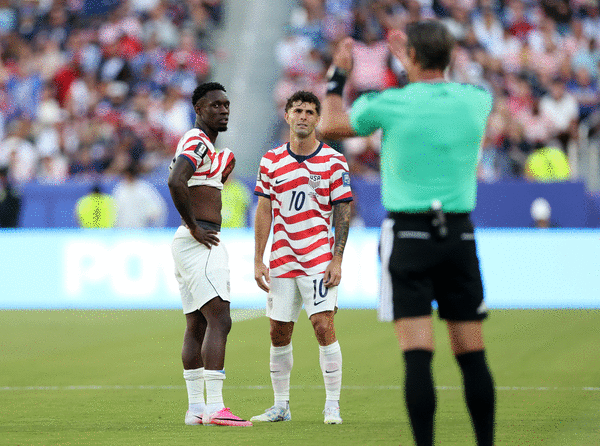
It was the step seen ‘round the World Cup.
High-definition footage, slowed down and frozen, of United States striker Folarin Balogun stepping on the bent ankle of Bosnia-Herzegovina’s Tarik Muharemovic as they jockeyed for the ball.
The contact appeared unintentional, but after a Video Assistant Referee (VAR) review, Balogun was assessed a straight red card and ejected in the 64th minute of the United States’ 2-0 win at San Francisco Bay Area Stadium on Wednesday night.
Per FIFA regulations, Balogun must also serve an automatic suspension for Monday night’s round of 16 game against Belgium in Seattle.
The suspension cannot be appealed.
“It never was intentional,” United States coach Mauricio Pochettino said. “It’s never a red card. Never. … If the intention is to damage the opponent, OK, I understand. But that never was. It was a normal action in football that you are fighting for the ball and your feet land.”
This is a dramatic development for one of the United States’ best players who on Wednesday scored his team-leading third goal of the World Cup before his ejection.
By the literal interpretation of the law, the referee’s call was correct.
“Any player who lunges at an opponent in challenging for the ball from the front, from the side or from behind using one or both legs, with excessive force or endangers the safety of an opponent is guilty of serious foul play,” reads the FIFA rule book.
But the ruling — especially giving its potentially tournament-altering ramifications — has become the subject of considerable controversy.
Critics argue the incident looked worse on replay than it did in real time and that the referee’s review-aided ruling did not align with the spirit of the play. The World Cup introduced VAR in 2018.
“In full speed, this is nothing,” ESPN analyst Herculez Gomez said on “Get Up” on Wednesday. “But when you freeze it, when you slow it down, when you send the referee to VAR and say, ‘Look here at the contact’ … he’s going to call this as a red card every single time.”
United States star Christian Pulisic described the red card as “so unfortunate” and “harsh.”
U.S. midfielder Weston McKennie agreed, calling it “bogus” that Balogun’s suspension cannot be appealed.
“I think there’s been many other plays like that throughout the tournament on other players that a card wasn’t given at all,” McKennie said. “It’s disappointing.”
Indeed, Argentina superstar Lionel Messi wasn’t assessed even a yellow card for stepping on an Algerian player’s ankle during the group stage.
“We need common sense,” ESPN’s Bradley Wright-Phillips added on “Get Up” of Balogun’s ejection. “When you’re looking at that, it’s a regular play. In a game, they’re tussling for the ball. … It’s not malicious.”
Balogun grew up in London, but he was born in Brooklyn because his parents, during a trip to New York, were prevented from boarding a flight back to England seven months into his mother’s pregnancy.
The 24-year-old was eligible to compete for England or Nigeria in this World Cup but chose to represent the United States, doing so under his birthright citizenship, and has quickly emerged as one of the faces of the team’s run.
Now, the 15th-ranked United States will have to win a tough game without Balogun — against ninth-ranked Belgium — to keep its World Cup dreams alive.
Some of that burden is likely to fall on 23-year-old striker Ricardo Pepi, who is expected to take Balogun’s spot in the starting lineup.
But replacing Balogun’s production will be more of a team effort — one that Pulisic says the Americans will be ready for, even if they disagree with the circumstances.
“He’s done so much for us, and now we got his back,” Pulisic said. “If he has to miss the next game, it’s just ridiculous for something like that.”
©2026 New York Daily News. Visit nydailynews.com. Distributed by Tribune Content Agency, LLC.




Comments