The USMNT has one World Cup knockout win ever. Right now is the best chance to change that.
Published in Soccer
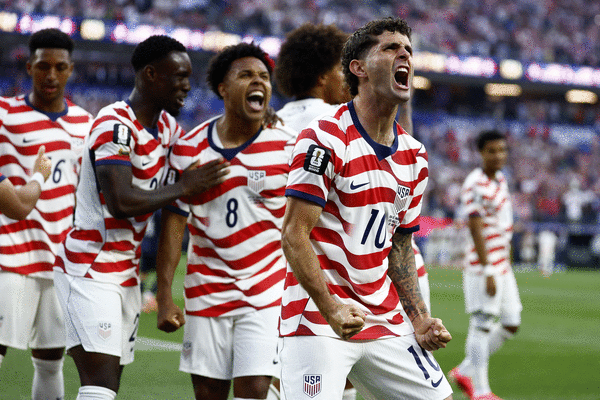
IRVINE, Calif. — Right now is a good time to remember that the U.S. men’s soccer team has won just one World Cup knockout game in its history.
In fact, every day for the rest of this tournament is a good time to remember that, especially leading up to Wednesday’s round of 32 contest with Bosnia & Herzegovina (8 p.m. ET, Fox29, Telemundo 62).
This is the moment that the players have dreamed of, whether since growing up or since leaving Qatar four years ago. This is the moment Mauricio Pochettino was hired for, with U.S. Soccer bringing in hedge fund billionaires to help fund the famed manager’s salary.
And this is the moment when history echoes. The U.S. men have played eight World Cup knockout games all-time, from their first in 1930 (a 6-1 loss to Argentina) to their latest in 2022 (a 3-1 loss to the Netherlands). Their lone victory came in 2002, 2-0 over Mexico.
Beyond that? 7-1 to Italy in 1934, 1-0 to Brazil in 1994 (more on that in a moment), 1-0 to Germany in the 2002 quarterfinals, 2-1 in extra time to Ghana in 2010 and 2-1 in extra time to Belgium in 2014.
If reading that opens some old wounds, apologies. But it’s necessary to explain why one of the most tense moments of any World Cup, the start of the knockout rounds, is especially tense for this program. There is no sterner test of a national team’s quality than whether it can win the do-or-die contests that live longest in the memory.
The last time the U.S. men played a World Cup knockout game on home soil was 1994 at the old Stanford Stadium — just down the road from the 49ers’ NFL palace in Santa Clara where Wednesday’s game will take place.
It was a stroke of coincidence, if not quite fortune, that the Americans landed in a July 4 matchup with Brazil after finishing third in their group. Finishing second would have sent them to Washington to play Spain, and finishing first would have had them at the Rose Bowl (where they already were) to play Argentina.
Challenging the team that would go on to win the title was always going to be a mountain of a task. But the U.S. battled gamely, losing 1-0 to a Seleçao squad that saw defender Leonardo sent off in the first half for a nasty elbow to American star Tab Ramos.
This time, the U.S. is favored, and not just by the bookies. Bosnia & Herzegovina is No. 64 in FIFA’s global rankings, well below the U.S.’ No. 17.
The Dragons are also the lowest of the five third-place teams across the field that the U.S. could have faced, depending on which eight groups’ third-place finishers advanced. The opponent could have been from Group E, F, I or J in other circumstances, and those teams turned out to be No. 23 Ecuador, No. 38 Sweden, No. 15 Senegal and No. 28 Algeria.
On top of that, Bosnia is the second-lowest-ranked team of all eight. Only No. 73 Ghana is lower. (The others not named yet are No. 28 Paraguay and No. 46 Democratic Republic of the Congo.)
Still, an American sports fan watching soccer in the summer needs only to think of any given March to know it’s never so easy.
The players know this, even someone like Balogun who has spent almost his entire life in Europe.
“I can feel the difference in the atmosphere,” he said. “So for me, there’s a change in my mindset and mentality as well. Not that I wasn’t taking it seriously before, but you can go to another gear. Because you want it more, and I don’t want the journey to end.”
Another point he made about himself might feel especially resonant to a U.S. fan base that has seen Balogun prove his worth as the striker the program long craved.
“This the business end,” he said, “and this is the stage where, in my opinion, the big players step forward and the big players carry the pressure and make things happen.”
The growing strength of the U.S. player pool is a project that has taken decades to fulfill, and could still take many more years to deliver a true World Cup contender. But a tournament on home soil is an opportunity unlike any other to make a statement, whether to the soccer world or to the non-soccer American public.
So while it may feel cliché to say this is one of the biggest moments in U.S. men’s program history, it’s also true.
“From my personal experience, the best way to break history is not to think about what hasn’t been done,” Balogun said. “It’s just to think about what you need to do and just to think about what needs to be done in order to progress. And as I said, that’s just to win on Wednesday.”
___
©2026 The Philadelphia Inquirer. Visit inquirer.com. Distributed by Tribune Content Agency, LLC.






Comments