Practice makes perfect? Not anymore for Wild and other NHL teams.
Published in Hockey
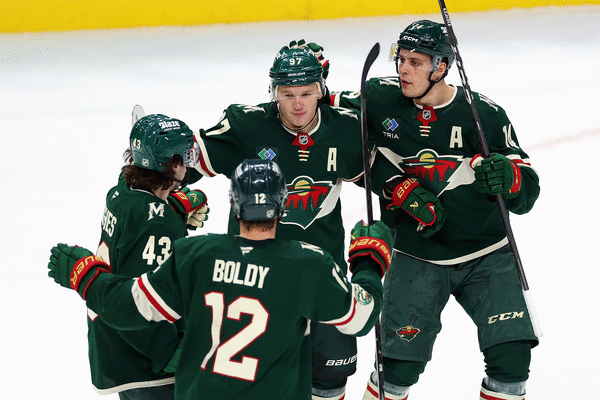
ST. PAUL, Minn. — Practicing in between games used to be routine for the Wild, so much so that they would trek to far-off or nondescript locations on their road trips if that’s what it took to skate.
There’s TGH Ice Plex at the end of a two-lane road in Tampa, Fla. Across from Calgary’s arena was the Stampede Corral before it was demolished in 2020. Winnipeg’s practice facility offers a second-floor conference room.
“There’s one I can picture what it looks like, but I don’t know the name of it,” veteran defenseman Zach Bogosian said. “It was your typical minor hockey rink that was really cold.”
Chelsea Piers in New York City didn’t have a locker room available.
“That’s the one that sticks out the most,” Wild captain Jared Spurgeon said.
Even locally, the Wild were once on the move, practicing at St. Thomas Academy in Mendota Heights, Ridder Arena on the University of Minnesota campus or Braemar Arena in Edina after riding the bus there in their hockey gear.
“There was no rebuttal,” alternate captain Marcus Foligno said. “There was no, ‘Oh, we’re tired.’ ”
Nowadays, the Wild have their own state-of-the-art digs, with Tria Rink opening in St. Paul in 2018. They aren’t utilizing that ice as much, however, let alone regularly seeking out a rink on the road that can also host corporate meetings.
“It’s like: ‘How you feeling? Should we take a rest day?’ Yeah,” Foligno said.
The NHL practice is becoming extinct, approaching the bygone era of wood sticks, tie games and visorless helmets — although there are still a few holdouts, like Bogosian, using that last accessory.
Since a mini training camp during the Olympic break in February, the Wild have had just one full-fledged practice.
Their last session on the road was Jan. 7 in Seattle, conveniently at the Kraken’s home arena, when they had two days off before their final game on the trip.
“That was the most I sweat in like a month,” Foligno joked afterward.
The decline in practices is practical.
The NHL is the fastest it has ever been, and that intensity — from the masterminds with the puck to the shot blockers who get in their way — takes a toll.
“It’s more demanding on your body now than maybe even 10, 15 years ago,” Bogosian said.
Then there’s the calendar: Because of how compact the 82-game schedule is this season with the NHL breaking for the Olympics, there isn’t time to work in extra skates ... not when playing three games in four days or four in six is so common.
But the shift is also supported by data, with the Wild embracing technology to help them decide what the players should or shouldn’t be doing.
“Sometimes less is more,” the Wild’s head strength and conditioning coach, Matt Harder, said, “and nothing is more and more beneficial.”
Rest over reps
The Wild track their players’ workload, or how much energy they’re expending, through a heart rate monitor and a sensor in their shoulder pads or jersey that calculates their movement.
A player might skate the same distance in back-to-back games. But because they’re tired in the second game, they can’t get their heart rate up as much as when they’re rested.
So, the Wild are paying attention to how players respond internally and externally, and these responses have thresholds that determine what someone’s day between games should look like. For example, if a player is high in one or both areas, they should stay off the ice.
“Hey, sometimes the analytics do help you out,” Foligno said.
Harder relays this information to Wild coach John Hynes, and that helps Hynes finalize the team’s schedule.
Sometimes a planned skate gets scrapped, or if the Wild do practice, Hynes knows to tailor the drills so players don’t become too fatigued.
Recently, Hynes alluded to possibly changing up the Wild’s routine, including practices, because slow starts were costing them and their preparation “isn’t where it needs to be.”
Hynes will rarely go against what the numbers are telling him, but he also takes into consideration what he feels the team needs.
“The mental mindset is the most important,” Hynes said.
The data shows this process is paying off for the Stanley Cup-contending Wild, who are in the top five of the NHL standings.
“We’re seeing guys perform better when they’re more recovered,” Harder said. “We can metrically see that they reach higher speeds, they have more amounts of accelerations, deaccelerations. We can see it on their heart-rate response when they’re in a more rested state because they’re able to push it harder and have higher load that way.
“So, unless we specifically need to work on something and if we’re playing three to four times a week, I don’t want to say there’s no reason to practice. We just have to be more specific and selective with what we do and how hard we do it and how long we go.”
Watch and learn
Hynes does miss running practices.
After training camp, which he loves, Hynes’ job becomes all about the game — prep beforehand, a review afterward and on-the-fly decision-making in between.
But times have changed, and the notion that teams aren’t preparing if they aren’t practicing no longer applies.
Add in the condensed schedule, travel, injuries and the Wild’s age — they’re the oldest team in the league, according to the NHL — and the downtime is more a necessity than a luxury.
“Coaches are just more receptive to the idea of recovery, knowing there’s juice out of that squeeze,” Harder said.
They also have other tools at their disposal.
Before most evening games, the Wild will get together for a skate in the morning. The team can use that session to fine-tune facets of their play that are better developed with on-ice reps, like the power play and penalty kill.
Coaches can also get their message across in meetings, but it’s the advancement of video that has really compensated for the loss of practice time.
Players used to have to go to the computer in the team lounge or find a coach and look at his laptop to watch their footage. Now, their shifts are emailed to them within 30 minutes of the game ending.
“There was never an overhead view my first 10 years in the league,” Bogosian said. “Now you have the eagle cam where you can see everyone on the ice.”
The quality of video has improved, too.
“If you look at some of my old highlights from Atlanta, it’s a little blurry,” said Bogosian, who debuted in the NHL in 2008.
Ryan Hartman will occasionally check out the shifts that end up in his inbox, but the forward will also use the iPad on the bench or look back at his scoring chances during an intermission.
He did rewatch his “Michigan” attempt March 10 vs. Utah in which Hartman tried to lift the puck into the net lacrosse-style, a move that came to him because he saw a clip of Chicago forward Andre Burakovsky pulling off a similar trick one day earlier vs. the Mammoth.
“It was all over the TVs,” Hartman said.
Practice makes pros
For Hartman, skating in between games is about staying sharp with the puck because the action in the game is unpredictable.
“You might go through two, three games where you just haven’t touched the puck,” Hartman said, “and that fourth game, the first time you get it, you’re like, ‘I need to touch some pucks.’”
That’s the biggest draw of practice … plus the opportunity to break in new skates.
The Wild aren’t changing their style, and players know how they should play because those schemes were installed back in training camp. But if mistakes happen, coaches can teach through video instead of physically showing players what to do on the ice.
“You’re not getting better at hockey by doing passing drills,” forward Nico Sturm said. “It’s just you’re getting your touches in. You’re getting the body going. You’re getting loose.”
So, to Sturm, the trade-off of more on-ice work isn’t worth it.
“What that rest brings you in a game versus are you really going to get better in a 25-, 30-minute practice?” he said.
After all, these are professionals playing in the best league in the world. They’ve been honing their skills for years — even, in Sturm’s case, before establishing himself in the NHL when he was in the minors with the American Hockey League’s Iowa Wild, where practices would be an hour-and-a-half long.
“It was all about reps, reps, reps because it’s a developmental league,” Sturm said, “and it was all about … drilling things home, like doing so many reps until it’s ingrained into your brain: Where are your outs? Where do you go? But at the NHL level, most guys have been here for a long time.”
Ready to play
That doesn’t mean players aren’t trying to improve, because they are.
“It’s more about the details that go away from you,” goaltender Filip Gustavsson said. “You play good for five games, and you kind of start cheating, and some bad habits kick in.
“It’s more about reminding yourself about, ‘This is the right way of doing it.’ ”
But there’s also an understanding: If the Wild are going to prioritize rest, players have to bring their best after a day off.
“It’s not like a reward,” Foligno said. “But I just feel like, ‘OK, listen, we’ve been off. We better be mentally sharp, be ready to go,’ and I think we have an experienced group that knows how to handle that stuff. It’s one thing if you’re goofing off and you think off days are handed to you.
“But for us, hey, we appreciate the off days, so we’re going to come ready and be ready to go, and I think honestly it just helps our group.”
Even during a day away from the rink, Bogosian stays active by going on a walk, playing with his kids or getting in the sauna and cold tub. Spurgeon might do yoga. But getting a break for the brain is just as important as it is for the body.
“It’s no different with any other job in the sense of sometimes you become a little mentally drained from it, right?” Foligno said. “So, I think it’s really good to kind of keep it up, and you should always come to the rink excited to be there and excited to play, especially over an 82, eventually 84-game season.”
That’s right, the NHL is adding two more games beginning next season.
Training camp is also changing, but that’s getting shorter — going from approximately three weeks to a maximum of 13 days.
By then, the Wild will have plenty of practice not practicing.
“I don’t miss it much,” Gustavsson said. “I like playing games. That’s why I play hockey.”
©2026 The Minnesota Star Tribune. Visit startribune.com. Distributed by Tribune Content Agency, LLC




Comments