Parsons Extreme Golf: Built differently, like its billionaire founder
Published in Golf
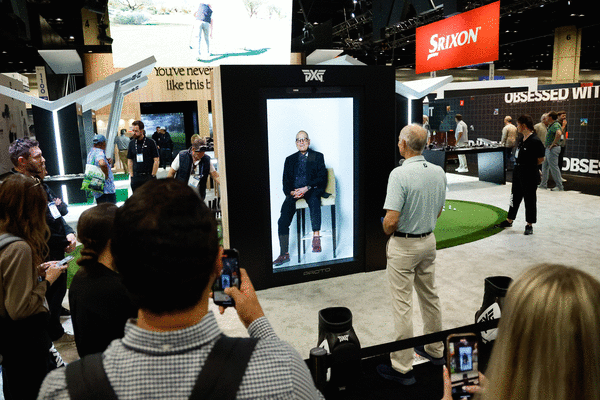



ORLANDO, Fla. — PXG golf made its long-awaited debut during this past week’s PGA Merchandise Show.
Founder Bob Parsons stayed in Arizona, home to a company with humble roots and bold vision.
True to his unpredictable, eccentric and singular nature, Parsons conducted interviews via hologram.
“I do what I can,” he said.
Parsons can draw a crowd.
Passers-by at Orange County Convention Center became onlookers. The unique setting was on brand for a company that has marched to its own beat since its 2015 launch.
A decade after Parson Extreme Golf’s unflinching rise in the $100 billion industry, the company stood out among nearly 1,200 participating brands — the annual event’s best turnout in decades — covering more than a million square feet at OCCC.
“We thought it was about time,” Parson said. “I’ve been talked to and talked to and talked to about exhibiting at the PGA Merchandise Show. The staff said, ‘Bob, we really think we should do this. It would be one more way for us to reach our customers.’
“Based on what we experienced thus far, we’re gonna be here for a while.”
PXG has evolved from a curiosity into a serious player in a competitive marketplace, with Parsons leading the charge.
A bold, black logo and in-your-face advertising on TV features a gravelly voiceover declaring, “Nobody makes golf clubs the way we do. Period.”
That line, delivered by Parsons himself, captures the ethos of PXG. The company was born from the will of a man who grew up dirt-poor in Baltimore, flunked fifth grade, served in Vietnam and became a billionaire.
Rather than focus on market research or industry convention, a middle-of-the-road golfer worth north of $4 billion merely wanted to lower his scores.
Parsons’ unprecedented path, Midas touch and entrepreneurial spirit epitomize the American Dream. The founder of GoDaddy.com lived it long before he turned his attention to a sport with roots across the Atlantic.
When Parsons entered the golf business, he refused to follow previous playbooks — an approach facilitated by his considerable resources and willingness to assume risk.
“We wanted to be different than everybody,” he said. “If we would have went in and done business the way everybody does business, we’d have gotten clobbered. I learned when I was in the Marine Corps in Vietnam, you don’t run into a machine gun.
“You run around and attack it from the side.”
PXG had financial freedom but faced an uphill climb.
The initial project, Slick Golf, patented a golf ball but never manufactured a club.
Recast as PXG, the company entered an industry dominated by recognizable, ubiquitous companies — Titleist, PING, TaylorMade, Mizuno, COBRA, Cleveland — that held most of the market share and defined how equipment was designed, priced and distributed.
PXG, meanwhile, began as a boutique brand based in Scottsdale, Ariz.
Instead of selling clubs through big-box retailers, PXG required customers to travel to them. The brand provided custom fittings — uncommon at the time — and a premium-priced adventure emphasizing personal attention over volume.
“When we released our first golf club, Gen1, we had two guys fly in from New Delhi to get fitted,” Parsons recalled. “They bought three sets of clubs. They gave us their credit card, never asked the price, and then flew back.
“You got to start somewhere.”
That emphasis on experience remains central to PXG’s identity.
The company offers “The Xperience,” a three-day golf escape priced at $30,000, blending PXG’s custom-fitting clubs with the luxury of Scottsdale National Golf Club — a private members-only oasis in the Sonoran Desert. Besides getting new clubs, guests receive unlimited golf across 45 wide-open holes with no tee times, spa treatments, a tour of PXG headquarters, apparel fittings and five-star dining.
Yet PXG has become increasingly available to the masses.
More than 200 fitting locations are available, along with approximately 25 dedicated fitting studios, including one in Orlando. The company also sponsors players on all the professional tours.
Yet the true test comes courtesy of Parsons, who ponders PXG’s forgiveness, feel and technological advances whenever he plays a round.
“I’m the chief tester,” he said. “If our clubs can help my game each and every time, we’re there and I can tell instantly if we’ve made a step forward and when we haven’t.”
The GEN8 irons ($1,603, 5-gap wedge), Lightning driver ($649) and Sugar Daddy III wedges ($299) remain priced higher than the competition yet far more competitively than in the past.
The cost comes with a personal guarantee.
“If don’t improve them in every way, we don’t release them,” Parsons said. “We’re very different in that respect. We’re not constrained by price points and we’re not constrained by release date.”
PXG taps into the essence of a game even elite players fail to fully grasp while providing enjoyment to those who struggle to break 100.
“Golf is a game unlike any other,” Parsons said. “I don’t care how talented you are — you can’t master it. But every once in a while, you’ll hit a shot as good as the best pro golfer. It takes you totally outside of yourself.
“How many things can we say do that?”
Parsons is one-of-one himself. Shaped by hardship long before he achieved success, the 75-year-old is quick to downplay his genius.
“I didn’t pass the fifth grade,” he said. “Because of a fluke, I wasn’t held back. I went into sixth grade with about third- or fourth-grade school skills — and I probably still have third- or fourth-grade school skills.”
Directionless and close to dropping out of high school, Parsons enlisted in the U.S. Marine Corps at age 17. He served as a rifleman with Delta Company, 1st Battalion, 26th Marines, and was wounded in action during a 1969 tour in Vietnam, earning a Purple Heart.
“I was failing most subjects in my senior year,” he said. “I had discovered both the opposite sex and alcohol — neither one has ever put anybody on the dean’s list. I was a knucklehead. The Marines turned me around. They taught me everything.
“I will give the Marine Corps 100% credit for anything I ever accomplished.”
After returning home, Parsons earned an accounting degree from the University of Baltimore, graduating magna cum laude. A career in IT and software sales followed, culminating in the founding of Parsons Technology in 1984.
In 1994, he sold the home accounting firm to Intuit for $64 million — the first step toward the fortune that would spawn GoDaddy.com in 1997 and later YAM Worldwide Inc. along with PXG.
Parsons’ success led him and his wife Renee to create a foundation that has awarded more than 96 charities; the Parsons pair has given around $150 million to organizations that support U.S. military veterans and their families.
Parsons’ philanthropy comes from growing up with nothing in East Baltimore.
“My parents were compulsive gamblers. We never had anything,” he said. “If I wanted something, I had to scheme a way to get it — mowing lawns, running errands, working construction. A lot of times, I was just in the right place at the right time.”
This sense of responsibility beyond the business world is “the right thing to do,” Parsons said.
Giving golfers more enjoyment is part of the mission.
“Helping people with their golf game is valuable,” Parsons said.
Turns out, doing things differently at PXG isn’t a marketing slogan — it’s the entire point.
©2026 Orlando Sentinel. Visit orlandosentinel.com. Distributed by Tribune Content Agency, LLC.





Comments