Maryland men's basketball goes cold in 72-64 loss to No. 9 Tennessee
Published in Basketball
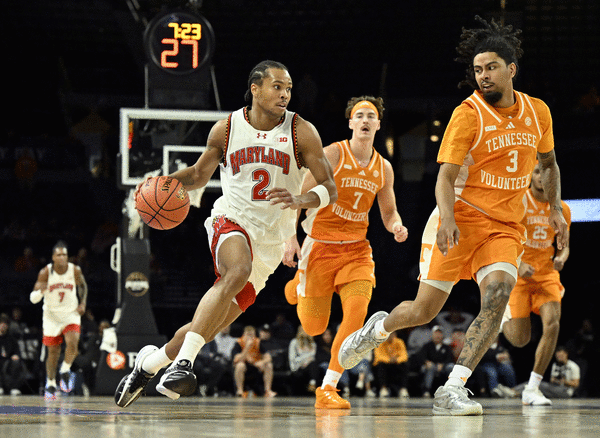
The Terps can play with good teams. Beating them is another matter.
Eleven days after squandering an 11-point halftime lead against then-No. 6 Virginia, Maryland men’s basketball again proved incapable of sustaining a promising performance against a ranked opponent. The Terps missed all 14 of their second-half 3-point attempts Tuesday in a 72-64 loss to No. 9 Tennessee at the Players Era tournament in Las Vegas. They’ll face San Diego State on Thursday.
A seven-point first-half lead became a 13-point second-half deficit. Maryland (3-3) clawed back within three with 2:26 remaining, but the Volunteers (6-0) scored eight of the game’s final 11 points.
Buzz Williams is now 0-11 against ranked opponents as Maryland’s coach. Nearly eight months removed from the end of a 21-loss season and armed with an overhauled roster, Williams is still searching for his first signature victory in College Park.
“I think we are learning to embrace the difficulty in playing at the highest level and what’s required,” Williams said.
Here are three takeaways from the loss.
Andre Mills needs to pick his spots
There’s a fine line between a green light and a license to shoot indiscriminately. Mills flirted with it Tuesday.
The guard scored a team-high 17 points on 18 shots, making just one of his 12 attempts from beyond the arc. He missed his final 10 3-pointers, seven of which came in the second half.
What makes that shot distribution particularly frustrating is how effective Mills was inside the arc. He made four of his six 2-point attempts, earned eight free-throw attempts and recorded three first-half steals. His athleticism allows him to influence games in ways that don’t require a reliable jump shot.
Mills said the game’s many stoppages made it harder to find a rhythm. “I definitely say it’s a little difficult because the game’s always stopping … but I’d say it’s just moving on to the next thing and focus on what you can control for the most part.”
Maryland needs Mills’ fearlessness. There are stretches when the Terps appear desperately short of players willing to take ownership of an offensive possession.
But a player taking nearly half of his team’s 3-point attempts should be considerably more selective, particularly when the shots aren’t falling.
The arithmetic doesn’t work
Maryland took 14 more shots than Tennessee, grabbed 22 offensive rebounds and forced 18 turnovers.
And lost by eight.
It takes a particularly dreadful shooting performance to render those advantages meaningless. The Terps managed one Tuesday, shooting 31.3% from the field and 11.1% from beyond the arc.
“They just always defensively sound. Just very disciplined on defense, and they communicate a lot. And the main thing is just their physicality,” D.J. Wagner said of Tennessee.
The last Maryland 3-pointer came from Mike McNair Jr. with 3:25 remaining in the first half. The Terps spent the next 23 minutes trying unsuccessfully to make another.
It was an uncomfortable reminder of their loss to Georgetown earlier this month, when Maryland made three 3-pointers and the Hoyas made 15. Between the two losses, Maryland shot 6 for 47 from beyond the arc. Its opponents shot 24 for 53.
That’s a 54-point disparity.
There is plenty to like about Maryland’s physicality and willingness to pursue second-chance opportunities. But offensive rebounding can only compensate for so many missed shots.
For all the work Williams did to reconstruct his roster this offseason, perimeter shooting remains a glaring vulnerability against high-level competition.
Where are the guards Maryland recruited?
Last March, Bishop Boswell was helping Tennessee navigate the NCAA Tournament. Mike McNair Jr. was finishing a season in which few players in the country shot the basketball better.
Eight months later, the two combined for five points against the Volunteers.
Boswell’s performance against his former team was particularly forgettable: zero points, four turnovers and one assist in 19 minutes.
Consider what he accomplished in March. Boswell recorded 13 points, nine assists and zero turnovers against Virginia in the second round of the NCAA Tournament. He followed that performance with eight assists against Iowa State in the Sweet 16.
That was a player Rick Barnes trusted to facilitate an offense deep into March. Where has that player been in College Park?
McNair’s struggles are similarly perplexing. The Boston University transfer made a school-record 110 3-pointers last season, connecting at a 44.4% clip that ranked fifth nationally.
And before dismissing those numbers as a product of Patriot League competition, consider his performances against Northwestern and Penn State. McNair averaged 24 points in those two games, making 13 of his 21 attempts from beyond the arc.
Through six games at Maryland, he’s shooting 46.2% from deep in victories and 30.8% in defeats. He finished Tuesday 1 for 8 from the field.
Not all of Maryland’s transfer guards struggled Tuesday. Wagner scored 14 points, nine of which came in the second half, finding success attacking the basket while the Terps’ perimeter shots refused to fall.
Meanwhile, the most compelling backcourt development of Maryland’s young season has been the emergence of true freshman Kaden House.
House scored 10 points Tuesday — the entirety of Maryland’s bench production — and provided one of the afternoon’s most consequential defensive plays, stealing the ball and converting a layup to pull the Terps within three in the closing minutes.
He has reached double figures in five of his first six college games.
Williams said the team has continued to take on the growing pains together. “They haven’t backed up. They haven’t looked to blame. They haven’t looked to complain.”
Maryland went into the transfer portal this offseason looking for experienced, proven guards who could help restore the program’s competitiveness.
One of its most reliable has never played a Big Ten game.
©2026 Baltimore Sun. Visit baltimoresun.com. Distributed by Tribune Content Agency, LLC.






Comments