Mac Engel: Debut of TCU's Robbie Avila v. Texas A&M shows best and worst of college basketball
Published in Basketball
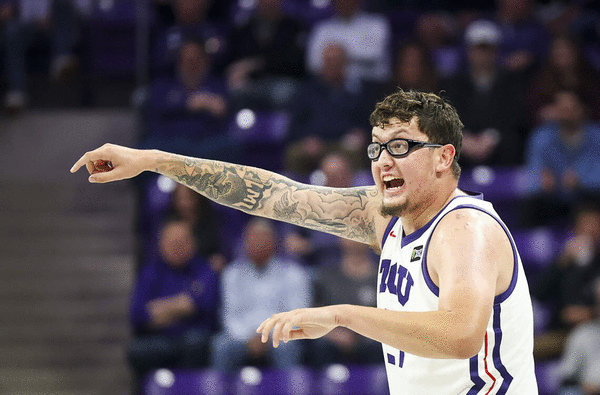
FORT WORTH, Texas — The same fans who booed a Baylor player who walked onto the same floor because both he and the team violated the “spirit” of college basketball had no problem buying tickets and cheering when their school did the same thing.
On Thursday night against Texas A&M, fifth-year senior transfer center Robbie Avila made his debut for TCU, an appearance not that much different than what Baylor did with forward James Nnaji.
Nnaji was the former 2023 NBA draft pick who came to the Bears at the semester break in January of this year, and made his debut for the team at TCU, which caused the national reaction of, “What are we even doing?”
The response to that, as well as everything else in college sports, is not a damn thing.
TCU basketball coach Jamie Dixon said then, “Call it what it is; you can be as good as you want to be. We’ve seen that in football. Just put the resources into it.”
(When did “resources” become a synonym for “cash?”)
Call all of it what it is — a joke, the antithesis of what college sports is supposed to be about. It’s also perfectly “legal” in a world where a rule book only exists to be challenged in court, and any enforced penalty will promptly be overturned by a local judge.
As evidenced by the game and the capacity crowd on what was a great night of college basketball in Texas A&M’s 97-92 overtime win over TCU, the sport is not on the precipice of certain death. It remains in desperate need of a few modifications, starting with enforceable rules, because in a remotely logical world of college sports Robbie Avila is not playing for TCU.
Texas A&M vs. TCU shows what college basketball can still be
November and December have never been great draws for college basketball, and now with an influx of neutral-site tournaments all over the country played before eight fans, the visual of the sport can sometimes look awful.
TCU hosting Texas A&M showed what the sport can be; 7,000 people packed in a quaint environment watching two good, and well-paid, teams play a tight game.
“What about the crowd tonight? It was great. You could feel the energy in the gym. I know we came out on the right side, but everybody should walk away from that game [feeling] there wasn’t a loser in that game,” Texas A&M coach Bucky McMillan said.
“It was just a great game. It was great basketball. If you watch these games going on right now in Las Vegas [at the Players Era Festival] with great teams, but there is no one in the crowd. You’ve got to remember this is about these universities. The basketball team is 15 individuals at the university; you can go out to Vegas and be out there with your team and maybe rally around it, but what about it’s here in the state and both universities get to rally around it? With so many good teams we’d like to play more in-state teams, for sure.”
Most coaches agree on the concept, but they seldom can agree on the specifics.
After TCU played its old Southwest Conference opponent, former Pac-12 rivals Oregon State played Oregon on the West Coast. But the game wasn’t in Eugene or Corvallis, but rather in Portland in an NBA arena before an announced attendance of 5,607.
That’s on the coaches.
Put the games where they belong, on campus. Give the fans a reason to go to the games with strong, regional matchups and people will show up. The atmosphere inside TCU’s Schollmaier Arena for its game against A&M was undeniably fun.
The transfer portal has done permanent damage to roster building and continuity, but college students and fans are still drawn to the game and a decent opponent.
“I like it way better than getting on a plane,” McMillan said after the game. “We’ve got so many great schools here in Texas. Just look at the quality of play, and how many [NCAA] tournament teams were from Texas last year.”
Texas A&M vs. TCU shows college basketball’s problems
One day before former University of Michigan coach Dusty May made his regular-season debut with the Dallas Mavericks last month, I asked him what he felt the biggest adjustment between NCAA and NBA basketball will be.
His answer was in college he didn’t know who would be on the other team, and preparing was a guessing game.
Transfers and player eligibility is damaging, not killing, college basketball.
Teams all over the country, including Texas A&M, have a player or two whose presence required a lawyer and a judge. What LSU football coach Lane Kiffin and basketball coach Will Wade are trying to do to get players may make former Louisiana Gov. Huey Long proud, but it’s an embarrassment to the school.
“It seems like ‘litigation’ should be a different category (in a box score); rebounding-litigation-points,” Dixon said after the game
Between Indiana State and Saint Louis University, Avila played four years of college basketball; he was not selected in the 2026 NBA draft, but he signed a contract with the L.A. Lakers and played for their summer team.
Now he’s back in college because he, along with a host of other players who signed pro contracts but didn’t “make it,” was granted a fifth year of eligibility. The Big 12 is loaded with these guys.
Because TCU, like so many other schools, offers a variety of degree plans on varying schedules, Avila could easily enroll for classes in the second week of November. He will be here for a little more than five months, and he’s gone.
It’s “legal” — whatever that means — but it’s ridiculous.
As evidenced by the crowd and atmosphere for Texas A&M at TCU, the sport is hardly dead, but it’s in dire need of modifications, starting with more games like these in November and December on campus.
©2026 Fort Worth Star-Telegram. Visit star-telegram.com. Distributed by Tribune Content Agency, LLC.






Comments