Nets find their spark in Dëmin-Brown pairing, nearly erase 22-point deficit in Cleveland
Published in Basketball
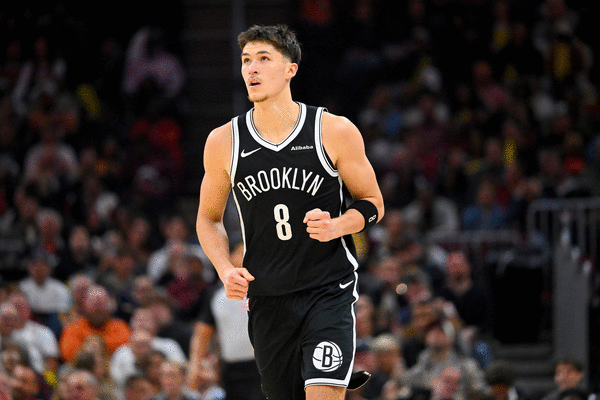
It took a 22-point deficit and nearly 40 minutes for the Nets to offer their first glimpse of what the future might look like.
With 8:18 remaining in the fourth quarter Saturday night, Egor Dëmin checked into the game against the Cleveland Cavaliers. Mikel Brown Jr. was already on the floor. For the first time in their NBA careers, Brooklyn’s two young guards were playing together.
The Nets trailed by 18. Their offense had spent much of the evening searching for answers. Cleveland seemed comfortably on its way to victory.
Then the basketball started falling through the net.
Brown had already buried consecutive stepback 3-pointers from 30 and 33 feet. Dëmin followed with three triples in a span of just 47 seconds, the first in transition, another off the dribble and a third on a running pull-up. Suddenly, Cleveland’s lead was down to 11, and a game that had appeared hopeless had taken on an entirely different complexion.
What followed nearly became one of the most remarkable comebacks of the young NBA season.
Brooklyn ultimately fell, 125-121, at Rocket Arena, dropping to 0-2 despite erasing all but two points of a deficit that reached 22 early in the fourth quarter. But the loss came with something the Nets had been missing for much of their first two games: a sustained stretch of spirited, competitive basketball, fueled by the players they hope will help shape their future.
Dëmin finished with 22 points, four rebounds and six assists, shooting 5 of 10 from beyond the arc and making all seven of his free throws. Fifteen of those points came in a sensational fourth quarter, when he connected on four 3-pointers and helped Brooklyn outscore Cleveland 41-29.
The performance represented quite a turnaround from his uneven start.
Dëmin displayed his passing instincts early, recording four first-quarter assists and repeatedly finding teammates in promising positions. His own jumper, however, was less convincing. He missed his first two attempts from deep and struggled to establish an offensive rhythm as the Cavaliers gradually took control.
By the time the fourth quarter began, Dëmin had just seven points and five personal fouls.
Neither appeared to discourage him.
The hesitation that had characterized some of his earlier perimeter opportunities disappeared. Dëmin attacked his shots with conviction, stepping confidently into pull-ups and making Cleveland pay whenever it afforded him space. A four-point play with 3:54 remaining provided another jolt, trimming a 17-point deficit to 13 and keeping Brooklyn within striking distance.
Brown supplied a different kind of electricity.
His final line of eight points on 3-of-10 shooting and five assists hardly captures the experience of watching him navigate his second NBA game. There were defensive mistakes, hurried decisions and missed opportunities, all familiar growing pains for a 20-year-old rookie.
There were also moments that explained why Brooklyn invested so heavily in his potential.
Those two deep stepback 3s demonstrated the individual shot creation the Nets have sorely lacked outside their established scorers. Brown created separation, gathered himself and converted difficult looks that required little help from the offense around him.
Later, when Brooklyn needed another basket to keep its comeback alive, he showed something equally valuable: patience.
With the Cavaliers leading 123-118 in the closing seconds, Brown probed the defense rather than forcing a contested attempt. He found Michael Porter Jr. beyond the arc, setting up a 3-pointer that brought the Nets within two with 8.1 seconds remaining.
That combination of scoring confidence and playmaking awareness offers a tantalizing glimpse of what Brown might eventually become.
And it raises an intriguing question about what he and Dëmin might accomplish together.
Their first shared minutes did not immediately produce an established two-man connection. Brown didn’t assist on any of Dëmin’s three consecutive fourth-quarter 3s. Still, their contrasting offensive strengths suggest possibilities worth exploring. Brown can break down defenders and manufacture shots, while Dëmin’s passing vision, size and perimeter shooting could make him an effective partner both with and without the ball.
Brown’s minutes remain restricted as he works back from a preseason ankle injury, complicating Nets coach Jordi Fernández’s rotation decisions. Even so, it was notable that Brooklyn waited until midway through the fourth quarter of its second game to experiment with a pairing that could become central to its rebuilding plans.
Especially considering how little had worked beforehand.
Cleveland scored 68 first-half points, exploiting Brooklyn’s defensive breakdowns and inconsistent execution. The Cavaliers finished shooting 50.6% from the field and held a 46-30 advantage in points in the paint, repeatedly finding opportunities around the basket.
Donovan Mitchell scored 22 points, Jarrett Allen added 21 and Evan Mobley contributed 20 points and 10 rebounds. Jaylon Tyson supplied 15 points off the bench.
Brooklyn, meanwhile, struggled to generate efficient offense despite respectable production from its veterans.
Porter finished with 28 points and nine rebounds, while Julius Randle added 23 points, six rebounds and five assists. Randle joined James Harden as the only Nets to begin a season with consecutive performances of at least 20 points, five rebounds and five assists.
But those contributions weren’t enough to prevent Cleveland from stretching its lead to 104-82 with 9:29 remaining.
The Nets also had to contend with another troubling development involving starting center Day’Ron Sharpe.
Sharpe was assessed two Flagrant 1 fouls for reckless closeouts on Harden’s 3-point attempts, the first coming late in the second quarter. His second, with 6:54 remaining, resulted in an automatic ejection and was also his sixth personal foul.
The timing was especially damaging. Dëmin had just drilled three consecutive 3s, and Brooklyn was beginning to apply pressure.
Sharpe finished with seven points and eight rebounds in 22 minutes. Despite his offensive struggles and foul trouble, the Nets outscored Cleveland by six points while he was on the floor, another indication of how much they depend on his physicality and rebounding.
But that impact means little when unnecessary fouls prevent him from finishing games.
Remarkably, Brooklyn continued fighting without him.
After falling behind 116-99 with 4:03 remaining, the Nets unleashed a 17-4 run. Porter supplied timely offense, Dëmin kept attacking, and the defense began forcing turnovers and hurried decisions that had largely eluded it earlier.
Chaney Johnson, who contributed 10 points and five rebounds in an expanded role, buried a 3-pointer off a Dëmin assist with 33.6 seconds remaining.
The deficit was suddenly four.
When Cleveland’s Peyton Watson was called for an offensive foul with 26.4 seconds left, Brooklyn had possession and a legitimate opportunity to make things even more uncomfortable for the Cavaliers.
Instead, the comeback encountered its most painful sequence.
Coming out of a timeout, Noah Clowney’s inbound pass went out of bounds untouched, resulting in a turnover. There appeared to be contact between Harden and Randle as they battled for position, but officials explained that the play could not be challenged because the pass had not been deflected.
Cleveland retained possession, leaving Brooklyn without a shot attempt on a potentially pivotal trip down the floor.
Fernández then made defensive substitutions, inserting Josh Minott and Keon Ellis while keeping Dëmin on the floor despite his five fouls. The rookie committed his sixth with 25.6 seconds remaining, ending the most explosive quarter of his night in an obvious fouling situation.
Even that couldn’t extinguish Brooklyn’s resistance.
Randle drove for a dunk, Harden split a pair of free throws and Brown found Porter for the late 3 that made it 123-121. Sam Merrill finally gave Cleveland breathing room with two free throws at the 5.2-second mark, and Minott missed a desperation 3 on Brooklyn’s final possession.
The Cavaliers escaped. The Nets were left to wonder what might have happened with a few cleaner possessions, better discipline or a little more time.
There is plenty for Fernández to address before Brooklyn hosts the Indiana Pacers on Sunday. His team’s defensive execution remains inconsistent, Sharpe’s foul trouble has become a costly concern, and the offense still has too many stretches when possessions feel unnecessarily difficult.
Two games are hardly enough to draw sweeping conclusions about a developing roster. Nor does one exhilarating quarter establish Dëmin and Brown as a finished partnership.
But the Nets showed something important Saturday night. Against an established playoff team, facing a deficit that could easily have produced another dispiriting finish, they refused to disappear. Their young players didn’t simply collect meaningless points in a decided game. They made consequential plays with the outcome still hanging in the balance.
The most revealing moment may have come well before the final whistle, when Dëmin stepped onto the floor beside Brown with 8:18 remaining and Brooklyn seemingly headed toward a comfortable defeat.
It took the Nets nearly 40 minutes to try that combination.
It took considerably less time to see why they should try it again.
©2026 New York Daily News. Visit at nydailynews.com. Distributed by Tribune Content Agency, LLC.





Comments