The Timberwolves are getting younger. Rudy Gobert is showing them how to stay that way.
Published in Basketball
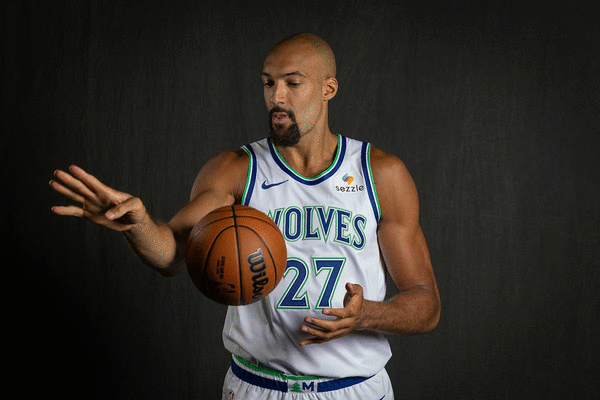
MINNEAPOLIS — You catch more teammates with honey than with vinegar. That’s how the saying goes, right?
For Timberwolves center Rudy Gobert, that’s the plan.
The noted health-food advocate harvests honey from bees on his property, a hobby he has had for about five years. He has endured stings, including in the face. But the pain is worth the reward: the sweet (and organic) miel he can eat and gift to others.
“He gives us honey every year,” Wolves shooting guard Jaylen Clark said. “I’m finally growing up because I finally used it too.”
There’s a lot of “growing up” ahead for the Wolves, who enter this season as the NBA’s youngest contender — the only projected 45-win team expected to start at least four players under the age of 26.
Shifting away from proven veterans and toward an increasingly young core is a risk, a roster-building gamble — especially for a team lacking “championship habits,” as Anthony Edwards lamented in May following the Wolves’ postseason exit.
But Wolves President Tim Connelly is a betting man. And he has a solid hedge in Gobert.
Connelly and coach Chris Finch have spoken at length about the need for players like Edwards and Jaden McDaniels to take on more leadership responsibilities. As they step further into those roles, they will need guidance. And Gobert is always happy to provide some.
Whether his younger teammates heed that advice is another matter, but they seem to be coming around.
They’re not drinking the Kool-Aid, but they might be starting to eat the honey.
At least Clark is.
“He might be first-team all defense,” Gobert said at a recent practice, smiling as he heard Clark had finally used his gift.
“From my experience, I’ve learned some things,” Gobert later added. “I want to share them to everyone, so they can apply when they want, when they can. And then, it’s really rewarding for me to watch people prosper.”
Does every team need a veteran leader?
“You need the right veteran leader,” Finch said earlier this summer. “A lot of vets, at the end of their career, they’re bitter, they’re trying to hang on.”
Not Gobert, who is entering his 14th year in the league. He led the NBA in field goal percentage last season (.682) and ranked top five in rebounds.
His defensive accolades (four-time Defensive Player of the Year) and impact on winning (.625 winning percentage since 2019-20) speak for themselves. How the 34-year-old got there, and has stayed there, speaks volumes to his teammates.
“You just don’t see that at his size and stature,” Clark said. “His availability is everything.”
Gobert takes pride in his exhaustive off-the-court work, including hyperbaric chambers; red-light therapy; a strict “real food diet” supplemented by a personal chef; osteopathic and somatic work; and a 64-hour darkness retreat.
These habits started early.
Gobert hired a chef as a 21-year-old Utah Jazz rookie — “people were looking at me crazy then” — and now recommends it to younger players.
“You can get a nice car,” said Gobert, “[but] don’t forget that you have to invest in yourself.”
Some teammates are still “looking at him crazy,” but many are listening.
Joan Beringer, like Gobert a native of France, said Gobert has helped him rethink his diet and sleep habits.
Guard Ayo Dosunmu said taking care of his body was a top priority this summer. So, naturally, he talked to Gobert.
“I asked him what are some ways that you know help and send me some recovery options,” Dosunmu said. “He has been a huge advocate for me.”
Trey Lyles has known Gobert since Lyles was a Utah rookie in 2015, but the Wolves forward only recently learned about hyperbaric chambers from him.
Bones Hyland said Gobert, “bought us this red-light thing. Probably was like 3,000 or 4,000 dollars. He bought everybody on the team it. So that was dope.”
Clark joked he began going to dinners hosted by Gobert “because it was free,” and was impressed by the attention to detail — “he doesn’t do GMO food.” But Gobert’s dietary evangelism has begun to rub off some of his teammates, like McDaniels.
“If I’m at places or restaurants and see something on the menu, I’m like, ‘It’s something Rudy would order,’” McDaniels said.
“I still don’t get it,” McDaniels later added. “But it’s good that I remember that. Like, all right, I’m actually listening to what he’s telling me.”
Gobert’s true superpower, in his own opinion, is his ability to adapt.
He’s had to do that a lot in Minnesota, where he’s become increasingly comfortable switching, guarding different types of bigs and operating outside the traditional drop-coverage role.
On the offensive end, Gobert’s comfort around the rim has increased. His teammates are practically salivating about the highlights that LaMelo Ball lobs will produce this season.
Gobert is being asked to adapt off the court, too.
“He’s an incredible professional,” Finch said this past week at training camp. “Leads by example, and that’s rubbed off on a lot of people here already, the younger guys.
“But we need to hear his voice a little bit more this year.”
Finch said Gobert is “very good” at talking in games, but he wants Gobert to speak more in film sessions and help newer Wolves understand the intricacies of the defense.
Gobert isn’t opposed, per se. He would just rather lead through his daily approach.
“When there’s more to say, I will say it,” Gobert said. “I’m more of a guy that connects individually. Just being able to talk to all the guys and be there for them, but also challenge them when needed.”
That accountability might be even more important this season with the absence of veterans such as Mike Conley Jr., Joe Ingles and Kyle Anderson. Clark called it “a big locker room shakeup.” Hyland agreed.
“Obviously, Joe’s humor is funny,” Hyland said. “But he also spoke up during tough moments where a lot of people didn’t really want to break the ice or say things.”
Gobert took a big step this summer. He organized a team trip to Paris — complete with workouts, dinners and a boat ride on the Seine.
“Guys could be doing their own thing, right?” he said. “But they chose to take the time and buy the plane tickets to come to Paris. It shows you want to be with one another. You want to accomplish something together.”
Gobert doesn’t expect younger teammates to adopt all his rituals. He is not demanding that everyone become Rudy. But he is keen on showing them, over and over, what has allowed him to still be Rudy at age 34.
“It’s about our mindset,” Gobert said. “It’s about our daily habits. It’s about our resilience. Being willing to do the things that are boring over and over. We always talk about this."
“The league is super competitive, and we have to have those standards for ourselves,” Gobert later added. “Championship standards.”
____
©2026 The Minnesota Star Tribune. Visit startribune.com. Distributed by Tribune Content Agency, LLC






Comments