Analysis: Climate Pledge Arena has passed test for Sonics to return
Published in Basketball
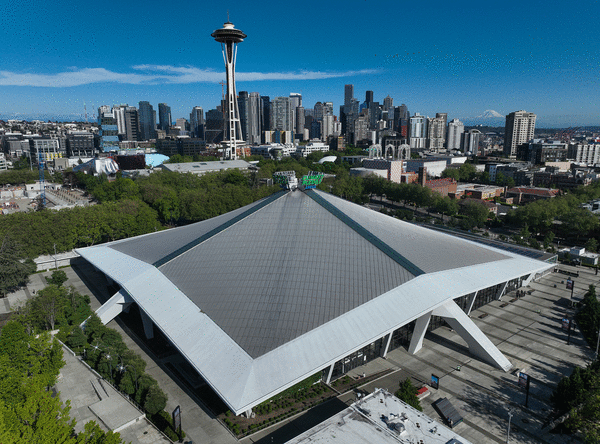
NEW YORK — Twenty years ago, parts of the NBA went out of its way to disparage KeyArena. The previous owner of the SuperSonics didn’t like it because of the lease. The new owners of the team didn’t like it because it wasn’t in Oklahoma City. The commissioner of the league really didn’t like it, period.
It was outdated the day the doors opened, many claimed, and what was deemed an untenable situation with the building became the vehicle that helped drive the franchise out of Seattle, leaving behind four decades of history and poisoned a segment of marketplace — potentially forever.
KeyArena was a great place to watch a game and a difficult place to own a team.
That history made the nugget NBA Commissioner Adam Silver dropped following the latest meeting of the league’s owners Tuesday so notable to those who remembers the context and the backstory of why the team left in the first place.
In explaining why so much of this owners’ meeting focused on the questions that remain with the expansion possibilities in Las Vegas, Silver dropped in this line related to Seattle and Climate Pledge Arena:
“If we were opening in five weeks, we could be ready in Seattle,” he said.
In the eyes of the NBA, the arena is no longer the issue in Seattle. For the first time someone official with the process said the building that was gutted and rebuilt from the bottom until it was attached to the historically protected roof meets the NBA’s standards.
Seattle — in this case the city, Oak View Group and One Roof Sports and Entertainment — have collectively done their job.
“We have had operational groups out to Climate Pledge. You clearly have a state-of-the-art arena there,” Silver said.
This was the goal when Climate Pledge was built — be a sparking NHL venue and if the NBA came calling then it’d be ready for that, too. The foresight was there, unlike the original renovation of the old Seattle Center Coliseum in 1994 that didn’t fully consider the needs in the future.
But even with the assurances that the building was NBA ready, there has remained an undercurrent of uncertainty from many in the NBA community who have only seen the building from afar. Isn’t it still KeyArena? Won’t an NBA team need its own building? How can a building constructed for a hockey team be to NBA standards?
If you’re not from Seattle, haven’t gone to a game or seen one of the several college games played at Climate Pledge, the skepticism can be understandable. But to have NBA operations staff visit and give approval to the point Silver is saying the arena is turnkey ready is one less obstacle to overcome when presenting the case for expansion to the other owners.
Now, will the NBA finally say yes to returning the league to the city with an expansion franchise that won’t heal the wounds of the past, but will be there for the next generation that hasn’t seen the Sonics here for nearly two decades?
It’s a big question and one that will likely be decided in the next three months. Ultimately, it’s likely to come down to dollars. Billions of them that will eventually be divided up among the 30 owners should the league say yes.
What remains, Silver noted, is getting the full picture around ownership — the composition of the group, how they can add to the league and ultimately, their financial wherewithal.
While Silver continues to say there is more than one group being vetted for Seattle, the clear leaders are One Roof. The known parts of the group as investors in the umbrella organization — Kraken majority owner Samantha Holloway, billionaire philanthropist Melinda French Gates, Amazon CEO Andy Jassy — present a strong front that doesn’t appear to come with any of the misgivings of other owners or recent owners — Steve Ballmer and Mark Walter of note.
Silver said he views Las Vegas and Seattle together as unique hubs that could be added to the NBA portfolio — global entertainment hub in Vegas; global tech hub in Seattle.
“Seattle is a global tech capital and so that speaks to the quality investors, the amount of energy behind technology and media that exists in the market,” Silver said. “It’s not lost on me that one of our largest partners, Amazon, is based there. We’ve had a longtime relationship with Microsoft, so all those things are brought to bear.”
There are no certainties in this proceeding. There are still 23 owners that need to be convinced expansion is a good thing for the league — and their bank accounts — and that can be a tricky dance. But most, if not all, small- and midmarket teams should be in favor of expanding, meaning only a handful of big-market teams need to jump on board to get the process to the completion.
When the league said “before the end of the year” to decide, they meant it. That might be November. It could be December. The path has been long and arduous for basketball fans, but there seem to be fewer obstacles and fewer objections standing in the way between them and seeing the SuperSonics in Seattle once again.
____
©2026 The Seattle Times. Visit seattletimes.com. Distributed by Tribune Content Agency, LLC.






Comments