Michael Rand: Jonathan Kuminga fills a big Timberwolves need. But can they unlock his potential?
Published in Basketball
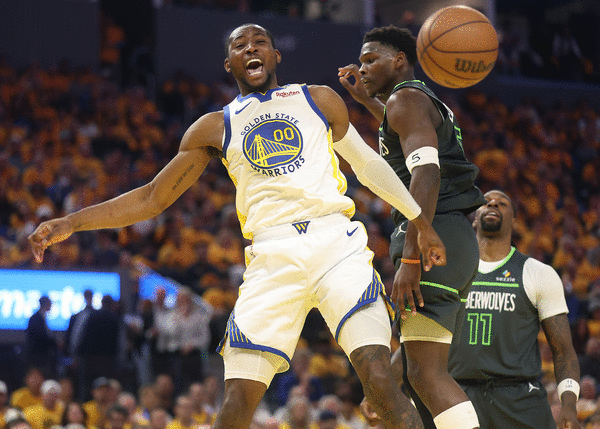
MINNEAPOLIS — The Timberwolves’ plan at power forward from the very beginning of this offseason up until just a couple days ago, when they agreed to a contract with Jonathan Kuminga, was equal parts hilarious, concerning and absurd.
They essentially traded their two best and most productive power forwards, Naz Reid and Julius Randle, in deals to bring in LaMelo Ball.
That left an obvious hole at power forward, which they tried to fill with LeBron James.
And for a while, it seemed like their plan was: Well, we’re either going to get the greatest player of all time ... or we’re going to get a warm body on a veteran minimum contract. No offense to Trey Lyles, a productive player who should have a role on the Wolves still, but it sure looked like that was going to be the outcome when LeBron signed with the 76ers.
Kuminga, who agreed to a two-year, $12.4 million deal with a second-year player option earlier this week, is not LeBron, but he is also more than a warm body.
Let’s explore more of his skill set and how he fits on the Wolves roster:
Kuminga was the No. 7 pick in the 2021 draft by Golden State, and like a lot of lottery picks there were projections of star potential for him. His best years were probably his second and third in the league, when his combination of size (6-7, 225), physicality, finishing ability and decent enough shooting made him a valuable emerging player. He averaged 16.1 points and 4.8 rebounds in 26.3 minutes per game as a 21-year-old in his third season.
But injuries and underperformance dogged him the past two years. He was benched by Steve Kerr in Golden State last year and later traded to the Hawks. The Wolves are betting on his upside and a fresh start in order to unlock some of those traits he showed off earlier in his career.
In Basketball Reference’s projections for production per 36 minutes in the 2026-27 season, Kuminga and Randle have very similar stat lines. Getting that production for $6 million with Kuminga instead of $33 million for Randle seems like a good business decision. If this works, Kuminga will provide a necessary player prototype that the Wolves sorely lacked before this signing while reaping the benefits of playing with Anthony Edwards and Ball.
He fits their under-26 roster construction as another young veteran (about to turn 24) with experience and talent. But Kuminga is used to being a high-usage player. His figures to be more of a role player or at least complementary player than he was early in his career. How he fits into that mix, and whether he can recapture his initial success while staying healthy are real concerns.
Two of the biggest things to like about this deal are 1) The Wolves (particularly Ant) recruited Kuminga hard and won a battle with the Lakers, who reportedly offered more money on a longer-term deal. Players know players, and if Ant wanted Kuminga that tells you something about a player at his peak. 2) Kuminga simply helps the rest of the roster make sense.
Instead of your main options being Lyles or sliding slim Jaden McDaniels to power forward, Kuminga makes the team more complete. But I wouldn’t promise Kuminga anything if I was the Wolves. Make him earn it and show he can be the kind of player you need him to be, not the one he thinks he is.
Before the Kuminga news can become official, the Wolves will need to make another move to shed salary. His deal will put them a little more than $2 million over the second apron of the salary cap — a threshold teams seek to avoid because of roster-building penalties and a line the Wolves can’t cross this year, period, because of how the Ball trade was constructed. They figure to do one of two things; both involve Josh Green, the other player acquired in the Ball trade.
In the first scenario, they could trade Green and his $14.7 million expiring contract to another team for a player or players who have a low enough cap hit to allow the Wolves to be under the second apron. Or they could use the NBA’s waive-and-stretch provision on Green, by which they would cut him and be able to spread his cap hit over the next three seasons (a little less than $5 million per year). That’s not ideal because it puts dead money on future seasons, but it might be necessary if they can’t find a trade partner.
Monday is the deadline for NBA teams to waive-and-stretch a player in order to experience cap savings this year, but players first must go through a 48-hour waiver period. So really if the Wolves are going to go this route, the need to do it by Saturday.
One fact that I might be a little to interested in is that Kuminga was chosen by the Warriors in 2021 with the top-3 protected first round pick the Wolves sent Golden State along with Andrew Wiggins to acquire D’Angelo Russell. When Wiggins helped the Warriors win a title in 2022 and Russell’s inconsistency became apparent in Minnesota, Kuminga’s possible ascent had the potential to make the trade look like a disaster for the Wolves. But his progress stalled. Tim Connelly somehow traded D-Lo for Mike Conley Jr. and Nickeil Alexander-Walker. Both of those guys were huge factors in the Wolves’ rise in the Western Conference. Now they’re gone and Kuminga is here.
©2026 The Minnesota Star Tribune. Visit startribune.com. Distributed by Tribune Content Agency, LLC





Comments