C.J. Holmes: Can the Nets keep selling patience while the Atlantic Division races ahead?
Published in Basketball
NEW YORK — You’ve probably seen it a few times by now.
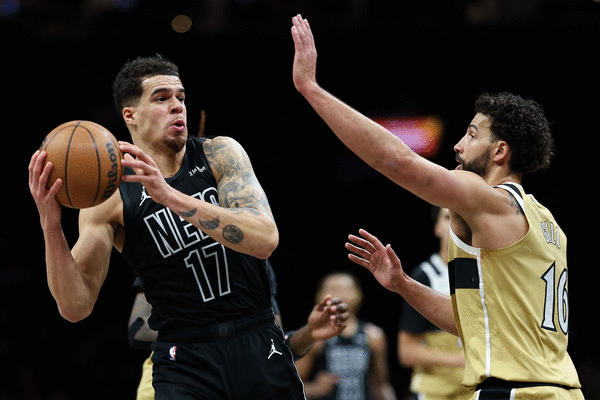
Michael Porter Jr. stands outside The Twenty Two New York while security appears to search for his name. He waits above the crowd. Then Jalen Brunson arrives with his wife, Ali, and walks straight inside.
Porter wasn’t necessarily being denied. Other recognizable guests also faced delays as the venue reached capacity. A routine door check became a viral New York basketball parable anyway. Brunson had just led the Knicks to their first championship in 53 years. Porter had just finished his first season as the leading scorer for a 20-win Brooklyn Nets team still searching for its next defining player.
One star entered without breaking stride. The other paused while somebody checked the list.
For Nets fans already tired of waiting, the explanation couldn’t dull the image.
The Knicks had arrived. Brooklyn was still being asked to wait.
Patience has become the Nets’ most dependable offseason offering. It comes wrapped in draft picks, young players, cap space and the promise of a future move capable of turning years of losing into something worth enduring. This summer made the sale harder.
Every other team in the Atlantic Division found something immediate to offer.
Across the East River, the Knicks own a championship. The Philadelphia 76ers traded Paul George and four draft picks for Jaylen Brown, then signed LeBron James. The Boston Celtics dealt Brown but still have Jayson Tatum, Joe Mazzulla and a system built to withstand change. The Toronto Raptors agreed to bring Kawhi Leonard home, though the deal remains on hold pending the NBA’s investigation into the Los Angeles Clippers.
Brooklyn answered with several calculated additions, but no defining one.
The Nets drafted Mikel Brown Jr. at No. 6, moved back into the first round for Joshua Jefferson, added Julius Randle and Keon Ellis, and preserved most of the financial and draft flexibility general manager Sean Marks spent years building.
Each move served a purpose. Brooklyn’s front office believes the veterans can help its younger players sustain their habits and growth across a full NBA season. What the Nets still lack is a proven centerpiece. They may have raised their floor, strengthened their developmental environment and protected their future, but they still project near the bottom of the Eastern Conference while the rest of the Atlantic pushes for contention.
Brooklyn is again asking its fans to wait while every division rival offers something tangible.
Frustration begins with what the Nets carried into the offseason. Few teams had more spending power. Brooklyn also owned one of the NBA’s deepest supplies of tradable first- and second-round picks. Marks repeatedly described their position in terms of optionality, assets and flexibility.
Philadelphia created more meaningful change with fewer available tools.
The 76ers didn’t build their roster without sacrifice. Brown cost George, two first-round picks and two second-rounders. Still, one major move changed the team’s trajectory, and James followed. Brooklyn held enough resources to pursue several paths. It chose incremental improvement and continued maneuverability.
Marks never promised anything else.
After the Nets fell to the sixth pick in the draft lottery, he rejected the urge to rush before evaluating Brooklyn’s young players.
“For us, it’ll still be about having patience,” he said. “But at the end of the day, we’ve got optionality, we’ve maintained flexibility, we’ve got the cap space and assets. So I think the word would be opportunistic.”
At Summer League, he maintained the same approach.
“Something we’ve always prided ourselves on with how we’ve built is not using up all our flexibility. … I like the roster we have. … I don’t think we’re in any immediate rush to do anything and add more pieces.”
Marks’ plan has remained consistent. Let the young players develop. Protect the asset base. Avoid long-term commitments before Brooklyn knows which prospects belong in its foundation. Push in the chips only when the right player becomes available at a price the Nets can live with.
However, cap space doesn’t create an obligation to spend it. Owning a mountain of picks doesn’t require burning several on the first available star. Flexibility exists so a team can strike at the right moment, not manufacture one to quiet an impatient fan base.
Under the modern salary system, Marks’ caution has merit. The first and second aprons restrict the methods expensive teams can use to improve, turning one poor valuation into a lasting roster problem. A player can be productive and still become damaging at the wrong salary, age or stage of a rebuild. Brooklyn has spent years recovering control of its future. Surrendering it for a player who raises the floor but caps the ceiling would repeat an old mistake under harsher rules.
Even a contender built around Nikola Jokic can lose options once major salaries pile up. One bad valuation can trap a franchise. Several can leave a front office choosing which weakness it can afford to keep.
Still, restraint doesn’t erase the burden of proof.
After a 20-62 season, cap room and draft picks can’t serve as accomplishments on their own. Losing teams often have both. Those resources gain value only when a front office turns them into elite talent, developmental progress or a credible route to contention. Brooklyn still lacks a proven franchise cornerstone, and its collection of prospects hasn’t separated itself from every other rebuild. Not yet.
Poor lottery fortune deserves a place in the evaluation. Two losing seasons produced the eighth and sixth picks, denying Brooklyn access to the top tier of prospects in either draft. Egor Dëmin and Mikel Brown Jr. still offer meaningful upside. Neither should be dismissed because the lottery didn’t place him higher. Their growth could change every judgment now being made about this rebuild.
Brooklyn still sees this summer as one step in a longer plan. Porter, Randle and the veteran group should help a young roster hold up over a full season. The Randle trade also moved the Nets from No. 33 to No. 28, where they selected Jefferson, without costing them their best picks.
Time is the bet. Their Atlantic rivals are spending for now, while Brooklyn hopes to rise as those teams age, hit apron limits and lose draft options. The plan only works if Dëmin and Brown Jr. become core players and Marks acts when the right deal appears.
A projected $68.6 million in 2027 cap space gives Marks another chance, but some fans may hear one more summer of waiting.
The club clip proved nothing. Still, it fit the moment.
Brooklyn has kept its options. Now it has to prove it knows when to use them.
____
©2026 New York Daily News. Visit nydailynews.com. Distributed by Tribune Content Agency, LLC.






Comments