C.J. Holmes: College basketball is keeping more stars, and the NBA is feeling it
Published in Basketball
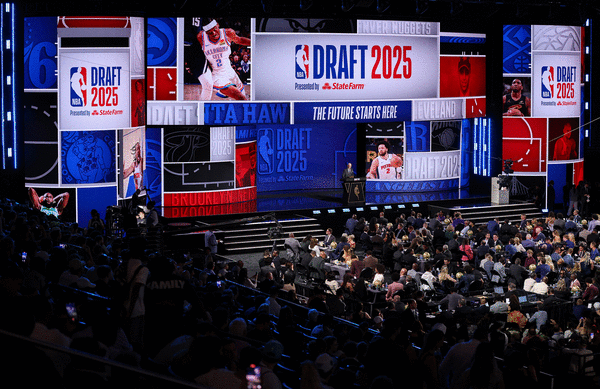
NEW YORK — Only 71 players filed as early-entry candidates for the 2026 NBA draft. According to the NBA, that’s down from 106 in 2025, 283 in 2022 and 353 in 2021. ESPN noted that this year’s number is the smallest early-entry group in more than two decades.
Now, that number doesn’t suggest players suddenly care less about reaching the NBA. That’s still the dream for many. But it suggests college basketball finally has enough pull to make staying feel like the smarter choice for a certain class of player.
For a long time, the sport pushed those players in one direction. If you were hovering around the back half of the first round, or somewhere in that uncertain space between late first and early second, the pressure was obvious. Go. Take the shot. Start the clock. Even if your stock was fragile, even if your game still needed polish, college basketball usually couldn’t offer enough financially to make waiting make sense. That’s changed.
Thomas Haugh is one of the best examples. ESPN reported that he returned to Florida despite being viewed in lottery-to-first-round territory, and head coach Todd Golden didn’t pretend money was irrelevant. Golden said Haugh’s value in Gainesville through NIL was dramatically higher than what he’d likely make in the NBA next season.
Braylon Mullins made a similar choice at UConn. Yahoo reported Dan Hurley saying players in Mullins’ range could probably earn more by staying in school than by landing outside the lottery in the draft. That used to sound like something a college coach might imply. Now it’s something he can say plainly.
Then there’s Patrick Ngongba II. Sports Illustrated grouped him with Haugh and Mullins as first-round-level returners whose decisions helped thin the 2026 class, writing that his stock had likely settled somewhere in the middle-to-late first-round range before he chose to go back to Duke.
Those aren’t just random stories. They’re the whole point.
College basketball has finally become strong enough, financially and structurally, to keep some of its best players in school longer. And yes, I think that’s good for the college game. Movement is constant in the transfer portal era, but NIL has given college basketball a little more staying power. Teams can get older, continuity can actually matter again, good players don’t have to disappear after one season, and fans aren’t forced to learn a brand-new cast every winter, in some cases.
Florida is better with Haugh. UConn is better with Mullins. Duke is better with Ngongba. The sport is better when players of that caliber stay on campus. But that gain comes from somewhere, and the NBA draft is where you can see the cost.
A list that falls from 353 names to 71 in five years isn’t just shedding fringe dreamers. It’s losing some of its middle. The league will still get the obvious stars. It’ll still get the premium upside swings. What it’s losing, at least in part, is a group of players who used to declare because college basketball offered too little reason to stay.
NBA and draft coverage around this year’s class has made that point directly, with the shrinking pool reflecting a market where returning to school can beat the economics of being drafted outside the very top of the board.
I understand why that’s happening. I was a walk-on at Auburn from 2012 to 2015, under Tony Barbee and Bruce Pearl. I wasn’t the kind of player who would’ve commanded some giant NIL number if those rules had existed then. That’s not my claim. What I do know is what it felt like to be part of a college program in an era when belonging to the thing still carried its own kind of worth, even if money wasn’t attached to it.
I’m not romanticizing that old model. It was unfair to too many players for too long. Too much value was being created by athletes who didn’t have enough control over any of it. NIL corrected part of that imbalance.
Still, it’d be dishonest to pretend the correction didn’t reshape the feel of the sport. A system can become more fair and more transactional at the same time. Players can gain leverage while the ecosystem around them loses some of its old softness. College basketball is gaining stronger rosters and older stars. The NBA draft is losing some of its in-between layer. The players are making smarter choices. The pipeline is becoming more efficient. None of that’s inherently bad. It just changes the shape of both games.
So, when I look at 71 early entrants, I don’t see fear. I don’t see less ambition. I see a market correction. I see college basketball finally becoming strong enough to compete with the league for a particular kind of player. I also see a draft that’s no longer built the way it was when leaving early felt like the only sensible move for anybody living near the middle of the board.
That’s why this feels like a net positive for college basketball and an unresolved question for the sport at the same time. What happens when staying in school is no longer the sentimental choice, or the patient choice, but the best business decision available?
©2026 New York Daily News. Visit nydailynews.com. Distributed by Tribune Content Agency, LLC.






Comments