Bill Madden: Brewers make Milwaukee famous for old-time baseball
Published in Baseball
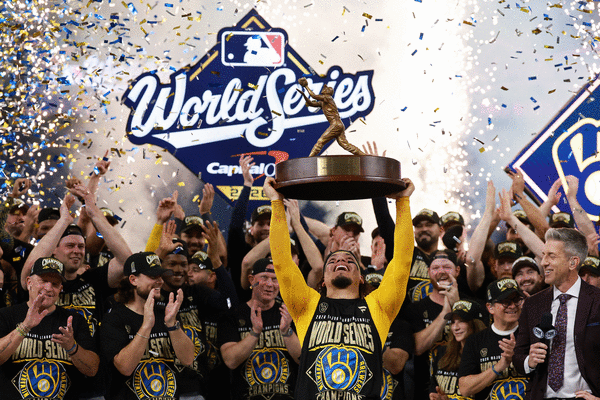
NEW YORK — Back in May a traumatic event occurred in Milwaukee when the Pabst Co., the parent company of Schlitz, announced they would no longer be producing Schlitz beer which for 177 years had been billed as “the beer that made Milwaukee famous.” It was indeed a sad day for Milwaukee but now five months later iconic Schlitz beer has been replaced by the World Champion Brewers as the “team that made Milwaukee famous.”
And that they have done — not just by winning their first World Championship and first Milwaukee world championship since the 1957 Braves — but by the way they have won it, with a modest 19th-ranked payroll of $146 million that has varied only slightly over the last nine years, and a judiciously crafted roster of eight drafted players, 14 acquired by trade and four under-the-radar free agents. And making their championship even more appealing was their “team first” DNA established by their baseball lifer manager Pat Murphy, who is not afraid to spank them whenever he perceives they are not adhering to that.
At least twice this season Murphy benched star players for failing to hustle. On Aug. 25, he benched 22-year-old rookie shortstop Cooper Pratt, to whom the Brewers signed to an eight-year, $50 extension before he had even played a major league game, for screwing up a bunt play and then not reaching second base when it hit the ground. Then on Sept. 25, with the Brewers having already clinched the NL Central title, Murphy benched his best player, catcher William Contreras, for failing to run hard on a grounder to shortstop that was bobbled by the Trea Turner of the Phillies. It didn’t matter that Contreras’ workload has been substantial behind the plate, Murphy wanted to make the point there are no exceptions to his expectations.
“You have to be a certain kind of player to play for Murph,” said Brewers veteran leader Christian Yelich. “You have to be mentally tough and physically tough. I think that’s by design and it’s a credit to those guys in the locker room that we’re accepting and willing to be coached that way. You couldn’t coach that way throughout the league.”
So in doling out credit for the Brewers’ inspiring season, you have to start with the 67-year-old Murphy, an old school manager whose team plays old school un-analytic baseball, with a major league-leading .258 batting average, 1,422 hits (as opposed to the Yankees’ 29th ranked 1,250) and .341 on-base pct. Their 154 homers ranked 29th in the majors because unlike the Yankees, they were a team that valued putting the ball in play and not relying on homers to sustain their offense.
Throughout their five-game World Series win over the Rays and overall 11-2 postseason record, the word that was continued to be heard in describing the Brewers was relentless. That’s what they were and as we soon came to learn as the postseason went along, there were no outs in this Milwaukee Brewers lineup. Just a bunch of gritty scrappers who are — yes — relentless in making contact. In their 16-hit barrage against the Rays in Game 3 of the Series, all but four of them were hit to the opposite field.
I suspect — or hope — other teams are going to start emulating the Brewers’ hitting philosophy, eschewing the home run for making more contact. It’s a better game and now we know it wins. Meanwhile, unfortunately the one area where analytics has triumphed beyond repair is the emasculation of starting pitchers and from here on out we must resign ourselves to World Series of Bullpen Ball.
In this latest series, both the Brewers and Rays starters averaged 4 2/3 innings. You can’t win a World Series today without a deep and dominant bullpen and that’s what the Brewers had. Their relievers covered 55.1% of their innings in the postseason. And according to MLB’s crack statistician, Sarah Langs, they were not just prolific, but dominant, with a 1.38 ERA and 1.73 batting average against in 65 innings.
It took this World Series for the baseball world to fully recognize the sustained excellence of the Brewer front office, beginning with Doug Melvin (2003-2015), to David Stearns and now Matt Arnold, who have been the model team for relying heavily on scouting to procure players and then acting responsibly when it comes to free agency. Despite payrolls consistently ranked in the lower middle of the majors, the Brewers have won the NL Central title six times in the last 10 years, finished second twice and been to the playoffs 10 times since 2008.
They have steadfastly avoided getting involved in long-term contracts with players in their 30s, no matter how much they may love them. Two years ago they traded their best pitcher, Corbin Burnes, who was coming up for free agency, to the Orioles for lefty reliever D.L. Hall and utility infielder Joey Ortiz, both of whom played significant supporting roles in this year’s world championship. Burnes wound up signing a $210 million deal with the Diamondbacks and then had Tommy John surgery and has made only 14 starts the last two years.
In December of ’24 they traded their closer Devin Williams, also coming up on free agency, to the Yankees for third baseman Caleb Durbin, who this last February they shipped to the Red Sox for David Hamilton, one of their heroes in the World Series, and left-hander Kyle Harrison, who was their top winner the first half of the season before being sidelined by injuries.
Similarly, in January of this year, they traded their other top starter, Freddy Peralta, who was also in his free agent walk year, to the Mets for Brandon Sproat and perennial prospect Jett Williams. While it’s yet to be determined if either of those two work out, there is no way the Brewers would pay whatever the 30-year-old Peralta reaps in the free-agent market this winter despite his rep as a six-inning pitcher.
The Brewers will face another challenge after next season when their catcher Contreras comes into his free-agent walk year, also at age 30. The Brewers kind of lucked into Contreras back in December 2022 when the Braves, who rarely make mistakes on young players, threw him into the three team trade with the A’s that sent catcher Sean Murphy from Oakland to Atlanta. Ordinarily you would expect the Brewers to trade Contreras before he can become a free agent, although if there’s cap implemented out of the collective bargaining agreement, that might somewhat alter the way they do business.
These are just raw estimates but the cap parameters being talked about are around a $240 million ceiling and $185 million floor. That would give middle market teams like Milwaukee an extra $40 million they’d be required to spend, and they might be comfortable signing Contreras for another three to four years.
In any case, a cap will spell the end of these ridiculous $200-$300 million contracts that extend players into their 30s and never work out. A cap is going to especially crush the Mets, who are stuck with paying Juan Soto $51 million a year through 2039. That sort of irresponsibility would never happen in Milwaukee, the town that has now made old-time baseball and smart baseball decision-making famous.
©2026 New York Daily News. Visit at nydailynews.com. Distributed by Tribune Content Agency, LLC.





Comments