Tom Krasovic: Brewers' throwback approach at the plate brings smiles, memories
Published in Baseball
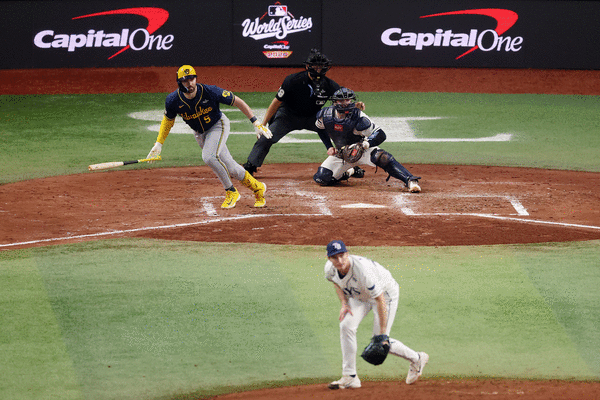
SAN DIEGO — Bringing to mind a Padres great, Milwaukee Brewers hitters didn’t make the home run a top priority.
They waited longer on pitches, stayed behind the ball, and drove it the other way at high rates.
The Brew Crew behaved like visitors from another baseball era, taking special pride in hitting ground balls the other way.
“Are we going to have an opposite-field grounder in our bag?” manager Pat Murphy said in spring training, when Brewers hitters were required to work on that skill on day one.
Tony Gwynn — the hitter who popularized the “5.5 hole” single — would’ve approved of the Brew Crew’s methods and the versatile show that followed.
Milwaukee finished second of 30 MLB teams in runs scored despite hitting the fewest home runs per plate appearance. They ranked in the top five in singles, doubles, batting average, bunt singles, walks and stolen bases. They led the big leagues in hitting the ball to the opposite field and driving ground balls the other way.
They took older baseball fans back to the 1980s.
“Tony would be smiling, for sure,” Chris Gwynn said Thursday after the Brewers won their first World Series title.
The more I paid attention to the Brewers, the more I heard Tony Gwynn’s catchphrases, uttered countless times in his 20-year career.
The Brewers, said hitting coach Jason Lane, believed in “letting the ball travel” deeper in the strike zone.
“In theory,” Lane, the team’s coordinator of offense and strategy, told The Ringer in June, “we want to see the ball maybe a touch longer to be more accurate with our barrel, our eyes and our hands. Balls tend to get deeper on us, so they would go the other way.”
The Brewers became famous for creating tough at-bats up and down the lineup.
They also powered up in the playoffs. Driving long balls to all fields, the Brew Crew outhomered the Padres 3-2 in the Division Series, the Dodgers 7-1 in the NLCS and the Rays 3-1 in the Fall Classic.
Gwynn would’ve loved that show, too. Because he believed that sound hitting habits led to home runs. And he had his own October moment to prove it. Jumping on an inside fastball in Game 1 of the 1998 World Series, the lefty launched a home run off the right-field facade at Yankee Stadium. Earlier in the game, he hit an opposite-field, hit-and-run single. One success, he suggested, led to another.
Chris Gwynn said he wasn’t surprised that Milwaukee belted as many homers as it did this month.
“When you’re good hitters and you’re getting good pitches to hit, line-drive hitters and gap hitters can become home run hitters,” said Tony’s brother, himself a former Padres outfielder and .261 hitter across 10 major league seasons. “It’s just how you’re seeing the ball, and how you’re swinging.”
Chris Gwynn, who scouted for the Padres and oversaw the Seattle Mariners’ farm system, said Brewers hitters applied the same basics that his brother preached.
“They seem to stay within themselves,” he said. “They seem to have a good plan at the plate. It’s contact and put pressure on the D. Not overswinging, being who you are. Try to do damage if you are a guy who’s going to do damage. They didn’t give up easy outs. You look up and see it’s 10, 11 pitches in the at-bat.”
Mr. Padre would’ve appreciated Murphy’s command to learn how to hit ground balls the other way.
“It’s like golf,” Murphy said. “Sometimes you need the wedge. Hitters hit about 200 points higher when they go back side on the ground.”
Sports Illustrated’s Tom Verducci corroborated Murphy’s claim, noting that big leaguers batted .415 on back-side grounders compared with just .205 when pulling ground balls. Brewers hitters, cutting against another trend, finished last in “pull-side air.”
Everyone enjoys the home run. If you enjoyed MLB offensive styles of the 1970s and 1980s, you probably enjoyed these Brewers more than other recent World Series champions.
“I loved it,” said Chris Gwynn, a San Diego State alum and first-round pick of the Dodgers who reached the big leagues in 1987. “That’s the way I played baseball when I came up. I consider what I saw from the Brewers good baseball.”
Brewers first baseman Jake Bauers, the NLCS MVP, said the widespread quest to hit pull-side fly balls isn’t all that it’s cracked up to be. He noted this era’s increased fastball velocity and spin on breaking pitches, saying pitchers are making it tougher to get the barrel to a pitch soon enough to launch a pull shot.
Manny Machado, the Padres star who was 20 when he entered the big leagues, said this summer that the game is evolving. The 34-year-old cited the increase in fastball velocity. For his career, the average fastball Machado has faced has increased more than two miles per hour. Fernando Tatis Jr. has seen the average fastball increase from 93.0 mph in his rookie year to 94.9 mph this year and 96.8 mph in the postseason.
Chris Gwynn likened baseball styles to a pendulum. He said he’s interested to see if other teams lean into what the Brewers are doing.
Here’s hoping they do.
©2026 The San Diego Union-Tribune. Visit sandiegouniontribune.com. Distributed by Tribune Content Agency, LLC.






Comments