5 reasons Rays were watching and Brewers were celebrating Series win
Published in Baseball
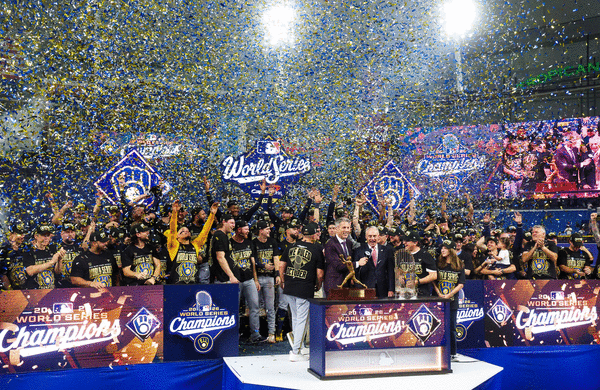
There are a lot of reasons why the Rays lost the World Series in five games.
What turned out to be the biggest and most obvious reason is the one they could do the least about: The Brewers were just the better team.
After the Brewers bolted out to a three games to none series lead — winning the first two games by one run and the third in a blowout — Rays veteran starter Drew Rasmussen said the differences between the teams were obvious.
“That’s a really talented group that we’re playing against,” he said. “In all honesty, they’ve outperformed us in all three facets of the game. I think they’ve pitched better than us. I think they’ve done better offensively. And I think they’ve played better defense than we have.”
Plus, he also noted, “We’re going to have to play to the best of our capabilities to stay alive. If you don’t, this team, Milwaukee, they will suffocate you.”
After the Brewers clinched by winning Game 5 on Wednesday night at Tropicana Field, Rasmussen had an even more clear and pointed observation:
“It’s the best team I’ve ever played against.”
But the Brewers’ talent and relentlessness doesn’t absolve the Rays of blame either. This was a matchup of the best team in each league, and the Rays could have accounted for themselves better in a number of ways.
Here are five:
Junior didn’t step up
Typically at the championship level a team needs its best players to be its best players.
And Junior Caminero was not the Rays’ best player.
In the five games, Caminero hit .211 (4 for 19 with three singles), knocked in one run, had zero homers and posted a .513 OPS.
He made some good defensive plays, and some that weren’t so good, including a debatable decision on whether to throw to second or first base at a key moment in Game 3, and a couple of near collisions with teammates on pop-ups.
He got more attention for his Game 2 dugout outburst, where the Fox cameras showed him yelling at teammates — which he said was to remind them of the importance of “getting outs” on defense and being done to fire them up — than anything he did on the field.
Asked after Wednesday’s loss what he learned during the postseason run, Caminero, via team interpreter Kevin Vera, said “some things were different.”
The other boys weren’t bopping
Caminero wasn’t the only Ray to have a quiet series. Neither of the other two members of the Big Three — Jonathan Aranda and Yandy Diaz — did much, and the team overall hit .182, scored 12 total runs, has eight extra-base hits (one homer) posted a .466 OPS and went 8-for-39 with runners in scoring position.
Manager Kevin Cash said the reason was obvious:
“(The) Milwaukee Brewers pitching, it’s as simple as that.”
The key to much of the Rays offensive success throughout the season was putting pressure on teams, and they rarely did that during the series.
There were only two of the 48 innings where the Rays cobbled any kind of sustained rally and scored more than one run.
In the first inning of Game 2, four of the top five hitters in the order against Logan Henderson reached base and scored, though the Rays would subsequently blow the 4-0 lead.
And in the 12th inning of Game 4, when five straight batters reached and they scored two runs, the second on Ben Williamson’s game-winning single.
The shortcomings were everywhere:
Taylor Walls was 0 for 12 with six strikeouts, Richie Palacios 0 for 9, Ryan Vilade 0 for 7, Williamson 1 for 10, Jonny DeLuca 3 for 20, Victor Mesa Jr. 2 for 12.
Plus, the Rays struck out 40 times and walked seven.
About the only Rays you’d say had a good offensive series were Chandler Simpson (.400 average, .900 OPS) and Liam Hicks (.286, the lone homer, .946 OPS).
As for the Big Three?
In the regular season, Aranda, Diaz and Caminero combined for a .281 average and .828 OPS, striking out 18.9% of the time. Over the full 14-game postseason, they hit .250 with a .693 OPS, striking out at a 21.8% rate. In the World Series, they managed just a .193 average and .492 OPS, striking out 21.1% of the time.
For starters
Though the Brewers were the best team in the majors pretty much all season for good reason, the one area where the Rays looked to have an advantage was in starting pitching.
But it didn’t turn out that way.
Rays starters went 0-3 with a 5.48 ERA, allowing a .286 average and posting a 1.45 WHIP (walks and hits per inning pitched). Their five starts looked like this:
— Nick Martinez: 5 innings, 5 hits, 2 runs
— Drew Rasmussen: 3 2/3 innings, 6 hits, 3 runs
— Freddy Peralta: 4 2/3 innings, 7 hits, 5 runs
— Griffin Jax: 4 innings, 4 hits, 2 runs
— Rasmussen: 4 innings, 2 hits, 1 run
Brewers starters went 3-0 with a 2.38 ERA, including allowing a .169 average, posting a 0.75 WHIP. Their five starts looked like this:
— Jacob Misiorowski: 5 innings, 4 hits, 1 run
— Logan Henderson: 3 innings, 3 hits, 4 runs
— Robert Gasser: 6 innings, 1 hit, 0 runs
— Dustin May: 3 innings, 3 hits, 2 runs
— Misiorowski: 5 2/3 innings, 2 hits, 0 runs
Not their style
The Rays also prided themselves on playing clean baseball on the way to an AL-most 98 wins. But they did not do that in the World Series, making mistakes on the bases and in the field, some at critical moments.
One of the things the Rays did best during the season was to not give away outs on the bases. Another was to make the plays in front of them and not allow teams additional opportunities.
Yet they were, from the series opener on, watching balls go off their gloves or drop untouched, and running into outs on the bases.
Some were mistakes of commission, some of omission.
Rasmussen said he felt they “played really tight” during the first three games, but said “no one has the answer” why.
And there were some of tough decisions.
In the sixth inning Wednesday, the Brewers had a 3-0 lead, runners on third and second with one out when Cooper Pratt hit a fly ball clearly foul down the right-field line. Ryan Vilade could have let the ball drop and have Tyler Wells keep pitching to the red-hot rookie, but opted to make the catch, which allowed William Contreras to tag up and score.
Getting some relief
Cash was telling anyone who would listen how dominant and absolutely elite the Brewers bullpen was, and they showed exactly how and why.
Over the five games, Milwaukee relievers worked 24 1/3 innings, allowed four earned runs on 17 hits, three walks and a hit batter while striking out 25, posting a .193 opponents’ average and 0.82 WHIP.
(Tampa Bay relivers posted a 4.38 ERA, allowing 12 runs over 24 2/3 innings with 27 hits, 10 walks and two hit batters.)
The late-inning trio of Aaron Ashby, Abner Uribe and Trevor Megill combined to work 14 1/3 innings, allowing nine baserunners (seven hits and two walks) while striking out 19.
“As elite of a bullpen,” Cash said, “as I’ve ever seen.”
©2026 Tampa Bay Times. Visit tampabay.com. Distributed by Tribune Content Agency, LLC.






Comments