Bill Plaschke: The Dodgers had everything needed to three-peat. This is why they failed.
Published in Baseball
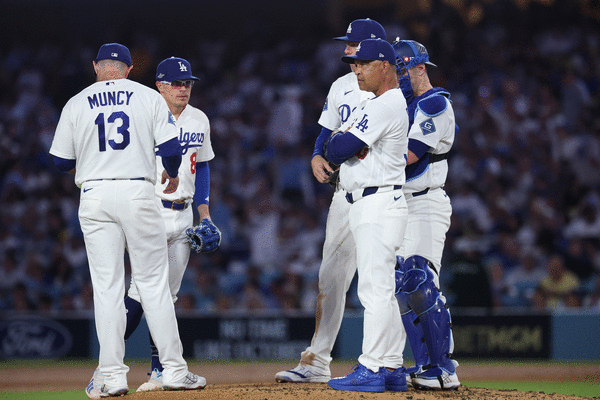
LOS ANGELES — The two World Series championship trophies royally entered Dodger Stadium in a blue convertible while being cradled by two October heroes.
The 2024 trophy was held by Freddie Freeman, whose grand slam toppled the New York Yankees.
The 2025 trophy was held by Miguel Rojas, whose home run stunned the Toronto Blue Jays.
On this bright afternoon late last March, the Dodgers past shined and their future dazzled in a celebration that came with a promise.
It was elicited by an impromptu cheer by a pregame musician in a voice so loud, one could imagine it resonating until October.
“Three-peat!” shouted the man.
Yes, they were going for the three-peat, attempting to become the first team in National League history to win three consecutive championships.
And, yes, they had the stuff to do it, with a batting order led by the best player in baseball history and a pitching rotation led by a World Series MVP and the best reliever in baseball and the winningest manager in baseball and all the money and smarts in the world.
On opening day, as epitomized by Freeman and Rojas, the Dodgers were unbeatable.
Six months later, the Dodgers were unrecognizable.
Freeman had hit one home run since July 4. Rojas had hit one home run since June 30. Both men were 37 and creaky and, one year after these two men represented their team’s success, they now symbolized their failure.
The 2026 Dodgers grew old, quickly. They became fragile, suddenly. They lost the magic, overwhelmingly.
There were no Gibby-meet-Freddie moments. There were no Miggy Miracle moments. After two years of every little thing going right — including a bunch of little things in Game 7 last season — even the most trusted October moments went wrong.
Yoshinobu Yamamoto was blown out. Teoscar Hernández was knocked out. Will Smith was down and out.
Their quest for a three-peat didn’t even make the final lap, as they were defeated by the upstart Milwaukee Brewers in the National League Championship Series that ended Thursday in a 6-4 decision that gave the Brewers a four-game sweep.
Yes, this was the same Brewers team that had been swept by the Dodgers in the 2025 NLCS, marking the first time in baseball history that two teams exchanged sweeps in consecutive years.
In one short year, the Dodgers had been turned upside down, losing where they had won, stumbling where they had soared, failing where they had flown, a variety of swings and misses that could be whittled down to a single question.
What exactly happened?
It started with Shohei Ohtani.
If looking for a single reason the Dodgers didn’t three-peat, look no further than the guy who led them to their two-peat.
In the middle of the season he was hurting, but he wouldn’t tell the Dodgers how badly. He should have been put on the injured list long ago, but he insisted on playing. For the first time, baseball’s unicorn was human, yet he would never admit it, and the Dodgers suffered deeply from his stubbornness.
The owner of four MVP trophies, Ohtani began the season with a goal of also winning the Cy Young Award. So he focused on pitching, and he pitched well, going 8-2 with a 1.79 ERA in 14 starts.
Then he injured his knee, but he still pitched, long past when he should have been pitching. He was finally pulled off a mound in early July, but by then he had also injured his elbow and his offense was suffering because he was so worried about the darn pitching. It was at this point the Dodgers should have shut him down entirely, given him a month off to ensure he would be ready for October.
But no. Ohtani insisted he was fine even though his plummeting batting numbers said otherwise. When he was finally placed on the injured list in early September, it was too late, and he entered the playoffs as a shell of his former great self.
Bottom line, the Dodgers could not three-peat without the full strength of their most important hitter. Ohtani is the catalyst for everything they do, everything they are.
He hit a three-run homer in the second inning of Thursday’s Game 4, but it was too little, way too late.
Without him being Shohei Ohtani throughout the playoffs, they had no chance, period, end of season.
Here’s hoping the Dodgers braintrust will eventually regain control of their team from Ohtani’s tight grasp. Only the team’s future depends on it.
As for the rest of the offense, they just seemed worn down from three years of extra baseball and weighty pressure and suffocating attention.
The media hordes were huge. The expectations were unrelenting. Has any team in any sport ever endured a three-year period like this one? It all took its toll.
Perhaps nobody suffered more than Smith, who set a World Series record by catching 73 innings last October. He missed most of this season with a neck injury and, even though he finished September strong, he wasn’t ready for October, witness his .097 average this postseason.
Then there were the struggling players who had no weariness excuse. Kyle Tucker, we’re looking at you.
It is difficult to overstate the damage Tucker did to his new team, which he joined last winter after signing the highest annual salary contract in baseball. He was a $60 million bust, both at the plate and in the field, and his teammates were surely distracted by the constant boos that greeted him at Dodger Stadium.
Tucker was a bad acquisition by Andrew Friedman. The resident genius also didn’t do so well in acquiring Edwin Díaz, his other prize free-agent winter signing who was injured throughout the year and was barely needed in the playoffs.
But Friedman rebounded from his lousy offseason by trading for Tarik Skubal in August, a huge acquisition that most thought would ensure the Dodgers’ three-peat.
But nobody figured that the back end of the Dodgers’ rotation would suffer the same fate as the lineup. Blake Snell and Tyler Glasnow are each 33 years old with a litany of injuries in their past. Even though they only combined for 22 starts during the season, the added rest backfired and neither was as dominant as they needed to be.
Are you sensing a theme here? The Dodgers were just too old, too tired, and too set in their ways to make the right adjustments. The supermen were suddenly mortal, and they just couldn’t figure how to recapture their cape.
Which brings this accounting to the final nail in the Dodgers’ coffin, that being Dodgers manager Dave Roberts.
Please don’t spend the winter shouting, “Fire Roberts!” Those days are done. He’s going into the Hall of Fame. He’s not getting canned, not now, and maybe never, and he does not deserve to be even close to a hot seat.
But, face facts, Roberts didn’t have a Cooperstown postseason. Perhaps used to sitting back and watching his historic lineup pound the opponents, he seemed unprepared to fight the Brewers’ small ball.
Roberts didn’t bunt enough. He didn’t run enough. He made odd pinch-hitting decisions that burned some important bats while exposing others.
He’ll surely learn from this. The high-faluting Dodgers organization has surely been humbled by this. Maybe the Dodger fans, who showed striking apathy in the playoffs, will return to their post-dynasty roars because of this.
There could be much good that comes out of the Dodgers’ losing effort.
Ah, maybe not.
Built for greatness, favored by the world, clearly the best, the Dodgers nonetheless blew a chance for a three-peat, and nothing about that doesn’t stink.
©2026 Los Angeles Times. Visit at latimes.com. Distributed by Tribune Content Agency, LLC.



Comments