Josh Tolentino: Orioles' Albernaz still has many to win over
Published in Baseball
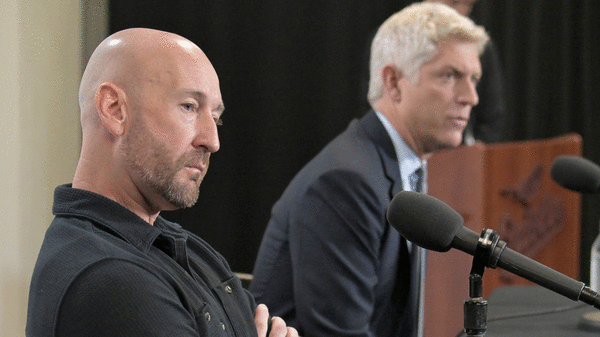
BALTIMORE — Jim Palmer sought a conversation. According to the Orioles legend, he couldn’t even get a text back.
During his appearance on the BMore Sports Podcast in an episode released last week with fellow Orioles Hall of Famer Mike Bordick and broadcaster Jerry Coleman, Palmer, a longtime Mid-Atlantic Sports Network analyst, recalled texting first-year manager Craig Albernaz in February with a suggestion for outfielder Colton Cowser: Study how fellow left-handed hitter Cody Bellinger attacks left-handed pitching.
In Palmer’s view, he had identified a weakness that only worsened. Cowser went on to bat .158 against left-handers this season, striking out 28 times in 57 at-bats.
Albernaz never replied.
Months later, Palmer said, he raised the unanswered message in Houston and received a dismissive response from Albernaz about how talking is easier than doing.
We haven’t heard Albernaz’s side. The Orioles declined a request for comment about the interactions Palmer described. Albernaz’s coaching staff, including hitting coach Dustin Lind and assistant hitting coach Brady North, presumably were already poring over video and tracking their hitters’ weaknesses from the outset.
Listening to Palmer, or at least acknowledging his message, hardly requires surrendering control of the batting cage.
But completely brushing off Palmer, if that account accurately captures their exchange, is an awfully clumsy move for a rookie manager attempting to establish credibility in Baltimore.
There is more context to Albernaz’s relationship with Palmer.
A league source familiar with the situation told The Baltimore Sun that Albernaz invited the Hall of Fame pitcher to serve as a guest coach during his first spring training as Orioles manager. The source added that Palmer has been invited to participate multiple times since the organization introduced its guest coach program. Orioles greats Adam Jones, Eddie Murray, Scott McGregor and Ben McDonald are among the former players who have participated in the program.
Palmer disputed that account in a phone call with The Sun on Monday. He said he was not invited to serve as a guest coach this past spring.
Palmer said the Orioles did extend an invitation three years ago, when president of baseball operations Mike Elias asked whether he would be interested in participating as a guest coach. Before committing, Palmer said he spoke with pitching coach Drew French about what the role would entail. According to Palmer, French told him much of his work would involve overseeing pitchers’ fielding practice and bullpen sessions.
Palmer wanted to know whether he could offer more specific pitching instruction, such as teaching pitchers to consistently locate a fastball low and away and other command-specific aspects of pitching. When French told him that probably wouldn’t be part of the role, Palmer declined the invitation.
Palmer stressed that French “couldn’t have been nicer” during their conversation and said he “thanked Elias profusely for thinking of him.”
As for Albernaz, Palmer, 80, clearly felt strongly enough about their exchange to recount it publicly on the podcast. His frustration was understandable. Who could blame him? Anyone who watched the Orioles stumble through this season had plenty of company.
But Albernaz, 43, and Palmer didn’t go from that February text until their August conversation in Houston without speaking. The two regularly interacted at Camden Yards throughout the season, crossed paths inside the team facility and traveled together on the Orioles’ charter.
Let me make something clear: I like Albernaz.
He drew a rough hand, and not only with the roster he inherited. In April, a screaming foul liner off Jeremiah Jackson’s bat struck Albernaz in the face, fracturing his right cheek in seven places and breaking his jaw. Somehow, he didn’t miss a game. Albernaz was back in the dugout managing the next day.
I want to see what he can accomplish with a stronger roster and more influence over development and personnel decisions. I also understand why Orioles fans need a whole lot more convincing after a second consecutive disappointing season left them watching other teams, including three American League East rivals, reach the postseason.
When Baltimore hired Albernaz, I reached out to many folks in the industry who knew his work. Rays president of baseball operations Erik Neander, longtime farm director Mitch Lukevics and Dodgers starting pitcher and two-time Cy Young Award winner Blake Snell offered glowing reviews. So did less heralded figures such as Mike Brosseau, who shared a winter with Albernaz on the Perth Heat in the Australian Baseball League in 2017, and Cubs vice president of pitching strategy Tyler Zombro, who never reached the majors but spent his early pro years developing under Albernaz in the minors.
Across different jobs and stages of his career, those who knew Albernaz best kept telling me the Orioles had made a smart hire.
Their enthusiasm echoed what the Orioles heard during their search. As Elias and controlling owner David Rubenstein interviewed candidates, conversations kept circling back to Albernaz.
“‘This person you’re interviewing is good, but if you get Craig, you’ll really be fortunate.’ They kept saying, ‘You may not get him, but if you can get him, this is the guy you want,’” Rubenstein said at Albernaz’s introductory news conference in November 2025.
I still respect those endorsements. But after a full season of watching Albernaz’s Orioles, I understand why fans remain unconvinced.
Baltimore finished 79-82, fourth in the AL East, with the same number of wins as last-place Toronto. The rookie manager inherited problems that reach well above his office. Still, addressing the careless baseball that kept sabotaging the club was central to his job, and the mistakes persisted through September.
Too often, the Orioles engineered their own undoing.
Baltimore committed 96 errors, tied for second most in the AL, and allowed an MLB-worst 88 unearned runs. For a manager who preached fundamentals throughout his first spring training, that’s a damning tally.
During his season-ending news conference, Albernaz pointed to continued work on cuts, relays and pitchers’ fielding practice. He also thanked players for embracing those drills and said the work paid dividends.
Did it really?
The willingness of players at the highest level to practice fundamentals should be an expectation. The manager’s evaluation and overall response should ultimately extend to what happens once the game starts.
How much progress can a club claim when basic preparation still betrays it in critical moments?
With Baltimore in the wild-card hunt in late September, outfielder Rece Hinds inexcusably neglected to wear sunglasses and lost a fly ball that produced the only run in a loss to Milwaukee. The following day, Jackson grounded out on the first pitch with the bases loaded after Brewers pitcher Chad Patrick had thrown nine consecutive balls.
Albernaz publicly unloaded on Jackson’s approach. “That’s not baseball, period,” he said. His frustration was justified. But where was that same bite when more heralded players made similar mistakes?
In August, Jackson Holliday also grounded out on the first pitch with the bases loaded after a pitcher walked two batters and hit another. Albernaz defended his aggression: “If he feels like it’s a good pitch to hit, you’ve got to go.” His patience extended to Gunnar Henderson, too. As the former All-Star struggled through a disappointing season, Albernaz regularly defended him and kept his criticism measured. Others weren’t always afforded that same grace.
Albernaz’s earlier comments about Samuel Basallo learning to play through discomfort invited questions about the then-21-year-old catcher’s toughness, although Albernaz insisted that wasn’t his intent. I supported him in holding a talented young player accountable.
But the manager’s public standards too often seemed to differ depending on whom he was discussing.
Part of the beauty of sports is the mix of personalities sharing a clubhouse or locker room. Each player responds differently to criticism and demands a coach who understands how to reach him. By all accounts, that was Albernaz’s calling card as a rising coach with the Rays, Giants and Guardians. That flexibility, though, should never leave players wondering whether the same rules apply to everyone.
Elsewhere, Baltimore’s hitters struck out 1,518 times, third-most in MLB behind only the lowly Angels and Reds. For all the lineup tinkering and platoon advantages the Orioles chased, putting the ball in play remained a stubborn problem.
By season’s end, Albernaz repeatedly pointed to a lack of “execution” and “consistency” to explain the team’s struggles.
To his credit, Albernaz included himself among those who fell short.
“Ultimately, you have to get the most out of your players, and you have to tee ’em up to best success to go out and win games. And ultimately, I failed at that this year,” he said. “That’s something where, going to the offseason, I got to get better at for the team to put these guys in a better spot to succeed. … It’s not a place where we wanted to be. But we’re here, and it sucks.
“Us as a group, if we all attack those margins and you look up, next year, hopefully, we’ll be in a better spot.”
It was a rough first year, but Albernaz certainly deserves the chance to show what he learned. He also has to understand why patience is running thin among Orioles fans.
Palmer’s account only deepened frustrations that had accumulated for months. Next season, Albernaz needs to give his skeptics the same confidence and conviction he inspired in those who championed his hiring.
____
©2026 Baltimore Sun. Visit baltimoresun.com. Distributed by Tribune Content Agency, LLC.





Comments