John Romano: The story behind the endless search for a Rays ballpark in Tampa Bay
Published in Baseball
TAMPA, Fla. — In another life — back when he was a young executive in charge of the Washington Post’s digital operation — Ken Babby had a boss who would often start meetings with a basic question:
“What’s the problem we’re trying to solve?”
A simple, unadorned and logical place to begin any endeavor. Except, in this case, the problem had already gone unsolved for decades.
Babby was soon to be the CEO of the Tampa Bay Rays and it would be his mission to find a location for the team’s next ballpark. A location that made sense geographically, financially and in every other way. Their deal to buy the Rays forbid Patrick Zalupski, Bill Cosgrove and Babby from engaging with local politicians until the last document was signed, so Babby did some initial homework to get a sense of where the Rays had previously looked and then hit up his local partners for their thoughts.
Turns out, Dan Doyle Jr. had thoughts.
Doyle, who is CEO of DEX Imaging and owns the Pelican Golf Club in Belleair, had ties to the Rays long before joining forces with Zalupski. His father was an original member of the Rays ownership group with Vince Naimoli, and Dan Jr. had once put his own group together in an attempt to buy the team from Stuart Sternberg.
Back in 2021, Doyle got together with Tampa attorney Fred Ridley and developer Chad Harrod to consider possible stadium locations in Tampa. The initial idea was to find a large plot that was still close to Rays fans in Pinellas County. Using aerial maps at the Harrod Properties office, they initially fixated on the Rocky Point area near the airport.
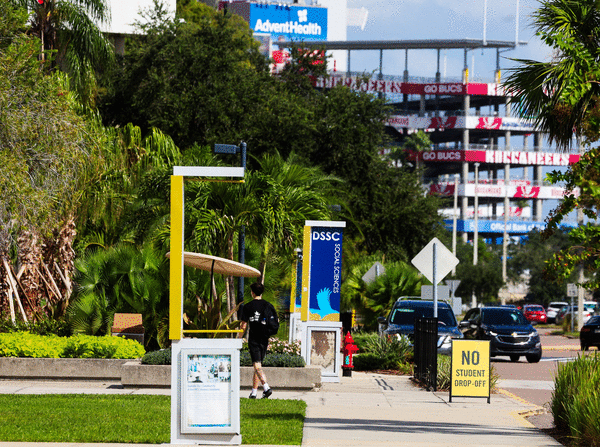
As they were pondering the implications of airport flight patterns in that general vicinity, they discovered how much land was going unused on the Hillsborough College campus.
“Chad Harrod and I drove over there probably three or four different times,” Doyle said. “We started to realize, ‘You know, this really is the perfect site.’”
Not wanting to cause an undue uproar at the campus, Doyle kept the idea to himself until last summer when Zalupski and Babby stopped by Pelican Golf Club for a meeting.
“I told them, ‘Let’s get in the car,’ and we all drove over there,” Doyle said. “I said, ‘Guys, this is your site.’ And they loved it. They immediately agreed.”
A week after the sale of the team was completed, Babby set up a meeting with the college’s president, Ken Atwater.
Atwater took Babby around the campus and pointed out the deterioration of buildings that had been constructed in the 1970s. He explained that getting money from Tallahassee was next to impossible, and he was spending $5 million to $6 million annually on building repairs. Atwater had a thriving institution with thousands of students but a crumbling infrastructure.
“He had a problem to solve and we had a problem to solve,” Babby said late Friday afternoon while sitting in the dugout at Tropicana Field. “Those two problems quickly became the problem we were going to solve together.”
Overlooked and underutilized
How did this go unnoticed? For years, there had been talk of tearing down nearby Jefferson High to build a stadium. Or, a mile or so away, maybe bulldozing WestShore Plaza and building a ballpark there. The greyhound track near Busch Boulevard was another possibility along with the fairgrounds off I-4. And everybody had ideas about Ybor City, the shipyard and the ConAgra flour mill in downtown Tampa.
But Hillsborough College? It was never under consideration, at least publicly.
Yet, it lined up with almost everything the team was seeking. There was lots of undeveloped land, around 100 acres filled with possibilities. That made it more attractive than Ybor City or downtown. It was close to the interstate, but not as distant as the fairgrounds. It was also controlled by the state, which would soon come in handy.
“They not only knew they wanted to be in Tampa, they wanted to be at Hillsborough College,” said Hillsborough County Commission Chairman Ken Hagan. “They went through the exercise of looking everywhere, but it was very obvious from our first meeting that Hillsborough College was the answer.
“I drove by that campus every day, and the thought had never occurred to me.”
The new ownership group had one other important commodity: a friend in the Governor’s Mansion.
Zalupski had donated to Ron DeSantis’ 2024 presidential campaign, and the governor is a former college baseball player who grew up 20 miles from Tropicana Field. While he had never expressed support for using state money on sports venues, the Rays were proposing a workaround where state funds would not go directly toward stadium construction.
Landing at Hillsborough College meant needing state money to rebuild a portion of the campus at the far end of the property. DeSantis could deliver that. It also meant getting a sweet deal for the land so the property taxes from a planned mixed-use development could theoretically repay the cost of building the stadium. DeSantis could deliver that, too.
So now, the Rays had a partner in Hillsborough College, a benefactor in Tallahassee and the ability to pay for half the stadium construction themselves.
“We knew the state would help Hillsborough College. We knew the Rays had the financial capability to put up 50% — which became more later on — into the project,” Babby said. “The unknown in all of that was if the county and city would be willing to be financial partners with us in the enterprise.”
Convincing the politicians
Previous attempts to build a stadium in Hillsborough County rarely got past the introductory news conference.
Talk to elected officials, and they say the Rays were constantly moving the goal posts. Talk to the previous ownership group, and they say there was never enough political will. In reality, the lack of abundant land for a mixed-use development made it a challenge to create a public/private partnership with obvious benefits to both sides.
“You’re not going to get the exact deal,” Tampa Mayor Jane Castor said days before the official votes. “Nobody is getting the exact deal they wanted, but it’s a compromise.”
Economists almost universally agree that sports venues do not appreciably change a community’s economic health. They argue that people spending money at a ballpark or at surrounding restaurants and bars are merely transferring their entertainment budget from one part of town to another.
What made this deal different — at least according to politicians on the Tampa City Council who voted 4-3 in favor of the deal and the Hillsborough County Commission who voted 5-2 — is that a property tax base was being created by capitalizing on the unused land at Hillsborough College.
It took months of negotiations, including lots of last-minute finagling regarding the disbursement of the property tax revenues. But they brought it in under the wire Friday, even if there are still details and documents to be worked out.
All because of Hillsborough College.
“We love being near where the Bucs are. Love the proximity to the airport. Love the proximity to the highway. And there was no tax revenue being generated in this location,” Babby said.
“We fell in love with the Hillsborough College site.”
____
©2026 Tampa Bay Times. Visit tampabay.com. Distributed by Tribune Content Agency, LLC.





Comments