Troy Renck: Why is Rockies legend Larry Walker getting a Coors Field statue? Homer at Shea Stadium tells story.
Published in Baseball
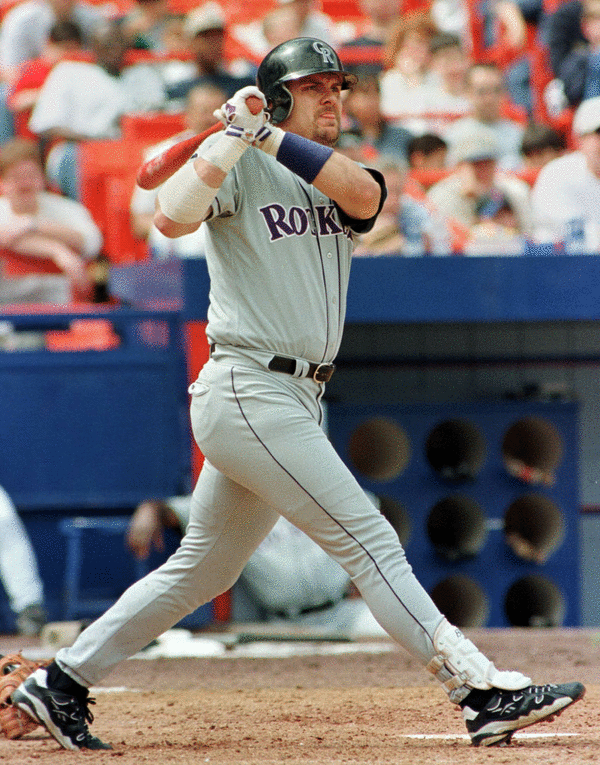
DENVER — Watching Larry Walker play baseball is like writing sentences with exclamation points.
He is the most talented player I have ever covered. He threw with the velocity and accuracy of a pitcher from right field. He motored around the bases like a sports car, knowing exactly what gear to shift into two steps out of the batter’s box.
And man could he hit.
A statue honoring his greatness will be unveiled Sunday morning in front of Coors Field. Appropriately, it features him finishing his swing.
It was, and now will forever be, a work of art. In this case, 21 feet from the base to the end of his bat.
“That’s kinda large,” quipped Walker on Friday.
About that bat.
It produced my favorite Walker memory.
Years ago, the Rockies were playing the New York Mets at Shea Stadium. For Colorado, East Coast road trips were measured by stats, not wins. Too often, Walker and Todd Helton were thin purple pinstripes standing between the Rockies and suffering the indignity of a no-hitter.
It was against this backdrop that Walker stepped to the plate. He recognized a fastball and uncoiled, producing the kind of loud contact that separates Hall of Famers from big leaguers.
It dropped jaws. Well, not all of them. The PA announcer forgot to turn off his mic.
“Holy (bleep)!” he screeched as the ball raced through the sky and shattered a light on the scoreboard.
Walker became Roy Hobbs. With his 34.5-inch, 32.5-ounce bat, he brought fiction to life, making everything seem possible.
Several years later, Walker found himself working out with Ryan Spilborghs in the 2003 offseason at Coors Field. Spilly was a Class-A outfielder finishing up his college degree at CU Boulder while working double shifts at the Village Tavern at The Flatirons Mall.
He was a terrible waiter. But a hard worker. After enduring constant ribbing for three months at the gym, Spilborghs was rewarded. Walker gifted him two bats, jewels of maple.
Spilborghs gained enough strength to consider using the bat in 2005. At the urging of teammate Sean Barker, he broke it out in a game. Using the LW33, Spilborghs went on a tear, batting .340 over stops in Double-A and Triple-A with “more than 100 hits from that bat.”
He made his big league debut in July, breaking the lumber against Reds left-hander Eric Milton.
“It is a family heirloom now in our house. The color is gone, but it makes it look like an antique,” Spilborghs said. “The time I spent working out with Larry was one of the highlights of my life. And every time I see him, I let him know I owe him a debt of gratitude because it was his bat that got me to the big leagues.”
©2026 MediaNews Group, Inc. Visit at denverpost.com. Distributed by Tribune Content Agency, LLC.






Comments