Paul Sullivan: After a lifetime of laughs, White Sox legend Ozzie Guillen gets emotional at number retirement
Published in Baseball
CHICAGO — Ozzie Guillén was deemed too skinny to become an everyday major-league shortstop, but a Chicago White Sox scout named Jerry Krause saw something in him. Guillén wound up as the rookie of the year and a three-time All-Star with a 16-year playing career.
Guillén was considered too crazy to become a major-league manager, but a White Sox general manager named Ken Williams saw something in him, and two years into the job in 2005, Guillén became the first man to guide the Sox to a championship since 1917.
Guillén’s English was thought too unintelligible to become a baseball analyst on an American TV station, but an NBC Sports Chicago executive named Kevin Cross saw something in him, and the Venezuelan-born Guillén became one of the game’s most entertaining and astute studio analysts.
The narrative was always the same.
But Guillén succeeded in every new challenge, becoming one of the most popular personalities in the history of Chicago sports.
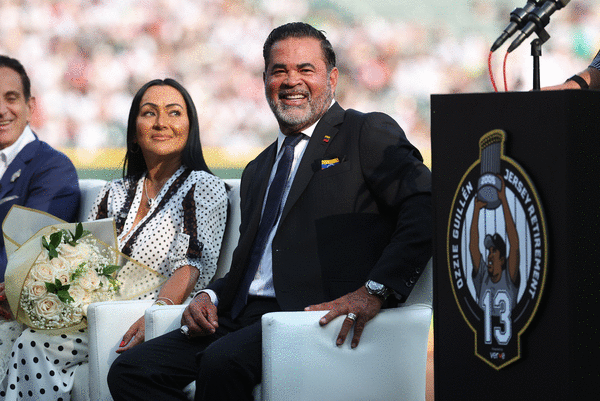
Guillén’s No. 13 was retired by the White Sox on Saturday in a pregame ceremony at Sox Park, with family and former teammates, players and coaches on hand to salute him. A packed house also showed up for the ceremony as he became the 13th former player — and first manager — to have his number retired and placed between Luis Aparicio (No. 11) and Paul Konerko (No. 14).
It was a long time coming, and something he prophetically spoke about in spring training in 1994, when he told the Chicago Tribune’s Alan Solomon: “Sometimes I dream about my number being retired. Believe me. Sometimes I think of what I’m going to say to the fans and the people there.”
Thirty-two years later, on a beautiful Saturday on the South Side, it happened.
Guillén said in a news conference before the ceremony that he worried his chance had passed, and told his wife, Ibis, to forget about it.
“Always in that conversation I hear my wife say, ‘Be patient, it will come, it will happen,'” he said. “I was like, ‘C’mon, they’re going to wait for me to die.'”
Patience paid off, and Guillén finally had his moment. A long standing ovation and chants of “Oz-Zie, Oz-Zie” echoed throughout the ballpark, and he teared up when talking about his family and Sox fans.
It’s been a long and winding journey, but Guillén said he knew as a player that he would one day manage.
“Yes, I was a better manager than the guy who was managing,” he said. “Let’s be honest.”
Guillén was always managing in his head at shortstop. He said he never thought it would be with the Sox, however, and thanked Williams and Chairman Jerry Reinsdorf for the opportunity.
“I know there were a lot of ups and downs, hate and love,” Guillén said. “Beautiful, nice but ugly. But we got it done. I think I did everything in my power in my life to make the White Sox team win every day. I really feel proud and pleased because every time I was managing this ballclub, Kenny Williams was thinking about winning. And Jerry was thinking about winning.
“As a manager you appreciate that, at least we’re on the same page. And obviously we don’t win every year, we had some tough times. We had an ugly summer here in Chicago between Kenny and myself, as you guys all know, but thanks to Kenny Williams I was managing here with the Chicago White Sox.”
Hiring Guillén was a bit of a risk at the time. He was always a clubhouse cut-up, and when I covered the Sox in the 1990s he was part of a group of players who weren’t afraid to openly mock their manager, Terry Bevington.
“By the way, it was Tony Phillips who told (Bevington), ‘Yeah, fall asleep and you will be the manager of the year, get out of here,'” he said with a laugh.
Guillén also learned what not to do, and convinced Williams he would be a different kind of manager who held players accountable and had fun along the way.
“We knew he had the knowledge and the gamesmanship, but there was the goofball side of him and we thought that maybe no one would take him seriously,” Williams said after giving him a two-year deal in 2003.
Guillén and Williams later went through a nasty divorce, as happens when two stubborn men with large egos refuse to accept the possibility he was wrong and the other one was right. Guillén went on to manage the Miami Marlins, which ended after one stormy year. A comment he made praising Fidel Castro angered some of the Cuban community in Miami, and after Guillén was fired he never got a major-league managerial job again.
But that turned out to be a blessing in disguise. It forced him out of his comfort zone and made him try something new. His new job as a broadcast analyst suited him perfectly. Guillén pulls no punches when discussing Sox players, managers or even the media, telling us we’re “soft.”
“I’m always going to be honest with the fans,” he said. “That to me is the No. 1 thing. My job is to tell the fans what I see. I might be wrong. I might be right. But that’s the way I look at it.”
Guillén loves to talk, for better or worse. “Ozzie needs to STFU,” former shortstop Tim Anderson once posted on social media after listening to some pointed criticism on the NBC Chicago Sports postgame show. Guillén was suspended once for posting about an ejection during the game, and forced to take sensitivity training in 2006 for insulting a longtime media antagonist.
Guillén has no filter, which often got him in hot water and made him some enemies along the way. But he was made-for-Chicago, always laughing, arguing, trading insults and hugging it out afterward.
“He fit the fan base here,” former Sox catcher A.J. Pierzynski told me. “A player, manager and broadcaster all in the same city for the same team. That’s the ultimate dream of any player. He just fit. The fans got him, and they understood him. White Sox fans are hardworking fans that expect the same out of their players. What Ozzie brought here, he talked a little trash, made some jokes. That’s all you need.”
No reporter could walk away from Guillén’s pregame sessions, which often lasted a half-hour or more, for fear that he might say something controversial the minute you walked away. He loved to argue with us as much as with the umpires.
Former Tribune baseball writer Dave Van Dyck covered him more than anyone in Chicago — from Guillén’s first spring training in Sarasota, Fla., in 1985 to his exit in ’97 to his hiring as Sox manager in 2003 to the championship in ’05 to the drama-filled exit in the final days of the 2011 season.
“Of course, he went out the same way he went in — talking nonstop,” Van Dyck wrote after Guillén’s final game. “Some making perfect sense, and some of it just the ramblings of a mind that never lingered on any subject for more than a few seconds. Guillén was always cursed, and blessed, with short attention. It is a simple complexity that made him loved and hated.”
But Guillén was beloved in Chicago, even by Cubs fans who enjoyed hearing him rant about the Wrigley Field rats. The Cubs-Sox rivalry was never as alive as it was when Guillén and Lou Piniella were in opposing dugouts. His gift of talking made him a media favorite, and the feeling was mutual.
“I respect the media more than anything,” Guillén said. “You guys know. I never carried no water for no one. I was so honest with you, I got in trouble a lot of times with my honesty. But on my first day I walked to the old ballpark, this city has always been behind me, the good, the bad and the ugly.”
There was never a day Guillén didn’t love what he was doing, no matter the job.
The city of Chicago adopted him 41 years ago, and he’s been our native son ever since.
____
©2026 Chicago Tribune. Visit at chicagotribune.com. Distributed by Tribune Content Agency, LLC.






Comments