Mike Vorel: Mariners coach Adam Bernero turned pain into purpose, now changes players' careers
Published in Baseball
Editor’s note: This article discusses suicide, self-harm and other topics related to psychiatric distress. If you or a loved one is in crisis, call 988.
SEATTLE — A baseball player walked onto the Golden Gate Bridge.
Adam Bernero believed that’s all he’d ever be. But as a boy, he hung maps of the world on his bedroom walls. “They always made me think of being free, he said, "that there’s a whole world out there for me.”
On the bridge, on the brink, he didn’t feel free. He felt purposeless, a pitcher with an irreparable arm. He was 33, surrounded by a world he couldn’t see. A cold, consuming fog obscured the skyline. His truck was left in a lot just north of the Bay Area bridge, with the driver’s door open and the keys inside; he no longer needed them.
It was October 2010, barely a decade after Bernero’s Major League Baseball debut. On Aug. 1, 2000, the Detroit Tigers’ revelatory rookie had scattered five hits and two earned runs in a 6-3 win over the Anaheim Angels in front of roughly 50 relatives and friends. “It was the most awesome feeling I’ve ever had,” a 23-year-old Bernero told The Sacramento Bee.
The feeling faded. It was replaced by a punishing perfectionism. By a constant, corrosive quest for outward approval. By losses, lots of them. By five stops in seven MLB seasons as a joyless journeyman. By what Bernero calls “my internal world of sadness.” By two surgeries on his exploding elbow. By a game that broke his body and left a hole behind.
“My whole identity was ‘baseball player.’ I didn’t really know the value I could bring to the world besides playing baseball,” said Bernero, whose playing career ended in 2008. “When you’re in that place of self-doubt — ‘I don’t really have value. I don’t have purpose’ — there was just nothing that felt like it mattered to me.
“It was a place of emptiness. It was easy to think, ‘Maybe I shouldn’t be here.’”
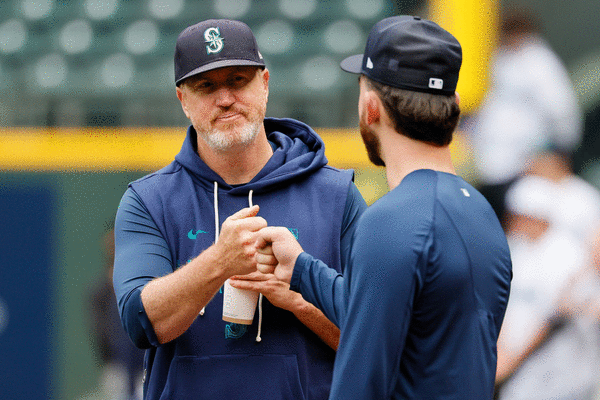
Which makes where he is now even more remarkable. Bernero recently entered his eighth MLB season with Seattle. As the Mariners’ mental performance coach, the 49-year-old has converted pain into purpose.
“The things he struggled with, I think he noticed them and got really good (at addressing them). He’s implementing that with us,” Seattle pitcher Logan Gilbert said. “He’s paying it forward to the next generation.”
But first, on the bridge, before the breakthrough, Bernero lifted himself onto the rail and looked over the edge.
———
It started with a name on a napkin.
Bernero starred at John F. Kennedy High School in Sacramento, Calif., where he was — according to then-Sacramento City College assistant coach Andy McKay — “one of, if not the best, high school pitcher from a (talent) perspective I can remember seeing.” He was drafted twice, in 1994 and 1996, but both the Chicago White Sox and Colorado Rockies declined to sign him.
So Bernero bounced from Sacramento City College to Division II Armstrong Atlantic State University. He was a 6-foot-4, 205-pound project, a ball of potential still learning how to pitch.
After his fifth and final college season ended at a tournament in Florida, the Armstrong Atlantic State Pirates took a trip to Denny’s. The Pirates’ pitching coach, Calvain Culberson, invited a Tigers scout named Gary York to tag along.
But York, who hoped to sign Bernero, didn’t bring a legally binding contract.
As the Los Angeles Times wrote in 2000, quoting Culberson:
“So he took a napkin and said, ‘This isn’t real legal like, but it’ll do for now.’ ” York, he said, wrote “something like, ‘I, Adam Bernero, agree to sign with the Detroit Tigers … here at this Denny’s in Jacksonville, Fla., and we agree to set a fee of $8,000.’”
York slid him the napkin, and Bernero signed it, surrounded by Grand Slam breakfasts and Moons Over My Hammy scrambles and Super Bird sandwiches.
“Congratulations,” the scout told him. “You’re a Detroit Tiger.”
For a while, his career felt like a fairy tale. Bernero made it to the majors in just 14 months. He was a red-haired meteor, ripping through the minor leagues. As Tigers staffer Rick Bennett marveled to The Sacramento Bee: “He competes like a bulldog out there.”
But baseball, with time, tends to tame bulldogs. Bernero went 11-27 with a 5.91 ERA in seven MLB seasons and 150 career games. He endured a team-record 17-start winless drought from June 2002 to May 2003. He also received the least run support in baseball, as Detroit lost a combined 225 games in those two seasons. He bounced to Colorado, Atlanta, Philadelphia and Kansas City — craving perfection and finding failure.
As Mariners utility man Brendan Donovan astutely summarized: “Baseball’s so intricate, as far as playing every day, travel, built-in failure. We joke it’s death by a thousand cuts.”
By the end, Bernero was covered in cuts. He underwent Tommy John elbow ligament surgery in 2007, but complications left his arm locked at a 90-degree angle even a year later.
“There were bone spurs in there, and they floated into a place where my arm wouldn’t extend. They had to take those out,” Bernero said. “With my elbow, there’s still so many things going on in there.”
After a second surgery, an attempted comeback abruptly ended in 2008, when Bernero felt another pop in his elbow. His pitching career was over. A trapdoor dropped. At 31, he fell into a real world he didn’t recognize.
“I lost five years to depression,” Bernero said. “When baseball is your whole life, transitioning to normal life is … I didn’t have any other skills. So it was difficult to know what to do or who I was.
“In baseball, we have this fantasy land here. Going into the real world and understanding how to do anything was really difficult.”
———
Bernero lifted himself onto the rail and looked over the edge. He saw water through the fog 200 feet below. He felt the wind whip. He thought about his mother. The fear flooded his senses, overpowering his pain.
“I had the vision of it and thought about it. I felt that emptiness," he said. "Then I got out there, and the reality was more shocking than the pain.”
In reality, Bernero didn’t want to die. He also didn’t know what he wanted to do. So he backed off the rail and sat against a steel pillar, as cars and people passed. He sat still for an hour, while the world went on. He considered a future he was set to sacrifice.
When he stood, Bernero did so with a decision.
If I’m not doing this, I’m going to have a good life. I’m going to have fun and have purpose.
Just then, the fog lifted, like another fairy tale.
“It became really sunny,” Bernero said. “I’m walking, and I was kind of hoping my truck was gone. I was like, ‘Yeah, you idiot. I hope someone did take your car.’ But I get there, and the door’s still open, and the keys are still sitting there.”
The world went on. So did Bernero.
***
Even after a thousand cuts, Bernero didn't die.
But the path to purpose still made many stops. Before and after the bridge, Bernero spent six years as an Alaska fishing guide. For five months, he woke at 5 a.m. and worked 12 to 14 hours every day.
He tried and failed to fill the hole baseball left behind. He dug a septic line in Alaska, drenched in dirt and sweat and anonymity. He practiced jujitsu and played softball and soccer. He learned to ski and mountain bike. He took up photography. When it wasn’t fishing season, he lived in Bend, Ore. — "a beautiful place to relearn yourself," Bernero said. He mowed lawns and did landscaping. He even worked for a while in a butcher shop.
“Five years after I was done (in MLB), I’m cutting smoked turkey deli slices for people,” Bernero said with a smile. “I’m like, ‘Wow, I went from a big-league paycheck to $7 an hour.' ”
Bernero's breakthrough didn't happen on the bridge. Not entirely. It was built with bricks, laid daily. With therapy and education and meditation. With breath work to soothe his nervous system. With a yearslong "learning process," per Bernero. With a marathon, not a fairy tale.
With a phone call.
Eventually, Bernero called McKay, who was working as the Colorado Rockies’ peak performance coordinator.
“He was obviously searching,” said McKay, now the Cleveland Guardians' field coordinator. “He was asking me about my day-to-day and what I do. He was like, ‘Jesus, that’s what I want to be doing. That’s what I should be doing.’ ”
Finally, Bernero’s future appeared before him. The fog lifted. He earned a master’s degree in sports psychology from the University of Denver in 2017. McKay, then the Mariners’ director of player development, hired him as a mental performance coach less than two years later.
He arrived with a perspective, and a purpose, he could pay forward.
———
Bernero filled the hole baseball left behind.
And another one as well.
“When you’re dealing with 26 players, you always have clients,” McKay said, describing the grind of an MLB mental performance coach. “There’s no time when all 26 guys are feeling confident and playing free. It would be like not having a trainer or a pitching coach. The hole that would exist in not addressing that part of the game … it’s too deep.”
Bernero was the right man, in the right moment, for the Mariners. He arrived alongside "a minor-league system that was starting to explode," McKay explained. "He was on the ground floor with Logan Gilbert and George Kirby and Cal Raleigh and Bryce Miller and Bryan Woo. So it was the perfect storm.”
Bernero has tools to weather all sorts of storms. He uses ice tubs to train on breathing through outside adversity. He meets with 22-year-old second baseman Cole Young for a five-minute conversation to flush frustrations after every game. He preaches commitment to a process, not perfection, to all the incremental wins that can be controlled.
After Gilbert's rough rookie season in 2021, Bernero helped the pitcher calm his mind on the mound. He encouraged Kirby to pick up painting, per Kirby, “to clear your mind and open up a different part of your brain.”
He trained Miller to visualize beating the Blue Jays.
When Miller surrendered a solo homer to George Springer on his first pitch of the 2025 American League Championship Series, and Toronto's Rogers Centre rumbled, the 27-year-old didn’t panic. He was prepared. Hours earlier, while the Blue Jays took batting practice, Miller had sat with his back against the center-field fence. Eyes closed, arms folded, he beat the Blue Jays. Miller manifested success from 400 feet away.
“I knew this was the biggest start of my career so far,” Miller said after spinning six one-run innings in a 3-1 Game 1 win. “I just wanted to go out there and mentally get in the zone and visualize having success on the mound.
“That’s something ‘Bern,’ our mental-skills guy, walks us through — visualizing certain pitches, with runners on, from the stretch, and seeing yourself having success from a third-person view. That way, when you’re in the moment, it feels like you’ve already been there.”
Bernero has been there, which McKay said adds “instant credibility.” That was certainly true for Woo, who ascended into an All-Star after sputtering in his college career.
“I struggled in college with a lot of similar stuff to what he experienced in the big leagues,” Woo said. “I was do-or-die based on the results I was getting on the field. It’s a tough way to live.
“To struggle like I have, or like he has, or like anyone has, and do it over a really long period of time, it wears on you. Sometimes that’s what it takes to realize, ‘Hey, I need to try something else.’ That was mental skills for me. It’s changed my career.”
———
Sometimes, Bernero worries he's not doing enough.
He's a bricklayer, building breakthroughs, changing careers. But paying it forward could be bigger than baseball.
“That moment on the bridge, how did I get there? I want to understand that, and help other people understand that and break their patterns,” he said. “So they can come to these places of struggle and go, ‘OK, I’m going to make a different choice.’
I didn’t know how to make that choice. If I was awake to the patterns, I don’t know if that five-year window (of depression) would have happened. Maybe it would have been a one-month window, or one day or one week.”
Bernero wants to help others understand themselves, to see through the fog. To find purpose and peace when a trapdoor drops.
On a sunny day at spring training, while music pumped and players passed, Bernero admitted: “I have definitely thought about what (my career) looks like in five, 10 years, and it’s probably not this.”
It might be counseling or consultation. For a graying bulldog who spends seven months in parks and on planes, it might be quiet weekends with a dog of his own. His worth is no longer bound to baseball, to a name on a napkin. Bernero knows there’s a whole world out there for him now.
A week after the fog lifted while he walked off the bridge, Bernero got an outline of a world map tattooed across his back. It’s a reminder in the mirror. So he always feels free.
A baseball player walked onto the Golden Gate Bridge.
That isn’t all he ever was.
Or all he’d ever be.
____
© 2026 The Seattle Times. Visit www.seattletimes.com. Distributed by Tribune Content Agency, LLC.






Comments