Sports
/ArcaMax
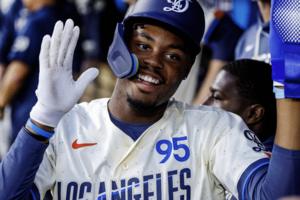
The Dodgers' Josue De Paula can hit. Now he's out to prove he can play defense, too.
LOS ANGELES — Dodgers rookie Josue De Paula sat down with third base and outfield coach Dino Ebel in the visiting coach's room at Great American Ball Park. Ebel pulled up defensive metrics on three different outfielders.
One was Cubs center fielder Pete Crow-Armstrong, the National League MVP favorite and MLB's defensive fWAR leader. Another ...Read more

Dave Dombrowski: 'Better to wait until our season is complete' before deciding on Don Mattingly's future
PHILADELPHIA — And then there was one.
Don Mattingly stands alone among baseball’s interim managers after the Mets and Red Sox announced Tuesday that they will retain Andy Green and Chad Tracy, respectively, with each receiving a three-year contract to stay at the wheel of those clubs.
The Phillies aren’t ready to make a similar ...Read more

Tigers' offense stalls in 3-1 loss to Nationals
DETROIT — The Tigers have a decision to make this offseason regarding right-hander Drew Anderson.
They hold a $10 million option to retain his services for 2027 and given the way he’s pitched since he was moved into the starting rotation full-time, that’s starting to look like a bargain.
Anderson, 32 and a veteran of three seasons in ...Read more
Jared Jones leads Pirates to fifth consecutive win
PITTSBURGH — Jared Jones got a standing ovation as he left the field in the seventh. It’s a sight he seems to be getting used to.
Jones allowed one baserunner — a softly hit double in the sixth — in seven shutout innings on Tuesday night, leading the Pittsburgh Pirates to a 2-0 win against the St. Louis Cardinals at PNC Park. Luke ...Read more

Cubs 3B Alex Bregman won't go on the injured list despite multiple facial fractures
CHICAGO — Chicago Cubs third baseman Alex Bregman sustained multiple facial fractures after getting hit on his left cheek by a foul ball during Sunday’s game against the Cincinnati Reds. But the Cubs won’t be putting him on the injured list, manager Craig Counsell said Tuesday.
Bregman is not ruled out for the regular season. He still has...Read more

Mets remove interim tag off Andy Green, sign manager for 3 years
ARLINGTON, Texas — The Mets have taken the interim tag off Andy Green, naming him the 26th manager in franchise history. David Stearns, president of baseball operations, announced the move Tuesday ahead of the start of the season’s final road trip through Texas and Washington.
The parties agreed on a three-year contract.
“Over the course...Read more

Carlos Rodón dominates as Yankees beat Rays in first game of doubleheader, keep AL East dreams alive
NEW YORK — Given the depth of the Yankees’ rotation, there’s a strong possibility — perhaps even a likelihood — that Carlos Rodón won’t be asked to start a game in the best-of-three wild-card round of the playoffs.
But Rodón looked every bit of an ace in Tuesday afternoon’s 2-0 win over the Tampa Bay Rays to kick off a ...Read more

Orioles-Blue Jays game Tuesday postponed; split doubleheader Wednesday
BALTIMORE — The Orioles will play their final two home games of the season on the same day.
Baltimore’s game against the Toronto Blue Jays on Tuesday night was postponed because of heavy rain in the region, and the two teams will instead play a split doubleheader at Camden Yards on Wednesday.
The first game is scheduled to begin at 1:35 p....Read more

Bo knows debuts: SF Giants' Davidson records first hit, steal, run in win over Twins
SAN FRANCISCO — All Bo Davidson needed was one inning to get the people on their feet.
Davidson quickly fell behind 0-2 to the Twins’ Zebby Matthews in his first career at-bat, but the rookie refused to go down without a scrap. He laid off a curveball and changeup out of the zone, fouled off a slider, then resisted an outside four-seamer to...Read more

Pirates ace Paul Skenes opens up about his struggles -- and the role the World Baseball Classic played
PITTSBURGH — Like many in baseball, Paul Skenes has spent plenty of time lately trying to figure out why his fastball velocity has decreased and why he’s been less effective this season.
As he’s looked back, he’s keyed in on one thing — the World Baseball Classic.
“There are a lot of other factors, so I don’t want to put ...Read more

Pete Alonso's 40th home run lifts Orioles past Blue Jays
BALTIMORE — Where would the Baltimore Orioles be without Pete Alonso?
In a season short on bright spots, Alonso has been one of the few constants. Baltimore committed five years and $155 million to him last offseason, and Monday night he gave the club another reminder of why.
After the Orioles were shut out in their final two games against ...Read more

Paul Sullivan: After all the highs and lows, the White Sox have a clear path to the postseason
CHICAGO — The end game has arrived for the Chicago White Sox, with six games to make history or go home for a long offseason.
No team has made the postseason after losing 100 or more games the two previous seasons, and the Sox came into 2026 with three straight seasons of losing 100 or more.
The buzzword surrounding the Sox all season has ...Read more

Dodger Stadium has a botanic garden tour. Meet the man entrusted with making it a draw.
LOS ANGELES — Tens of thousands of people walk in and out of Dodger Stadium on any given night, paying scant attention to the trees, plants, and other foliage surrounding it on all sides. Chaz Perea made his peace with that a long time ago.
"Getting to Dodger Stadium is not a small thing," said Perea, 41, the stadium's landscape manager. "You...Read more

White Sox win 8-1 and own 3-game lead for third AL wild-card spot with 6 games remaining
CHICAGO — The conditions were less than ideal.
But after a nearly four-hour delay, the result was just what the Chicago White Sox needed in their fight for a playoff spot.
The Sox scored three runs in the fourth inning to distance themselves from the Detroit Tigers in an 8-1 victory in front of 21,354 at Rate Field.
Chase Meidroth hit a two...Read more

Orioles fade, and their season with it, in 3-0 loss to Brewers
BALTIMORE — When a season is over, every team ultimately is what its record says it is. There are injuries and batted-ball luck and a bounce here or a bounce there, all of which impact whether a bubble team makes the playoffs or not. But records are the barometers that determine which clubs play in October and which ones watch from home.
The ...Read more

Padres complete sweep of Marlins, continue advance toward postseason
SAN DIEGO — Walker Buehler, who has pitched in three World Series and has a pair of rings, signed with the San Diego Padres in February for this feeling.
“Being on a winning team that does it the way we have this year and is going to make the playoffs, it looks like, I think is a huge accomplishment,” he said Sunday.
That’s right — ...Read more

Cardinals power way to final home win in 2026 with blasts from Ivan Herrera, Leo Bernal
ST. LOUIS — Jolted to a tied game in the eighth inning thanks to a homer from Ivan Herrera that marked his second of Sunday’s home finale at Busch Stadium, the Cardinals were lifted to a lead later that inning with a swing that produced the same result.
Down 3-2 entering the bottom of the eighth inning vs. the Nationals, the Cardinals ...Read more

Angels close home slate with ugly loss to Twins
ANAHEIM, Calif. — This was a fitting performance for what is likely to be the last Los Angeles Angels home game of a miserable era.
The Angels lost, 8-0, to the Minnesota Twins on Sunday afternoon, completing their home schedule in the final season under owner Arte Moreno.
They’ll have six more road games, and then their 11th straight ...Read more

Yankees' division dreams fading after series loss to Diamondbacks, another Rays win: 'It's gonna be tough'
PHOENIX — The New York Yankees continued to fall behind in the American League East on Sunday, dropping their second straight game to the Arizona Diamondbacks to cement a series loss at Chase Field.
Coinciding with the 8-4 defeat was yet another Tampa Bay Rays win over the Boston Red Sox. With that, the Yankees, who lost in walk-off fashion...Read more

Kade Anderson delivers best start of career as Mariners stave off elimination
DENVER — Kade Anderson believes in standards not expectations. He sets the standard for what is considered acceptable while others can have expectations.
In his previous outing in Anaheim, Calif., he made it bluntly clear that his execution and performance was far below the standard he had set for himself.
On a gorgeous Sunday afternoon, ...Read more
Popular Stories
- Pirates ace Paul Skenes opens up about his struggles -- and the role the World Baseball Classic played
- Paul Sullivan: After all the highs and lows, the White Sox have a clear path to the postseason
- Pete Alonso's 40th home run lifts Orioles past Blue Jays
- Bo knows debuts: SF Giants' Davidson records first hit, steal, run in win over Twins
- Cardinals unable to complete comeback in 11th, lose to Nationals
Comics