
The Greener View: Summer Questions
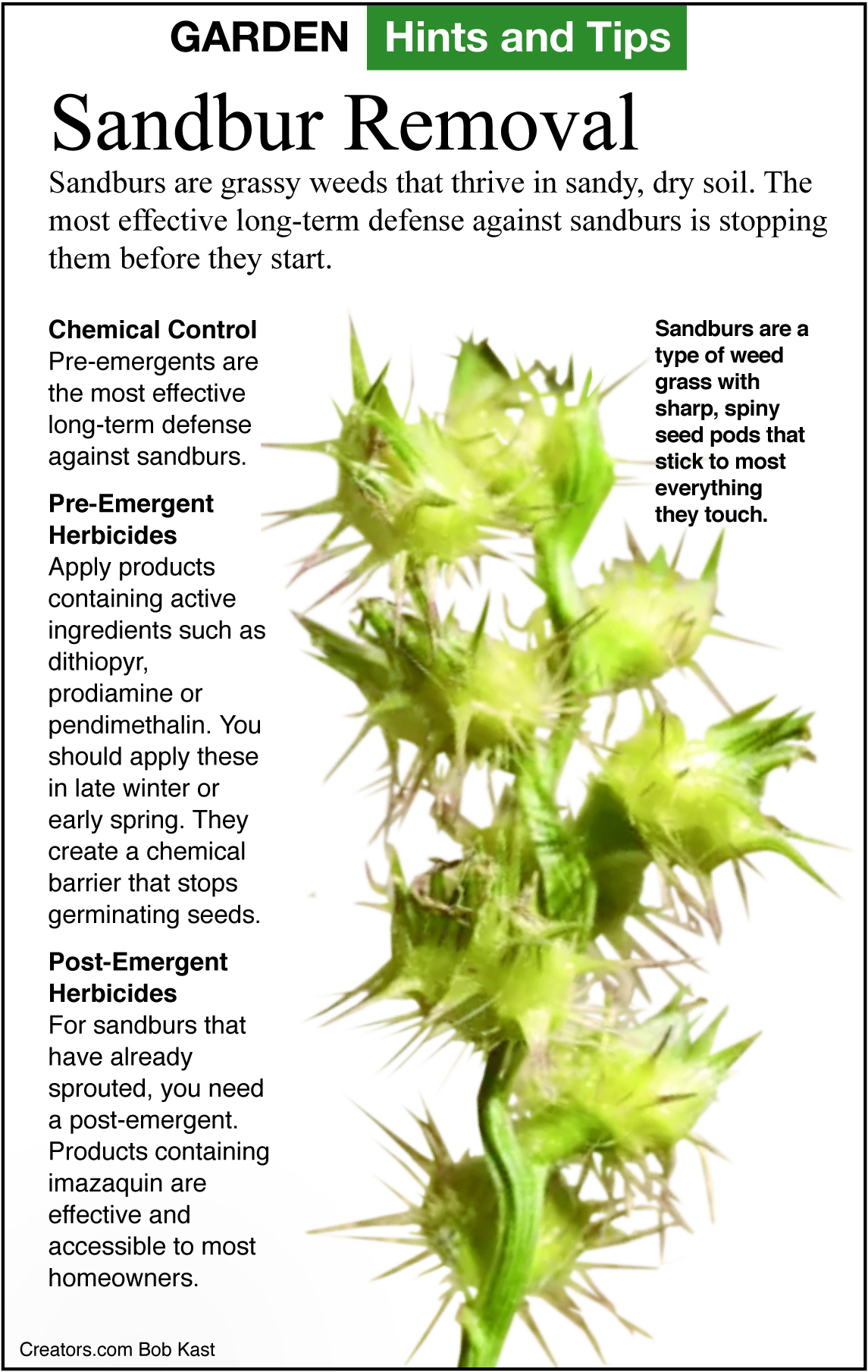
Q: Do you have any experience with sandburs? I'm trying to rid my property of them without spraying in order to maintain my property as organically as possible.
A: Sandburs are awful. They are the seeds of a type of annual grass. That means that you could use a pre-emergent to stop them from sprouting new plants in the spring. Whenever you can prevent the plant from producing seeds, you win a battle. They have to regrow from seeds every year, so stopping seed production is the key. Every time you see one of the plants, pull it out or chop it down to stop it from growing and producing seeds. Sandbur seeds do move by sticking to animals, and they can float to new places, so if your area gets flooded occasionally, the seeds may come back to start the cycle over again.
Q: My hostas and daylilies are blooming. When they are done, there will be a bunch of ugly stalks sticking up above the leaves. I cut them off, but this year I am recovering from surgery and won't be able to do that. Is there a plant health reason I should cut them off, or is it just an aesthetic thing for me?
A: There is nothing out there in nature that is cutting off the stalks when the plants are done blooming. If one or more of the flowers is developing seeds, the stalk will supply the nutrients necessary for the seeds to grow. If there are no seeds, the stalk will slowly transfer any remaining nutrients in the stalk back to the plant. The stalk will then turn yellow and die. At that point, it is usually easy to pull off the plant.
Pruning the stalks after the flowers are done blooming and before they turn yellow will definitely make the plant look nicer, and it is generally the recommended horticulture practice. However, it isn't required, and in a small way, it takes some nutrients from the plant.
Deadheading, which is the removal of spent flowers and seed pods, is recommended so that the plant doesn't waste energy growing unwanted seeds. The nutrients required to grow seeds are then spent on growing a bigger plant that will produce more flowers the next year.
Deadheading to remove unwanted seeds is not usually necessary on most daylily or hosta varieties as they don't spread around the garden by seeds.
Q: Something is eating circles and half-circles out of the leaves on my roses, but I never see anything doing it. What is the cause, and how do I stop it?
A: Leafcutter bees cut semicircular holes in the leaves of roses and other plants. They do not really harm the plant, unless there are a lot of leaves being cut up. A systemic insecticide will stop them without hurting other bees and beneficial insects, but it is not worth the bother.
Q: We bought some roses early in the spring that were supposed to be fragrant, but they do not smell at all. Are we doing something wrong, or are these just bad roses?
A: Roses that have plenty of water and are well taken care of might smell slightly better, but mainly this is a question of genetics. Some roses smell nice, and others don't. Roses have a variety of scents as well. While many roses are sold in the spring, it is best to buy a plant while it is exhibiting the characteristic you desire. Buy roses in bloom rather than in the dormant stage so you can test them.
Here is a list of some very fragrant hybrid tea roses that will not miss: Double Delight is a red-white bicolor, Fragrant Cloud is reddish-orange, Mr. Lincoln is dark red, Crimson Glory is red, Chrysler Imperial is red, Papa Meilland is dark red and Perfume Delight is pink.
Many other roses are fragrant. Most of the varieties known as Old Roses or Old Garden Roses, and many shrub roses, are also fragrant.
========
Email questions to Jeff Rugg at info@greenerview.com. To find out more about Jeff Rugg and read features by other Creators Syndicate writers and cartoonists, visit the Creators Syndicate website at www.creators.com.
Copyright 2026 Jeff Rugg. Distributed By Creators.





Comments