
Cutting the Auto Giant Down to Size
Published in Clarence Page
WASHINGTON -- When I was a kid growing up in the pre-Pearl Harbor days, the word that often described the average American family car was "transportation." It meant that the automobile was primarily a way of getting from point A to point B, with few bells and whistles.
After World War II that all changed, as the auto industry cultivated a huge public romance with the look, size and speed of the means of making that same basic journey. The kind of family car you drove became a prime status symbol, with enhanced appearance and design as well as performance.
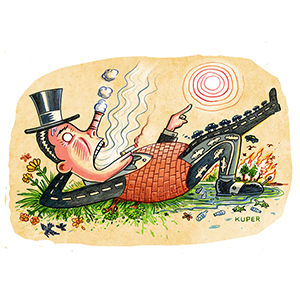
Big-and-flashy crowded out simple-and-dependable as the all-powerful American car business installed itself as the chief generator of the nation's economy. When GM CEO "Engine Charlie" Wilson as President Dwight Eisenhower's nominee for secretary of defense famously proclaimed that what was "good for the country" was "good for General Motors and vice-versa," there were few in the financial world who disagreed with him.
But with the invasion of innovative foreign competitors and the American concept of big-is-better eroding the home industry's commanding position, Engine Charlie's axiom eventually withered away. Exploitative foreign oil prices hastened the erosion as Detroit gas-guzzlers like the SUV continued to roll off the assembly lines, seemingly oblivious to the dire consequences ahead.
The once-unthinkable outcome of General Motors declaring bankruptcy, with Uncle Sam frantically pouring huge financial transfusions into the dying patient, became a reality the other day as Uncle Sam took majority control of its management and risk.
Well, maybe it's time to go back to those pre-Pearl Harbor days when American cars were looked upon primarily as "transportation." A sign of dim recognition of this need has been seen in the forced decision of GM rival Chrysler Motors to hook up with Fiat of Italy, presumably to turn out more small and energy-efficient cars.
Both GM and Chrysler, as well as Ford, have all strived in the last few years to make better and more practical vehicles and to convince American buyers to give them a second chance. But the horrible publicity suffered by two of the Big Three over the last several months has made the plea a particularly hard sell, even to Americans who might be moved by twinges of patriotism to Buy American in this trying time.
If the home market for domestic-built cars is to bounce back, it may take more than higher fuel efficiency and smooth road handling to get Americans to start buying GM and Chrysler products again. Ironically, given the Main Street USA fascination with bells and whistles -- with fancy gadgets that take a lot of the effort (and fun) out of being behind the wheel -- they may still be required to compete with the foreign usurpers of the American car market.
It's a dilemma for the "new" managers of the essentially nationalized domestic auto industry, many of whom apparently come from the management corps that was steering the business down a road to nowhere all these years.
No matter what a stumbling industry is, sometimes it takes a radically fresh mind to get the creaking Tin Lizzie out of the ditch. After World War II, to give just one example, a little-known entrepreneur named George Romney in Michigan took the skeleton of a failing Nash brand and turned it into American Motors as an upstart against the Big Three.
He introduced the concept of the compact car with the downsized Rambler that quickly caught on with low- and middle-income buyers. It was derided by competitors as just "transportation," but it met the existing market hunger.
Romney personally capitalized on the compact-car success by running for governor of Michigan in 1962, was reelected in 1966 and became the frontrunner for the 1968 Republican presidential nomination, until his own candidacy ran out of gas and he lost out to Richard Nixon. The Rambler, like Romney's political fortunes, also was eventually run off the road by the American car owner's romance with size and glitz, provided by the Big Three.
Maybe the U.S. car market needs another Rambler, and another George Romney -- the auto innovator, not the politician.
========
Jules Witcover's latest book, on the Nixon-Agnew relationship, "Very Strange Bedfellows," has just been published by Public Affairs Press. You can respond to this column at juleswitcover@earthlink.net.
(c) 2008 CLARENCE PAGE DISTRIBUTED BY TRIBUNE MEDIA SERVICES, INC.


















Comments