
White to Play and Draw
Published in Chess Puzzles
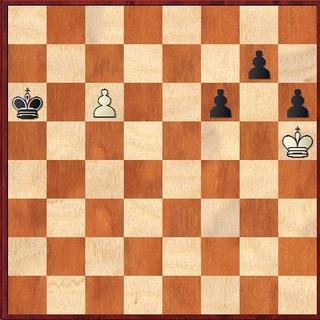
Since endgame problems are part of these puzzles, it would be a shame to leave out the classic endgame everybody in chess has to know. For those of you who know this problem, it is presented in the format from the 1930's book of Richard Reti's compositions rather than the usual one where the only Black pawn is on h7 and a Black rook occupies h8 with the White king on g7, the White pawn and Black king are in the same place as our problem. In any event, the geometric underpinnings of this solution make it not only essential to a knowledge of chess, but provide a beautiful endgame study. On first glance, it looks impossible for White to survive: if he takes the g-pawn, a Black pawn runs to queen, and the White pawn looks deader than the proverbial doornail; however, all is not as it seems.
Solution:
1.Kg6 Kb6 [1...f5 2.Kxg7 (2.Kxf5 Kb6 3.Kg6 Kxc6 4.Kxg7 h5) 2...f4 3.Kf6 f3 4.Ke6 f2 5.c7 f1Q 6.c8Q+] 2.Kxg7 h5 3.Kxf6 h4 4.Ke5 Kxc6 (else the White king comes over to escort his pawn to queen) 5.Kf4 h3 6.Kg3 and the last Black pawn disappears. It all comes down to the ability of the White king to reach his pawn and queen it if Black pushes his pawns, and if the Black king heads for the White pawn, the White king will eat up all the Black pawns. The way the White king "triangulates" to catch the runaway Black pawn proves that, on a chessboard, the shortest distance between two points is not always a straight line!
Send questions and comments to PTamburro@aol.com.




Comments