From the ArcaMax Publishing, History & Quotes Newsletter:
http://www.arcamax.com/news/quotes/s-185492-834893
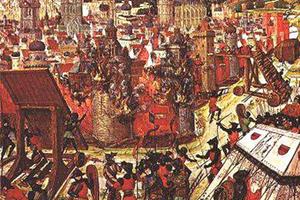
In 1527, German troops sacked Rome, killing some 4,000 people and
looting works of art and literature as part of a series of wars
between the Hapsburg Empire and the French monarchy.
n 1863, Confederate forces commanded by Gen. Robert E. Lee routed
Union troops under Gen. Joseph Hooker at the Battle of
Chancellorsville in Virginia.
In 1915, Babe Ruth of the Boston Red Sox hit his first major league
home run in a game against the New York Yankees in New York.
In 1935, in the depths of the Depression, the Works Progress
Administration was established to provide work for the unemployed.
In 1937, the German dirigible Hindenburg burst into flames while
docking in Lakehurst, N.J., killing 36 people.
In 1941, Josef Stalin became official leader of the Soviet government.
In 1954, 25-year-old British medical student Roger Bannister cracked
track and field's most notorious barrier, the 4-minute mile, during a
meet at Oxford, England. His time: 3 minutes, 59.4 seconds.
In 1975, U.S. President Gerald Ford broadcast an appeal to Americans
to welcome the thousands of Vietnamese refugees pouring into the
United States.
In 1992, legendary actress Marlene Dietrich died at her Paris home at
age 90.
In 1993, two postal workers, both apparently bitter over their
treatment at work, allegedly shot co-workers in separate incidents in
post offices in Michigan and California, leaving at least three dead
and three wounded.
In 1994, Paula Jones accused U.S. President Bill Clinton of making an
unwanted sexual advance during a meeting in a hotel room in 1991, when
he was governor of Arkansas. It was believed to be the first lawsuit
of its kind against a sitting president.
Also in 1994, the U.N. Security Council voted to impose a tougher
trade embargo on Haiti if the nation's military rulers did not step
down within two weeks.
And in 1994, the Channel Tunnel, a railway under the English Channel
connecting Britain and France, was officially opened.
In 1997, U.S. President Bill Clinton and Mexican President Ernesto
Zedillo Ponce de Leon signed an agreement for a broader mutual effort
to fight drug trafficking.
In 2001, Pope John Paul II became the first pope to enter a mosque --
the Umayyad Mosque in Damascus, Syria.
In 2003, as civil disorder continued in Iraq, U.S. President George W.
Bush named retired diplomat Paul Bremer III as his envoy to Iraq,
making him the chief U.S. figure in the reconstruction.
Also in 2003, U.S. health officials reported 63 cases of severe acute
respiratory syndrome, or SARS, but no deaths.
In 2004, the International Red Cross said it had found evidence of
widespread mistreatment of Iraqi prisoners by coalition forces in
prisons across Iraq.
Also in 2004, as violence continued, U.S. forces in Iraq seized the
governor's office in Najaf, a stronghold of radical Shiite cleric
Moqtada Sadr, and installed a new governor.
In 2005, a suicide bomber killed at least 58 people in a vegetable
market south of Baghdad.
In 2006, the largest rebel group in Sudan's Darfur region and the
government of Sudan signed a peace agreement ending their armed
conflict in a 3-year civil war that claimed an estimated 200,000
lives. However, two smaller rebel groups declined to sign an
agreement.
And, unbeaten Barbaro won the 2006 Kentucky Derby by 6.5 lengths.