Mark Zeigler: Ghosts of 1994 never far behind Colombia, which plays to win at Snapdragon Stadium
Published in Soccer
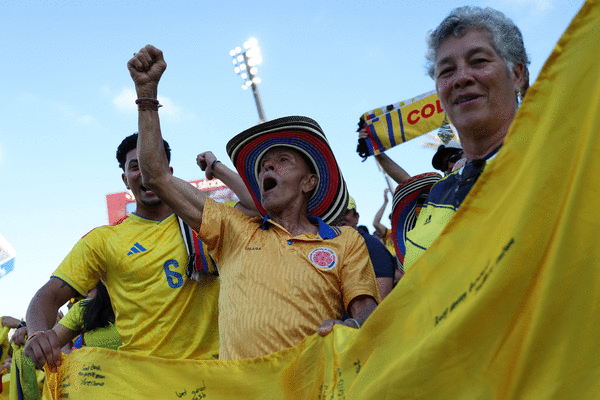
SAN DIEGO — A roster loaded with generational talent, a lengthy unbeaten streak, a successful qualification run highlighted by a convincing win against Argentina, a World Cup in the United States, a sexy pick to win in it all, belief, hope, dreams, aspirations, expectations.
It all seems so familiar.
It all seems so frightening.
Colombia’s national soccer team came to Snapdragon Stadium for its final tuneup ahead of its June 17 World Cup opener against Uzbekistan, receiving a passionate send-off in a clinical 2-0 win against Jordan from a massive, yellow-clad crowd finally allowing itself to make the raw, risky investment of emotional capital.
Co-lom-bia, Co-lom-bia, Co-lom-bia.
The parallels to 1994, the only other World Cup hosted by the United States, are shivering. The scar tissue from a stadium 127 miles north runs deep.
Los Cafeteros, as the national team is affectionately nicknamed, entered that World Cup unbeaten in 32 of 33 matches, including a 5-0 embarrassment of Diego Maradona 1990 finalist Argentina in Buenos Aires. None other than Pele tipped them as World Cup favorites.
Then the tournament started, and the pressure crushed them. Pressure from a populace desperate to launder Colombia’s image from headlines of cocaine and civil war. Pressure from drug lords who bankrolled the country’s top teams and top players, and also liked to bet. Pressure from unrealistic expectations for a national team that had qualified for only two previous World Cups and never advanced past the second round.
They lost the opener 3-1 against Romania at the Rose Bowl in Pasadena. Four days later, they faced the hosts on a sizzling day in the same venue knowing that a loss would eliminate them.
In the 35th minute, midfielder John Harkes sent a cross into the penalty area from the left side. Colombia defender Andres Escobar’s sliding attempt at a clearance went horribly awry and into his own net in what became a 2-1 defeat.
San Diego State alum Eric Wynalda started at forward, and as he was walking off the field at halftime, he slapped Escobar on the back in a sympathetic gesture of “tough luck.” Escobar’s response, in English, still sends haunts him: “You have no (expletive) idea.”
Wynalda exchanged jerseys with Escobar after the match. Soon, he was tearfully returning it to Escobar’s family after a funeral attended by more than 100,000.
Colombia’s final group match was June 26. Six days later, outside a nightclub in Medellin, Escobar was sitting in his car when he was shot six times, the gunman allegedly (and sarcastically) screaming “Gooooooooal” after each squeeze of the trigger.
The man convicted in the killing was the bodyguard for the notorious Gallon brothers, drug traffickers and paramilitary financiers who apparently had large bets riding on the U.S. game.
Colombia and all that talent would win only one match over the next four World Cups, 1-0 against Tunisia in 1998 and failing to qualify in 2002, 2006 and 2010. It reached the quarterfinals in 2014 before being knocked out by host Brazil, was eliminated by England in penalty shootout in the 2018 second round and didn’t qualify in 2022.
The trajectory of this team, though, is eerily similar to 1994: a 28-match unbeaten streak between 2022 and 2024; a 2-1 decision in qualifying that ended defending champion Argentina’s 11-game win streak; a 4-0 win against Mexico; a 5-1 win against the United States; a popular “dark horse” pick to lift the trophy in New Jersey on July 19; a superstar in Bayern Munich winger Luis Diaz.
Asked about 1994, Argentine coach Nestor Lorenzo avoided it like Diaz does defenders, talking about preparation and focus and logistics.
“I wasn’t even born in 1994,” 28-year-old forward Luis Suarez said. “I think football has obviously changed a lot. There are different players. Now we also have many more players in European leagues. So I think we’ve changed a lot.
“We’ve evolved, obviously, without diminishing the work done by the players of ’94.”
But the ghosts of ’94 are never far away. In February, Santiago Gallon was killed in Mexico, and news stories rehashed his role in sanctioning the hit on Escobar.
Colombia of 1994 is not Colombia of 2026, a safer country, a happier country, a more united country, a prouder country.
A country willing to make the raw, risky investment of emotional capital.
A day earlier at Snapdragon Stadium, Switzerland and Australia drew an announced crowd of 6,107; you could hear the players talking on the field. Ticket sales for Sunday hovered around 15,000 heading into the weekend, and the surge over the last 24 hours clearly caught stadium staff off guard, given the limited gates opened and lines snaking down Friars Road.
The announced crowd of 28,831 included basketball star Jimmy Butler, who lives in Poway and who was swept up in the passion, wrapping a Colombia scarf around his head and agreeing to present the man of the match trophy.
It was loud all afternoon. It was really loud when the players walked out and stood for the national anthem. If you live anywhere in Mission Valley, you heard 28,831 singing it through your windows.
Oh, unfading glory!
Oh, immortal joy!
In furrows of pain,
The good now germinates.
____
©2026 The San Diego Union-Tribune. Visit sandiegouniontribune.com. Distributed by Tribune Content Agency, LLC.



Comments