Commentary: Why unions inspire ambivalence in me
Published in Op Eds
When I was 14, I read my first union contract. It was the spring of 1972, a few months before I was to graduate from eighth grade, and the contract was between the United Steelworkers of America and Republic Steel.
The contract was the result of a long and contentious negotiation process between the union and Republic, and it was some time before the contract was ratified, printed and made available to members of the bargaining unit.
The published contract was compact, perhaps six by five inches, much like a literary quarterly. My father told me that was on purpose, as any union member should be able to have a copy in a back pocket, a locker or a lunch box.
At the time, in our decidedly blue-collar neighborhood, it was popular, and expected, that one would receive an eighth grade graduation present. One day that spring, my father asked me if I expected such.
Well … yeah.
Somewhat sternly, he handed me a copy of that contract, and told me that if I wanted a graduation present, I had to read it and he would then quiz me about it. “Take your time,” he said. “Just don’t take too long.”
I must have had a deer-in-the-headlights look, because he qualified the terms of our ad hoc contract. If I didn’t know what some words meant, I could ask him, as they might not be in my dictionary. Union stuff.
Since I wanted a present (10-speed bikes were popular then, both with my classmates and with the neighborhood’s bike thieves), I studied that contract, and a month later, I was ready. As my father was a grievance committeeman for his union’s local, I anticipated that his questions would be about the grievance process.
Did I pass? Later.
With a father like that, you might assume I’m ardently pro-union, but that wouldn’t be entirely true. My ambivalence comes from my own union experiences as a young, long-ago steelworker; as a middle-aged adjunct faculty member; and briefly, in my — gasp — old age, as a retail worker. Unions can either be effective or ineffective, and that depends entirely on their members.
Do members of the rank and file attend union meetings, defend the contract by filing grievances when needed, and support each other while on the job? Or do they let others fight to maintain the contract, look out only for themselves, or worse, play up to management to the detriment of their fellow union members? Unfortunately, I’ve witnessed many of those negative behaviors.
Also, when it comes to unions, I tend to root for the older industrial ones: steel, automotive and manufacturing. The travails of baristas, ride-share drivers or suburban supermarket employees don’t gather my sympathies as much as, say, the lot of the workers at the BP refinery in Whiting, Indiana, or the Ford plant on Torrence Avenue in Chicago.
As for teachers unions, I look at them askance. In the early 2000s, I served as the campus representative for the adjunct’s union at one of the City Colleges. The relationship between my union and the one for full-time faculty was often contentious, with the administration, at times, favoring the latter over the former. As did some of my own union’s members. Sycophants and snitches. And when a teachers union goes on strike, as did the full-time faculty back in 2004, students suffer.
Democracy has been likened to the process of making sausage, a messy endeavor but one worth the effort. So too with unions. If you’re in the position of needing to form one, there is a process that involves the National Labor Relations Board.
First, you must form an organizing committee and poll potential members as to their concerns. Next, employees must sign either a union authorization card or a petition, with a minimum 30% participation rate, with 60% being best.
If the employer doesn’t accept the results, the potential members can ask the NLRB to hold an election by secret ballot. If a simple majority votes for a union, the NLRB certifies the results and the employer must bargain with the union “in good faith.” Then comes the hard part, negotiating that first contract.
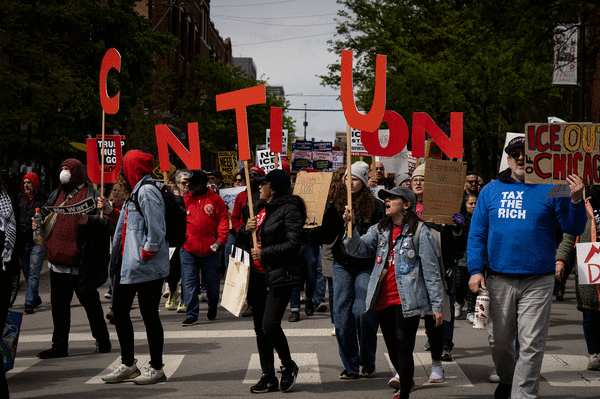
Forming, and maintaining, a union is not like the video clips on television, with protesters beating drums, chanting slogans, and raising clenched fists in solidarity! That’s all theater. It is, instead, an often messy, ongoing endeavor. However, if successful, the rewards will be there, but then you must work together to protect them.
And by the way, I passed my father’s quiz and got my bike.
And I made sure no one took it away from me.
____
John Vukmirovich is a Chicago-area writer and book reviewer.
___
©2026 Chicago Tribune. Visit at chicagotribune.com. Distributed by Tribune Content Agency, LLC.

















































Comments