Anita Chabria: What the primary chaos says about California Democrats
Published in Op Eds
The first rule of a primary election is: Don't make too much of the results.
The intrepid folks who bother to cast a ballot in these first-round races are largely a group of engaged voters, and drawing conclusions from such a narrow minority is a losing game.
So however the final June results tally out, the lessons learned won't easily translate to the larger electorate that will almost surely show up in November. But if this election doesn't tell us much about what fall voters will do, it does tell us something about the Democratic Party that dominates this state: It's chaotic, to put it gently. And no, that's not entirely the fault of the "jungle" primary.
Traditional rules seem to have broken down (not a bad thing) and new ones haven't yet emerged. The old guard has lost control, and maybe vision, and the result is more candidates willing to sidestep seniority and a wait-your-turn mentality to try their luck — especially younger progressives.
Sometimes that chutzpah works, sometimes it doesn't, but it's a mirror of the national trend of Democratic infighting and a glimpse into just how fragmented the party has become as it tries to figure out who it stands for and who it supports before the 2028 presidential election.
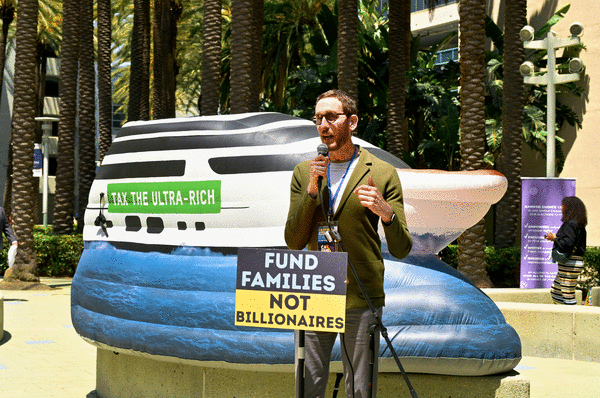
"I feel like I'm definitely running against major institutional forces, but that's how it is," state Sen. Scott Wiener told me recently. "At times we see sort of a little bit of a fortress mentality, and other perspectives are not welcome, and younger folks, newer voices are not welcome, and and that's a dynamic that plays out in a lot of different places."
Wiener, who could be considered king of the line-jumpers, just took the top spot in the San Francisco-centered race to represent the 11th Congressional District, the seat held by Nancy Pelosi since 1987, when Wiener was 17.
By most accounts, Pelosi and Wiener had a mostly cordial relationship until last year, when he entered the race before she announced her retirement. Though Wiener had been clear for years that he planned such a run when Pelosi stepped down, Pelosi is an icon in the city, beloved by constituents and uncontested as queen of the old guard.
Announcing his campaign before she officially made that decision — or had the chance to choose her successor — sent shock waves through the political firmament. When Pelosi endorsed Supervisor Connie Chan in May, it was seen by many as a sign of her displeasure. Chan, who had struggled to gain traction in the primary, came in second with the Pelosi boost and will face Wiener in November.
Across the state, there were other races with upstart contenders. In Southern California, Jake Levine, a progressive Democrat who served in the Obama White House, took on incumbent Brad Sherman. Sherman, who at 71 has served almost 30 years in Congress, resoundingly beat out Levine by more than 20 points.
In Sacramento, there is Mai Vang, a progressive City Council member, who is challenging Rep. Doris Matsui, another member of the old guard royalty. Vang is in a tie for second place with a Republican contender as remaining votes are counted.
And of course, there is the governor's race itself, which included a field so determined and uncontrollable even before the fiasco of Eric Swalwell's sexual misconduct scandal that the state Democratic Party started putting out its own polling in a seeming bid to convince some blue contenders to drop out. It didn't work. Notably, progressive Katie Porter and moderate San José Mayor Matt Mahan stuck in until the bitter end. But old guard candidate Xavier Becerra came out on top.
If these races have a lesson, it's that different Democratic voters want different things, but the party hasn't figured out how to embrace that other than offering up the moderate middle ground.
"This is a big question to this Democratic establishment, about how big of a tent they want to build," said Irene Kao of Courage California, a progressive advocacy organization.
She said that it "bodes well" that so many strong progressive challengers came out for the primary, because it allows a chance for candidates outside the party power structure to find an audience with voters, even if they are ultimately unsuccessful.
And where voters go, the party will eventually be forced to follow. That doesn't necessarily mean a more progressive Democratic Party, but it likely means a more inclusive one if they want to lure the kind of low-information and low-propensity voters who make or break a general election.
"People are sick of the games, and sick of people trying to just maneuver things to get their own person in," Wiener said. "People want to have choices."
©2026 Los Angeles Times. Visit at latimes.com. Distributed by Tribune Content Agency, LLC.



















































Comments