Andreas Kluth: The war powers resolution is working -- even if it fails
Published in Op Eds
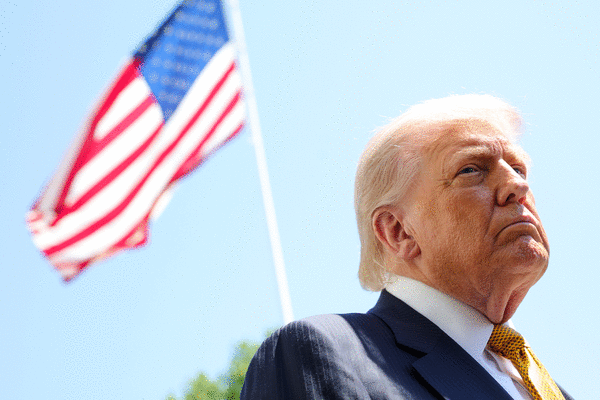
Donald Trump may pretend that he finds the quagmire he caused in the Middle East “very boring.” But even accounting for his notoriously short attention span, I find it more plausible that the president is starting to panic, as three realities start to sink in. First, he’s losing the ability to declare victory and walk away from his war against Iran, since the adversary clearly doesn’t feel defeated. Second, he’s losing ordinary Americans, who hate being at war, and not only because they’re paying so much at the pump. And third, he’s losing Congress.
That last insight must come as a shock to a president who until recently viewed the legislature, controlled by his own party, roughly as North Korea’s Kim Jong Un or Russia’s Vladimir Putin regard their rubber-stamp parliaments. But last week’s concurrent resolution in the House of Representatives, which is now headed for the Senate, signaled a different direction. Passed with four Republicans joining the Democrats, it “directs the President to remove U.S. Armed Forces from hostilities against Iran unless explicitly authorized.”
The resolution won’t actually coerce Trump to withdraw. Even if the Senate (which is cooking up a similar measure) adopts the House version, a concurrent resolution merely expresses the sentiment of Congress. It doesn’t have the force of law. To be binding, it would have to follow the usual legislative process, which requires a signature by the president or — since he won’t give it — two-thirds supermajorities in both chambers to override his veto. That’s hard to imagine for the rest of Trump’s term, even if Democrats win big in the November midterms. But all of that doesn’t matter so much.
What matters politically, Senator Jack Reed told me, is that the trend of the various antiwar resolutions is “already putting pressure on” Trump. Through successive attempts to constrain his war-waging — which started last fall when the administration began striking civilian boats in the Caribbean and eastern Pacific — “we’ve gradually accumulated more and more Republican colleagues, and that’s sending a strong signal to the president that if he keeps this up, at some point we’ll get this thing passed.”
Reed, the top Democrat on the Senate Armed Services Committee, is among many legislators — practically all Democrats and several Republicans — who regret that “we have not vigorously insisted upon our constitutional responsibilities. I mean, one of our responsibilities is to confirm nominations, [and yet] we confirm people who are clearly not qualified.” Just look at Trump’s cabinet. But the mother of congressional prerogatives (enshrined in Article I, Section 8, Clause 11 of the Constitution) is the power to declare war.
The last time Congress made use of this enumerated power was 1942. Since then, America has waged plenty of other wars in all but name, with presidents liberally interpreting their role as commanders-in-chief (also mentioned in the Constitution). By the time of the Vietnam non-War, though, Congress had enough: It adopted (over the veto of President Richard Nixon) the War Powers Resolution, which requires presidents to notify Congress when hostilities start, and then gives them 60 days to seek congressional authorization. Without it, troops must be withdrawn.
All administrations since, of both parties, have questioned whether the War Powers Resolution is constitutional. In practice, though, all presidents have felt politically constrained by it. For example, when George W. Bush went to war in Iraq and Afghanistan (the two “forever wars” that Trump and much of his cabinet spent so much time condemning), he first sought and received “authorizations for use of military force” from Congress.
Since starting the Iran war on Feb. 28, the Trump administration has consistently contradicted itself, arguing that it doesn’t need congressional approval while also signaling that it doesn’t want to run too afoul of the War Powers Resolution. It did notify Congress after Operation Epic Fury began. It then, implausibly, argued that the war was “terminated” in early April with the ceasefire, to avoid triggering the 60-day deadline of the War Powers Resolution (which expired on May 1).
Call this “phoney war” whatever you want, but it is hardly terminated. The “ceasefires,” in the Gulf and in Lebanon, show little ceasing and much firing. Trump keeps promising a “memorandum of understanding,” but simultaneously signals that the war could turn hot and big again at any moment. And yet he is now scared of that scenario. It seems to me that he understands that he’s trapped.
One sign that he worries about the trend in Congress is an idea the administration is reportedly hatching in case it wants to resume full-bore war in the Gulf. In that case, it would use a new code name: Instead of continuing Epic Fury, it would be starting Sledgehammer. (Who in the White House comes up with these names, the social-media meme crew?) You can then expect the administration to argue this is an entirely new war, with a new 60-day window. How risible.
And how desperate. The White House has noticed that Congress has subtly changed course: away from gradually becoming a rubber-stamp parliament and back toward being a robust check on executive power, as the founders envisioned and as King Charles III so slyly reminded Congress the other day. Also last week, the House passed an aid package to Ukraine, which Trump opposes, after 18 Republicans broke with their party and joined Democrats. Trump must know that he can no longer indulge his wildest ideas — to leave NATO or seize Greenland, say — unopposed.
Gregory Meeks, the ranking member of the House Foreign Affairs Committee and leader behind both the Iran and the Ukraine measures, proclaimed a “significant turning point,” a signal that if Trump “won’t clean up his own mess, Congress will.” That is too optimistic. But something big did happen. It’s that one of the world’s most vaunted legislatures, in limbo for more than a year, has pointed its bow away from Pyongyang and back toward Philadelphia.
____
This column reflects the personal views of the author and does not necessarily reflect the opinion of the editorial board or Bloomberg LP and its owners.
Andreas Kluth is a Bloomberg Opinion columnist covering US diplomacy, national security and geopolitics. Previously, he was editor-in-chief of Handelsblatt Global and a writer for the Economist.
©2026 Bloomberg L.P. Visit bloomberg.com/opinion. Distributed by Tribune Content Agency, LLC.





















































Comments