
White to Play
Published in Chess Puzzles
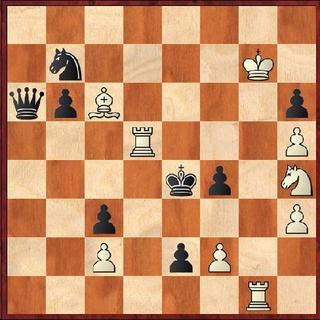
Here’s a tough Friday problem from that fellow Grimshaw again, and again from the Illustrated London News from 1854.
Solution:
As we’ve mentioned before, you have to look for functions of all the pieces. Two things should catch your eye: the two rooks. It’s pretty obvious that the rook on d5 at some point will discover check, but the rook on g1 is a bit of a mystery. What’s it doing there? Another question is what the knight is up to. Is it just to attack escape squares? Initial discovered checks are out in 99% of problems. Wouldn’t be subtle as far as our composers are concerned. So, you look for that mystery rook’s move or a knight move. Maybe the king., but that’s about it. It’s often process of elimination. You must also remember that the problemist is looking for a move that will startle you, like Qg8 in the previous problem. What candidate move(s) might do that here? Our bet would be 1.Rf1 or 1.Rd1. That’s when you might notice something about 1.Rf1:
1.Rf1 exf1=Q [1...exf1=N 2.Nf3 Ne3 (2...Nc5 3.Rxc5#) 3.Re5#; 1...exf1=B 2.Nf3 Bb5 3.Rxb5#] 2.Nf3 Kxf3 [2...Qxf2 3.Re5#] 3.Rd2# The knight’s role was to support a rook mate at d4 or e5, and if it were taken the discovered check would create the mate. Why the rook move to f1? To have the Black pawn take the rook so when White moves down to d2 with the other rook the absence of the Black e-pawn allows f2 to be defended! What happens if Black doesn’t cooperate with 2…exf1? Then, a whole variety of new functions for pieces and the pawn pop up: 1.Rf1 Qc4 [1...Nd8 2.f3+ Ke3 3.Ng2#; 1...f3 2.Rg1 e1Q 3.Rg4#; 1...Qd3 2.cxd3#; 1...e1Q 2.Rd3+ Ke5 3.Rxe1#] 2.f3+ Ke3 3.Nf5# That’s why I am in awe of these composers. What a thing to create!
Send questions and comments to PTamburro@aol.com.






Comments