
White to Play
Published in Chess Puzzles
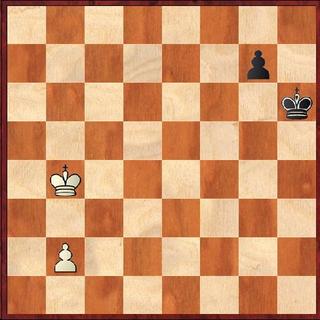
As we mentioned we’re going to spend some time on endgame play in the hopes you may learn some valuable lessons. Interestingly enough, some of the toughest endgames are often king and pawn vs. king and pawn. There’s not much on the board, but a lot of thinking needs to go on. This position is an introduction to that type of endgame, and we’ll look at it more deeply next week. So, how would you win this endgame? Can you figure it all out in your head? Counting the number of moves to promotion helps your decision making.
Solution:
This is a composition by O. Duras, a grandmaster as well. First things first: if you picked 1.Kc4 or 1.Kc3, those moves only draw. For example, 1.Kc4 Kg6 2.b4 Kf6 3.b5 Ke6 4.b6 Kd7. The winning method takes some thought: 1.Kc5 g5 [1...Kg6 2.b4 Kf7 3.b5 Ke7 4.Kc6! (Not 4.b6 Kd7 5.Kb5 Kc8 6.Kc6 Kb8 and draws) 4...Kd8 5.Kb7 g5 6.Ka7 g4 7.b6 g3 8.b7 g2 9.b8=Q+ and wins] 2.b4 g4 3.Kd4! [White can actually lose if he pushes too quickly: 3.b5 g3 4.b6 g2 5.b7 g1Q+ 6.Kc6 Qg3] 3...Kg5 4.b5 g3 5.Ke3 Kg4 6.b6 Kh3 7.b7 g2 8.Kf2 Kh2 9.b8Q+ Kh3 10.Qg3# Note that it was a combination of king and pawn moves that got the win. You have to calculate how fast you can get to the other guy’s pawn as well as calculating how fast he can get to yours.
Send questions and comments to PTamburro@aol.com.





Comments