
White to Play
Published in Chess Puzzles
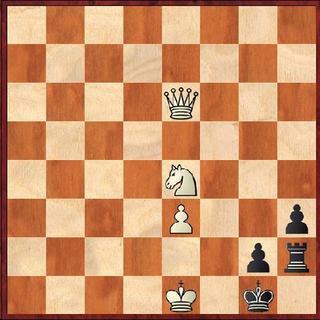
When I visit the Metropolitan Museum of Art in New York City, I am in awe of the magnificent works of art displayed there. I once told a chair of a university art department that my definition of art was, “If I can do it, it isn’t art.” Well, I can’t compose problems, either! They are truly art. I can’t even solve most of them! However, it gives me great aesthetic pleasure to give them a try, see the solution and then play through it noticing how each chess piece and pawn is there for a reason. I learn, too, some interesting ideas that every now and then become helpful over the board. For the next few days, you will get to try your hand at three-movers, noticeably tougher than two-movers. You might just get this first example, a mate in three composed by Chocholous and Dobrusky over a hundred years ago.
Solution:
White basically forces Black to move and even allows a discovered check and promotion to a queen in one of the variations. The problem does have a slight flaw in that White has two other ways to mate after 1…Kf1, but it does not take away from the creative thought of just playing 1.Kd2 1.Kd2 Rh1 [1...Kh1 2.Qc6 g1Q+ 3.Nf2#; 1...Kf1 2.Qf6+ (2.Qc4+ Kg1 3.Qc1#; 2.Qa6+ Kg1 3.Qa1#) 2...Kg1 3.Qa1#] 2.Qe5 h2 3.Qa1#
Send questions and comments to PTamburro@aol.com.






Comments