Cook County property tax bills will again be late, official says
Published in News & Features
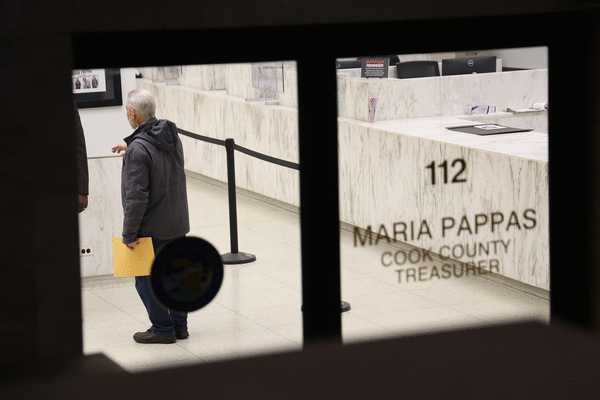
CHICAGO — Property tax bills will be roughly two months late this year, Cook County Board President Toni Preckwinkle said Tuesday, confirming the county’s long-running tax debacle will continue to stress homeowners and the public agencies like schools and libraries that rely on the money.
In an attempt to head off further uproar from various local government leaders, Preckwinkle announced Tuesday she is again setting aside $300 million to loan to local governments to help them balance their budgets and pay their employees. Unlike past years, she’s broadened eligibility rules for her bridge loan program to make sure more districts can qualify.
“This bridge fund gives schools, libraries, parks, fire districts and other local governments a short-term tool to keep serving residents while we continue the deeper work of fixing a fragmented property tax system,” Preckwinkle said in a release.
Applications open July 20 so that local governments have time to plan, and the county said it would “provide additional program guidance” throughout the process this year.
Only suburban taxing districts that rely on property taxes for 50% or more of their total governmental revenues are eligible, though “disinvested communities that do not meet the first criteria will be offered additional consideration,” the county said.
Amy Franco, executive director of the Hillside Public Library, has joined other library executives and a coalition of school district leaders in pressing county officials about the impact of delays. She told the Tribune in an email that Preckwinkle’s plan was welcome news.
Though the loans “are not a substitute for timely tax distributions and reliable reporting systems, expanding access provides an important safety net for libraries facing financial uncertainty,” Franco said.
While summer bills are typically mailed in July and due at the start of August, county officials already forecast their pessimism about hitting that deadline earlier this spring. The regular mailing cycle has been in flux in recent years thanks to the pandemic, a troublesome upgrade to the county’s property tax system, and setbacks in individual offices.
Under a two month delay, bills would be mailed in September and due at the start of October. The release did not give an exact date when bills would be posted.
Delayed receipts have been a top concern for local taxing bodies like schools, park districts, and suburban municipalities in recent tax cycles. In past years, Preckwinkle has rolled out the short-term, zero-interest bridge loans to help some taxing bodies get by until property tax receipts come through, but few have qualified — or applied in the first place — because districts either had cash reserves or bond ratings that were too high.
Districts with budgets that rely heavily on property tax receipts grew increasingly cash-strapped late last year, when distributions were months later than usual. It led to a groundswell of complaints from school and library leaders in particular, who were forced to take out their own loans, cash out investments or take money out of reserve funds. Schools alone estimated it cost them roughly $120 million.
Tuesday’s announcement about the late bills and the revamped bridge loan program came one day before library and school officials are scheduled to testify at a scheduled county hearing about “the adverse effects of delayed property tax bills and revenue disbursements.”
That includes continued confusion about the late — and sometimes inaccurate — payments that district leaders found in their bank accounts.
Several library districts are grappling with over- and under-distribution of property tax receipts. That includes Roselle’s public library district, which received 117% of what it levied this year, according to data compiled by a coalition of library officials earlier this month. Northlake, Glencoe, Palos Heights, Schaumburg and Palatine library districts also received between .29% and 13.2% more than they levied for the 2024 tax year.
The irregular cash flow, school and library leaders said, will distort their financial reports and has fueled mistrust about how the county is ultimately keeping track of where taxpayer money ends up. The county’s annual audit due later this month is expected to shed some light on where collections and distributions ultimately landed last year.
The problems have led to political infighting across the county. Leaders of local property tax offices pointed fingers at each other ahead of the spring primary elections, while the heads of local school and library districts previously told the Tribune they felt they were being left in the dark, unable to answer key fiscal questions from frustrated constituents or board members.
Erin Murphy, the superintendent of West Northfield School District 31 and one of many school district leaders raising alarms about the costs of delays in recent months, said she was still frustrated the payments won’t be on time, but thanked Preckwinkle’s office for listening “to our stories and engaging around possible solutions.”
Her district borrowed last fall and winter to weather late payments. She said the revamped bridge loan “provides a glimmer of hope in the face of continued delays.”
____
©2026 Chicago Tribune. Visit at chicagotribune.com. Distributed by Tribune Content Agency, LLC.





Comments