'Broadview Six' grand jury transcripts released showing alleged misconduct by prosecutors
Published in News & Features

CHICAGO — After failing to secure an indictment in the “Broadview Six” case last October, federal prosecutors tried again a week later but ran into immediate skepticism from some members of the panel, according to transcripts of the proceedings made public Tuesday.
One grand juror repeatedly pressed prosecutors on whether they could keep coming back for “unlimited tries” even when charges had been rejected, and asked if there was any new evidence that would be presented in the new session.
“Okay. I’m feeling the skepticism already,” Assistant U.S. Attorney Sheri Mecklenburg said, according to the transcript of the Oct. 16 proceedings. “Are you going to be able to listen with an open mind? Tell me the truth.”
The grand juror said no — and then added something even more startling.
“I heard this case like last week and I thought it was a crock of (expletive) then and I still think it is,” the grand juror said, according to the transcript.
“Okay. Thank you for your opinion for everybody,” Mecklenburg replied. “I kind of had that impression from last week, but thank you…If you feel that you can’t be (impartial), then excuse yourself.”
Mecklenburg then proceeded to have the foreperson count the remaining members of the panel to make sure they had 16, according to the transcript. The session continued with testimony from witnesses, though no indictment was returned that day, either.
A week later, on Oct. 23, U.S. Attorney Andrew Boutros went before the same grand jury, introduced himself as the U.S. attorney, and told the panel they had an important “constitutional” function to play in the judicial system, according to a transcript provided in an unusual report released by Boutros last week.
Boutros also said “setting aside your emotions, setting aside your personal views, beliefs and biases” was very important, according to a transcript provided in Boutros’ report.
Hours later, Mecklenburg began yet another grand jury session with a “mea culpa,” telling the jurors that she had conversations with two of their colleagues on the panel grand jurors outside the jury room, the transcripts show.
“I’m the one who knows the rules, and I did something today that I’m not supposed to do,” Mecklenburg said, according to the transcript.
In one instance, she said, a juror apologized to her in the elevator in connection with something that happened during the prior week.
“I told the Grand Juror that I accepted his apology. I wasn’t mad. I understand people have feelings,” Mecklenburg said. “The Grand Juror said at that time that he did have feelings, and he’s sure that he’s right, but he shouldn’t have walked out the way he did.”
She said that the second instance was a “brief conversation” with a juror who also apologized for interactions in the prior week.
“I was up here and somebody — one of the Grand Jurors said to me something about last week. And he said, “I’m sorry. I under- — I can apply the facts to the law. I understand that people have feelings, but we have to apply the facts to the law.”
Mecklenburg continued: “And I said, ‘That’s true. That’s exactly what we’re asking you to do,’ something like that, to the best of my recollection.”
She told the jurors it’s difficult to not respond when someone speaks.
“I won’t do that again,” she said. “If I see you and I don’t — and I just say, ‘Hello, how’s the weather,’ you will understand it’s nothing personal.”
The transcripts released Tuesday detail alleged misconduct by federal prosecutors in the “Broadview Six” case against Operation Midway Blitz protesters, which collapsed in dramatic fashion in court last month.
U.S. District Judge April Perry said in a court hearing Tuesday morning she would issue an order later in the day making most of the transcripts public, though she’s holding off on certain testimony from an FBI agent that is essentially a one-sided account supporting allegations that no longer exist.
“These charges have been dismissed. They aren’t coming back,” Perry said. “The FBI agent is laying out the government’s case against you… if that is released it will be out in the world forever.”
But the rest of the transcripts will be released Tuesday, shining a rare light on what is typically a secretive process, where prosecutors get to present evidence to a panel of ordinary citizens and seek charges without defense attorneys or a judge present.
The release comes three weeks after the Broadview Six case imploded on the eve of trial, with Perry describing “shocking” misconduct by the prosecutor who led the sessions and a misguided attempt to keep the issues from her attention.
Before two separate grand juries last year, Mecklenburg repeatedly stepped over the line, including “vouching” about the strength of the evidence, removing panel members who disagreed with the prosecution’s theory of the case, and having “ex parte” communications with a grand juror outside the proceedings, Perry said in court last month.
“Your sole goal is to do justice,” Perry told prosecutors. “Your client is justice itself. I do believe deeply in the presumption of regularity and that most government attorneys are doing the best they can to do the right thing. That trust has been broken.”
According to court records, the first grand jury refused to return an indictment, leading to the panel being convened on Oct. 16. That session ended abruptly after jurors were kicked off, and no vote was taken, according to Perry’s description of the events.
Word of the discord reached Boutros’ leadership team, prompting his exremely unusual appearance before the panel on Oct. 23.
“And just simply as I like to say, calling balls and strikes,” Boutros told the grand jurors that morning, according to transcripts made public by his office. “You’re the umpire and you can’t come in and be an umpire in favor of (a) particular team. You gotta call balls and strikes and that’s all we ask. But we also recognize that these are trying times, these are emotional times. You can’t help but turn on the news, read the newspapers, or for those of you who use TikTok and Instagram, and there’s stuff in there all the time.”
Boutros then said that if anyone was “struggling with a certain type of cases, such as the immigration cases” where they did not believe they could be objective, “I would ask that you raise your hand and identify yourself, because we have a different procedure for that.”
“Fairness is the key to the operation of our system,” Boutros continued, according to the transcript. “So is there anyone here who thinks that he or she cannot be fair, cannot be open-minded, cannot receive evidence, cannot set aside their personal feelings on any case, immigration or otherwise, child exploitation, immigration, whatever it is. Anyone who thinks they can’t do it, please raise your hand.”
According to the transcript, no one raised their hand, and after a few more general remarks, Boutros left the room.
That grand jury eventually returned a felony indictment alleging the six defendants conspired to impede an agent.
The transcripts detail just how fraught the prosecution’s case against the Broadview Six was even in the grand jury stage, where prosecutors only have to meet a relatively low “probable cause” threshold to secure an indictment and grand juries almost always vote in lockstep in the government’s favor.
The case has been beset by controversy from the moment the indictment was brought in October as the defense alleged the case was brought amid pressure from the administration of President Donald Trump and was nothing more than an attempt to silence protesters of the president’s immigration policies.
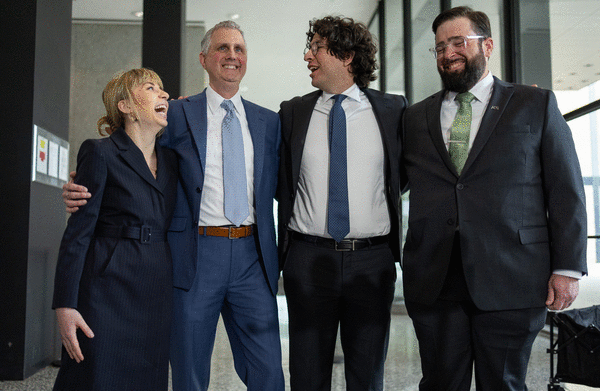
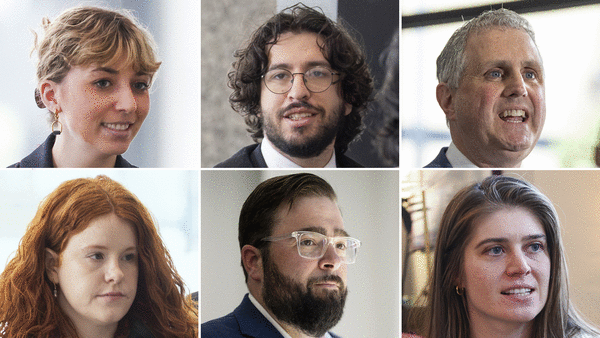
Charged in the case were: Katherine “Kat” Abughazaleh, 27, who came in second in the March Democratic primary for Illinois’ 9th District congressional seat; Andre Martin, 27, who was Abughazaleh’s campaign manager; Michael Rabbit, 62, a 45th Ward Democratic committeeman; Brian Straw, 36, a Democratic trustee in Oak Park; Catherine Sharp, a onetime candidate for the Cook County Board, and Joselyn Walsh, a part-time garden store worker and singer.
Prosecutors had alleged the defendants were part of a group that surrounded an ICE vehicle outside the Broadview facility during a Sept. 26 protest and “banged aggressively” on the vehicle’s side and back windows, hood and doors before they “crowded together in the front and side of the Government Vehicle and pushed against the vehicle to hinder and impede its movement.”
They further alleged that the protesters scratched the vehicle’s body, broke a side mirror and a rear windshield wiper and etched the word “PIG” into the paint — though no one was ever accused of specifically causing that damage.
The case was indicted with much fanfare but soon showed signs of cracking. The original prosecutor who had led the grand jury, Mecklenburg, left the U.S. attorney’s office in February for a job with the U.S. Senate Judiciary Committee in Washington, D.C.
Weeks after she left, all charges against Sharp and Walsh were dismissed. And in April, prosecutors announced the lone felony conspiracy count was also being cut.
As the suddenly low-level case wound its way toward trial, with jury selection set to begin after Memorial Day, Perry whistled prosecutors into court to explain redactions made in the grand jury transcripts that had been given to her, which she said contained “shocking” evidence of misconduct.
The judge said there was a “potential” for “sanctions for prosecutorial misconduct and for potential ethical violations, including lack of candor to the court,” the transcript showed.
In dismissing what was left of the case on May 20, Boutros issued a remarkable and lengthy apology to the court, saying he had only found out about the problems in the grand jury last month and made a quick decision to drop the felony conspiracy charge.
“I will tell your honor that as upset as you are, and have been, I too had not seen conduct like that, and it upset me which is why we did dismiss that indictment,” Boutros said.
Boutros also defended the current prosecution team, saying they believed the redactions initially made in the grand jury materials were complying with Perry’s order to turn over only portions dealing with the instruction on the law.
“No one acted with the intent to mislead your honor, and I think that they were following your order to give the law,” Boutros said.
In his report, Boutros said “the bottom line” was clear that he was only involved with the grand jury in his capacity as its chief legal advisor, not related to any presentation of “facts, evidence, or law.”
____
©2026 Chicago Tribune. Visit at chicagotribune.com. Distributed by Tribune Content Agency, LLC.


Comments