California's slow vote count faces changes as Supreme Court decision on late ballots looms
Published in News & Features
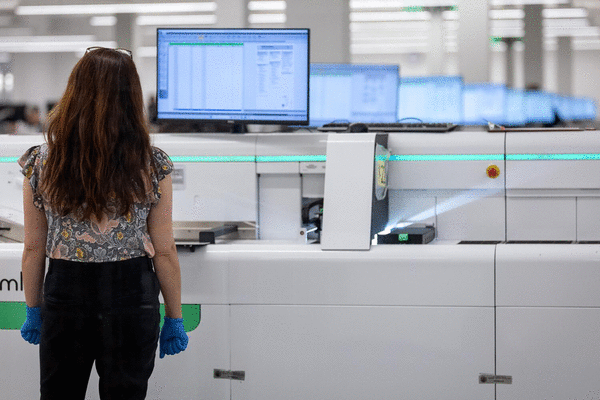
LOS ANGELES — California’s slow vote counting process — still underway and causing friction after last week’s primary — may be forced to change before November’s midterm elections, as the U.S. Supreme Court prepares to rule on whether mail ballots must be received by election day to count.
Whether those changes will speed things up — and help tamp down baseless claims from President Donald Trump and others that the slow count is evidence of fraud — will depend on a variety of factors, election experts said, including how the high court rules, how state lawmakers and local elections officials respond, and whether they push any additional steps to quicken the count.
“We’re all on the edge of our seats, waiting to see what the Supreme Court does,” said Kim Alexander, president of the California Voter Foundation.
“We’re certainly planning for a bad Supreme Court decision in this case, but we don’t really know all of our options for how to respond until we see the court’s decision,” said Assemblymember Gail Pellerin, D-Santa Cruz, chair of the Assembly Elections Committee and a former top elections official in Santa Cruz County.
Pellerin said she has been working on contingency plans with other state officials — including some from the offices of Gov. Gavin Newsom, Secretary of State Shirley Weber and Attorney General Rob Bonta — and has requested $35 million in state funds to educate voters on any new midterm deadlines, though that funding has not been appropriated.
Federal law has, since 1872, set “election day” as the first Tuesday following a Monday in November, and gives Congress oversight over elections for the president and members of Congress. However, most authority for running elections falls to the states.
California currently provides a grace period for ballots to be counted as long as they are postmarked by and received within seven days of election day. More than a dozen states have similar laws that allow for counting late-arriving ballots, and most states accept such mail ballots from members of the military who are stationed overseas.
In March, the nation’s high court heard arguments about a five-day grace period in Mississippi, with the court’s conservative majority appearing skeptical. Many observers expect from those arguments that the high court will rule, by the end of this month, that ballots — at least for federal races — must be received by election day to count.
That outcome — in the case Watson vs. Republican National Committee— is considered likely but not assured, and some elections experts believe the high court has little legal precedent to support such a conclusion.
“That is a bogus interpretation of the statute,” said Rick Hasen, an election law expert and director of the Safeguarding Democracy Project at UCLA Law. “It violates what the statute says as a matter of text and history, and just how it’s been understood since the Civil War basically.”
Hasen and others also doubt that such a change would have much impact on the speed of California’s vote counting process, given that huge volumes of mail ballots that are placed in ballot drop boxes or arrive at processing facilities on or just before election day would still count — and would still drag the counting process out for days after the election.
In 2024, California counted more than 406,000 late-arriving mail ballots, but they represented only about 2.5% of the statewide total.
“The main bottleneck is really not ballots that arrive after election day. The bottleneck is ballots arriving before or on election day,” Hasen said. “So I don’t think the Watson case — however it comes out — is going to appreciably change California’s timing on when they’ll get enough ballots counted in a close race for it to be able to be called by news organizations.”
Nonetheless, state and local elections officials are preparing for changes — and looking for other ways to speed up the vote count, which, as of Monday, had resulted in more than 7.7 million ballots counted from last week’s primary, but more than 1.7 million left to process.
State plans unclear
If the Supreme Court were to rule that votes cast in federal elections must be received by election day, California would need to respond quickly.
It would need to craft a messaging campaign to inform millions of voters of the new rules, and determine when to tell voters they must mail their ballots by in order for their votes to count, experts said. That calculation may be shaped in part by efforts by the Trump administration to assert federal control over the mail ballot process through the U.S. Postal Service, which California and other states are fighting in court.
California officials may also need to determine whether they will create a “bifurcated counting process” with different rules for primary and general elections and different rules for federal races and state and local races on the same ballots, Alexander said, as a narrow Supreme Court ruling may not apply to them all equally.
“That’s a big policy decision that lawmakers will need to make, and I’m not sure how that would go,” Alexander said, citing a lack of detailed public plans from state and local elections officials.
Weber — who urged voters to cast ballots early in last week’s election — did not respond to a request for comment.
Brandon Richards, a spokesperson for Newsom, said the governor’s office doesn’t comment on “hypotheticals,” but that Newsom “is planning for all eventualities, including but not limited to attacks on our democracy and disruptions in our elections.”
Bonta’s office said it is “in communication with election officials and actively preparing for the possibility that the U.S. Supreme Court could require changes to California’s election procedures,” but that it could not provide details.
Dean Logan, head of the L.A. County Registrar-Recorder/County Clerk’s office, said he was “not in a position to discuss specific contingency planning details” given the high court has yet to rule, but that his office “is closely monitoring the case and has begun evaluating potential impacts to election administration.”
If changes are required by the court, Logan said his office “is prepared to undertake a comprehensive voter education and outreach effort to ensure voters understand any new requirements, deadlines, or voting options,” which would be “multilingual, multi-channel, and designed to reach voters directly across Los Angeles County, particularly in communities that rely heavily on voting by mail and those that have historically done so.”
Funds needed for faster count
Alexander’s group has backed Pellerin’s request for $35 million for a marketing campaign to encourage voters to send midterm ballots in early, and advocated for another $55 million in state funding to support county efforts to build up their vote processing capabilities.
H.D. Palmer, a spokesperson for the California Department of Finance, said it would be “premature” to comment on those requests, but “discussions have been underway and are continuing.”
Both Alexander and Hasen said California should be investing more in its ballot processing capabilities even if the current process is fair and secure and the claims of fraud are baseless, because those claims have succeeded in diminishing trust.
“On the one hand, this is a manufactured crisis. There is nothing that is intrinsically bad about a slow count for a race,” Hasen said. “On the other hand, we live in an era of profound distrust in institutions and in the integrity of elections, in no small part because of Donald Trump.”
In 2012, slightly over half of all California votes were cast via mail ballots. However, that number has increased dramatically since, thanks in part to an expansion during the COVID-19 pandemic, and nearly 89% of ballots were cast by mail in last year’s special election.
Alexander said that throughout that same period, California lawmakers have passed new laws to expand access to the ballot but have not provided counties with the necessary funding to keep up with the volume — meaning “counties are left holding the bag.”
Alexander said California should fix that by providing consistent state funding for new ballot counting machines, more modern and efficient county processing facilities, and an expansion of a program backed by Pellerin and available in some counties already that allows voters dropping off ballot envelopes in person to essentially convert those ballots into in-person votes on the spot — which Alexander called a “hybrid” option that saves counties a huge amount of processing time.
She said the state spent millions to educate voters on new COVID-related vote-by-mail protocols and deadlines in 2020, and it led to both record turnout and a faster count — proving access and speed are not mutually exclusive.
“We’re being asked to make a false choice,” Alexander said. “It is possible to have accessible, secure, reliable and verified elections, and also an accelerated vote count.”
_____
Times staff writer David G. Savage in Washington contributed to this report.
_____
©2026 Los Angeles Times. Visit at latimes.com. Distributed by Tribune Content Agency, LLC.





Comments