Peru's diaspora emerges as tie-breaker in razor-edge presidential race
Published in News & Features
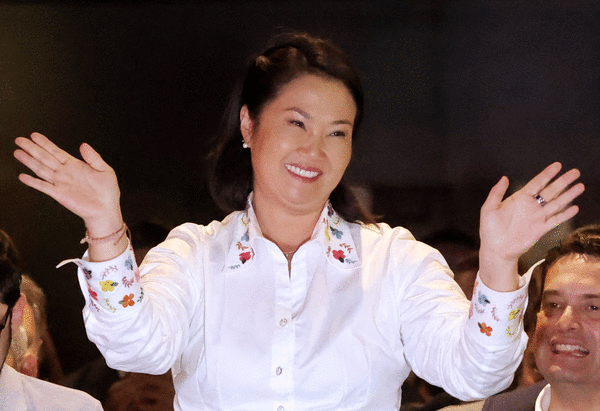
LIMA, Peru — Peru’s presidential election is so tight that it’ll likely be citizens abroad, rather than those from within the country, who will break the tie.
Leftist candidate Roberto Sánchez is leading the race with 50.06% of the votes, while three-time runner-up Keiko Fujimori has 49.94%. That’s a difference of just over 20,000 votes with nearly 96% of ballots counted.
Peru’s dollar bonds extended gains on Tuesday, and the sol jumped 3%, marking the biggest intraday gain since 2021 and outperforming emerging-market peers, according to indicative pricing data compiled by Bloomberg. Shares of Credicorp Ltd., Peru’s largest financial services conglomerate, jumped as much as 14%, the biggest intraday gain since 2020.
It’s become almost a norm that in the South American nation of 34 million people just tens of thousands of votes can determine the president — even if this year may yield the tightest race of all. In 2016, conservative Fujimori lost to Pedro Pablo Kuczynski by just 41,000 votes. In 2021, she again fell short by 44,000 ballots against hard-left former President Pedro Castillo, after whom Sánchez has modeled himself.
Experts and investors believe the diaspora vote is likely to ultimately decide the winner, with a chance that results flip and Fujimori emerges on top. Voting abroad is not mandatory, but in recent elections about 300,000 Peruvians abroad cast valid votes, typically leaning toward right-wing candidates.
“What remains to be counted is mostly in Keiko’s favor,” said Gonzalo Banda, political analyst at University College London. Particularly the overseas vote, he said, “could end up tipping the balance.”
Alberto Arispe, head of Peruvian brokerage Kallpa SAB, said that’s exactly what the market is betting on.
“The market assumes that once overseas votes are counted, Keiko Fujimori will win the election,” Arispe said. “That’s the market speculation.”
Authorities don’t expect official results until July.
Diaspora count
Inside Peru, where voting is mandatory, most of the ballots that have yet to be counted come from the country’s poorer, rural regions, and are more likely to favor Sánchez. Still, Fujimori has solid pockets of support in the Amazon.
There are also ballots in dispute that could represent roughly half a million votes. Most are from Lima, where Fujimori holds over 60% support.
Peru’s diaspora makes up about 4.4% of the country’s total electorate, mainly in the U.S., Spain and Argentina, according to government data. Just more than 30% of their ballots have been counted so far.
The overseas vote “could be crucial,” said Juan Pablo Sims, a political scientist at Universidad del Desarrollo in Chile.
Those “still left to be counted are the slowest to come in,” he said. “That creates a great deal of uncertainty.”
Peruvians abroad usually move in step with Lima, one of Fujimori’s strongholds. In the 2021 runoff, Fujimori won nearly two-thirds of the vote in both groups: 64.6% in the capital and 66.2% abroad. That means Sánchez would need to wipe out her lead domestically in order to offset the roughly 100,000 vote advantage that experts expect her to gain from the overseas vote.
In April’s first-round election, the international vote gave ultraconservative former Lima Mayor Rafael López Aliaga a 25% lead in that bloc among more than 30 candidates. Fujimori came second with 17%, while Sánchez came in eighth place with just 2.6%.
“I would be surprised if Sánchez holds on,” Banda said. “It would take a catastrophe in Keiko’s overseas vote for that to happen.”
_____
With assistance from Antonia Mufarech, Marcelo Rochabrún and Zijia Song.
_____
©2026 Bloomberg L.P. Visit bloomberg.com. Distributed by Tribune Content Agency, LLC.






Comments