Minnesota scientists are unraveling the mystery behind the state's walleye strains
Published in News & Features
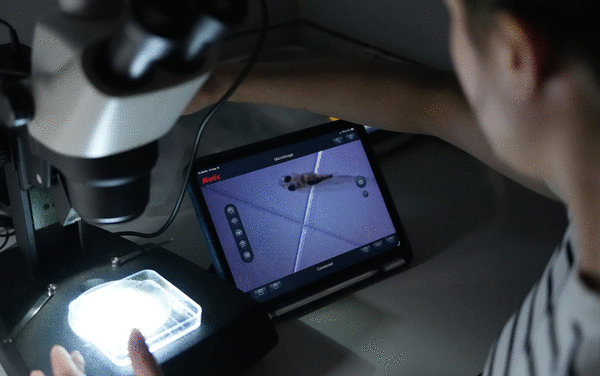
Working in a darkened laboratory, Laurel Sacco dips a cup into a large tank of water and scoops up dozens of young walleye. She pours one into a petri dish and examines it under a microscope.
The fry has been harvested from Pine River near the headwaters of the Mississippi River, where the Minnesota Department of Natural Resources has historically sourced most of its walleye eggs. It is mostly translucent in its earliest stages of development. Through the lens, Sacco looks for developmental progress, checking if the fish is able to sustain food in its belly or if its gas bladder has formed.
To the naked eye, the walleye is indistinguishable from those found in other lakes and rivers throughout the state. Yet, there is something in this fish’s genetic code that makes it more likely to die off when placed in a southern lake compared to another batch of walleye, swimming in an adjacent tank and sourced from lakes in southwest Minnesota.
For decades, state geneticists have been trying to unravel what makes one of the strains thrive better in southern Minnesota, said Sacco, doctoral student and Minnesota Aquatic Invasive Species Research Center Graduate Fellow.
When fully grown, the two strains of walleye, known as the Mississippi Headwaters strain and Lower Mississippi strain, look identical and have the same behaviors. Her study, which wraps up next year, would hopefully identify how different water temperatures change each strain’s development.
“We’re looking at things like potential differences in immune function and indicators of stress,” she said.
The experiment — the first to examine these differences under a microscope as the fry develop — builds on decades of observations from southwest Minnesota fisheries.
Part of the study also tests how the different strains grow under varying temperatures to determine which are most likely to survive and thrive in the future.
“The initial idea was to study some of the differences that are between these strains and what that might mean for how different Minnesota walleye might survive under future temperatures,” she said.
When the DNR started stocking walleye, before the turn of the century, staff harvested eggs from northern waterways like Pine River. Access was typically along a river and the eggs were easier to harvest, said Ryan Doorenbos, area fisheries supervisor at the DNR office in Windom.
From there, the eggs would be shipped to hatcheries in southern Minnesota, where the walleye would hatch and later be released into various waterways. Every year, they repeated that cycle. Then, in the 2010s, DNR staff realized through continuous observations and studies that walleye eggs that were harvested in southern waters end up doing better than walleye eggs collected from up north once they were released into southern lakes.
Today researchers have identified eight different strains of walleye in Minnesota.
“We were throwing all kinds of different walleye strains in the southern part of Minnesota,” he said. “It was viewed as a sort of dumping ground ... The main reason was because we were viewed as an area of the state where we probably didn’t have a lot of natural reproduction of walleye.”
There were a few exceptions. Lake Sarah in Murray County, about an hour north of Worthington, was one of them. The walleye there were thriving and naturally reproducing, so much so the lake didn’t need stocking for more than 30 years.
“We did evaluations on Lake Sarah and other southern lakes and they all came back with this persistence of this similar genetic makeup despite us not having stocked some of these lakes for more than 30 years,” he said.
Since changing the source of the walleye eggs in southern Minnesota, the DNR over time has halved the amount of fry stock going into lakes, Doorenbos said. Lake Okabena, for example, received 750,000 fry every other year in the 2000s. Now, it is stocked with about half that amount because natural reproduction makes up the difference, he said.
“We found that we can actually reduce the density of stocking of walleye fry that we have normally done,” he said.
Though there are many different strains of walleye in the state, Sacco’s research focuses on two distinct strains that are reared in hatcheries. Those two are naturally separated by St. Anthony Falls, which is an upstream barrier, said Loren Miller, research scientist at the DNR.
The observational theory, that one strain does better than the other in southern waters, was put to the test by the DNR in a five-year study that ended in 2022.
In it, staff released both strains into various southwest Minnesota lakes in the spring and then counted the number of walleye they could find in the fall. The results were staggering.
In Lake Okabena in 2022, for example, they counted 149 southern strain walleye compared to 30 northern strain.
Researchers also found that the differences that may give one strain an advantage over the other can occur within the first five months of a walleye’s life. While researchers weren’t sure what the difference was, they believed it gave the southern strain the ability to consume more and have a reduced susceptibility to predation.
The study also found that it cost $3,985 to stock the southern strain compared to $2,291 for the northern strain.
Harvesting the southern strain requires setting out nets in lakes and requires more effort than harvesting along Pine River where the fish can be caught going up river, Miller said.
“The real cost is the labor intensity of getting enough fish from smaller runs,” he said.
Although they cost more, the southern fish are more likely to survive to adulthood and reproduce naturally, ultimately reducing the overall cost of stocking them, Miller said.
“If you get your eggs from within a major watershed and use those to put in other lakes in that watershed, they’re probably going to better adapt for survival reproduction,” Miller said.
Sacco is hoping her research can help fisheries continue to improve their operations. She plans to collect tissue samples from the fish to study how their immune systems and genes respond to stress, clues that could eventually help managers decide which strains are most resilient as Minnesota’s lakes continue to warm.
“The head and kidney tissues are really important to see immune function [under] stress,” she said. “We’re going to be looking at what genes were turned off and on in those tissues.”
_____
©2026 The Minnesota Star Tribune. Visit startribune.com. Distributed by Tribune Content Agency, LLC






Comments