Haiti's World Cup team trains in Florida, proud to be back after 52 years
Published in News & Features
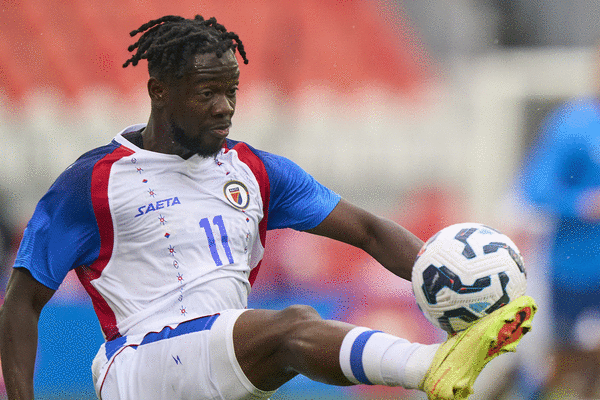
Duke Lecroix has never set foot in Haiti, but every time the 32-year-old New Jersey-born defender pulls that blue-and-red national team shirt over his head, his heart swells with pride and he vows to bring joy to the soccer-loving people of the impoverished island ravaged by gang violence and political instability.
When Haiti’s World Cup team lines up for the national anthem in Boston on June 13 ahead of its opening game against Scotland, Lecroix suspects he and his teammates will be overcome with emotion, just as they were on Nov. 18, 2025, when they gathered around a cellphone on a field in Curacao and learned that they had just qualified for the World Cup, the first time for Haiti in 52 years.
The feat was especially remarkable considering the Haitian team did not play a single qualifying match at home because the national stadium, Stade Sylvio Cator, was overtaken by armed gangs in March 2024.
The team last played at home in 2021. All of Haiti’s home matches were moved to neutral sites. No team in World Cup history had qualified without playing a single home game.
Celebrations broke out from Port-au-Prince to South Florida as word got around the Haitian community that The Grenadiers were headed to the World Cup for the first time since 1974.
The Miami Herald spoke with four members of the Haitian World Cup team this week as they packed up and headed to Port St. Lucie, Florida, for a pretournament camp that kicks off Monday and culminates with tune-up games against New Zealand June 2 in Fort Lauderdale and Peru June 5 at Nu Stadium in Miami.
No matter whether the player had never been to Haiti, such as Lecroix, was born in Haiti, such as Louicius Deedson and Carl Fred Sainte, or just visited Haiti, such as Derrick Etienne, their patriotism was undeniable.
“I think sports is a great unifier, and even though I haven’t been to the country, the country is its people, and I’ve spent a lot of time growing up around Haitians, and then in recent months and weeks feeling the support from the Haitian fans everywhere we’ve been, even though we haven’t been able to play any of our home matches on Haitian soil,” said Lecroix, a four-time All-Ivy League honoree at Penn who now plays for the USL team Colorado Springs Switchbacks.
“I even saw some Haitian flags at my games in Colorado.”
Deedson, a 25-year-old winger for FC Dallas, was born in Port-au-Prince and got his start in youth academies in Haiti before leaving for the United States as a teenager. He says although most of the World Cup roster comes from the Haitian diaspora, the dedication to the national badge is fervent.
“There’s no difference, to be honest, because once we’re together, we’re all united, and we know we represent one country,” Deedson said. “The guys who come from out of Haiti love the country as much as I do, and once we’re on the field, they’re willing to push just as much as I am for the team.
“Once they put on the jersey, they give everything for the country because they know what the country is going through and what we can bring them, to represent them well.”
Like Lecroix, Etienne was raised in New Jersey, but his connection with Haitian soccer runs deep. His father, Derrick Etienne Sr., and his uncle, Derrick Sr.’s twin brother, Darrell, both played professionally and on the Haitian national team. His grandfather, Fritz, also played, and Etienne feels he is honoring his grandfather’s legacy every time he plays for Haiti.
“My family definitely takes pride in representing Haiti because our grandfather came here at 18, people talked about how good a player he was and what he could have accomplished, but he gave that all up to come to the States, so I take pride in honoring his sacrifice by representing Haiti,” he said.
Etienne, 29, recounted the emotional moment when Haiti qualified for the World Cup.
Haiti entered the final round of qualifying matches needing a victory and Honduras to lose or draw to qualify automatically as the first-place finisher in Group C of Concacaf World Cup qualifying.
Deedson opened the scoring for Haiti in the ninth minute with a spectacular solo effort and Ruben Providence doubled the lead late in the first half. Meanwhile, in the other side of the group, Costa Rica held Honduras to a scoreless draw, which was enough to push Haiti into the World Cup field.
“It was an intense rush of emotions,” said Etienne, who plays for Toronto FC. “Having our fate depend on what happened in the other game, sitting there on pins and needles, waiting on that, but once that final whistle blew, we were able to celebrate, and it was an amazing feeling, because of the fact of what the team had had to go through, not playing in Haiti, being on the road the whole time.
“People were saying that basically that there’s a very little chance of us winning the group and going through, so the fact that we were able to beat all those odds was extremely gratifying.”
The Haitian team’s challenges brought players together, Lecroix said, and reinforced their can-do attitude.
“It’s an unfortunate situation that we can’t play in front of our fans and have a home game atmosphere, but at the same time I think reflecting and looking back, it kind of encapsulates the Haitian spirit that we’re going to fight regardless of circumstances, that we’re going to come together, that community will follow us wherever we go, and that we’ll have supporters, regardless of where we’re playing our matches,” he said.
Etienne agreed that the obstacles the team faced made them stronger.
“We knew what it meant to Haitians all around the world, and it gave us extra fuel, because we were doing more than just playing for our families and for ourselves, we’re playing for the ability to bring joy to a whole country,” he said.
Carl Fred Sainte, a 23-year-old midfielder for USL club El Paso Locomotive, was born in Grand-Goave, Haiti. He joined the AGE Foot youth team at 6 years old and at 12 he was invited to the Haitian U15 team. He later played in the U17 World Cup in 2019 in Brazil.
He eventually signed with Violette FC. When he turned 18, he moved to the United States and joined New Mexico United. He said he will never forget that November night they qualified for the World Cup.
“That night was crazy for me because I was thinking about the people back in Haiti, including my mother, my brother and my sister,” Sainte said. “It meant more to them than to us players because they are struggling on a daily basis. As soon as I found out we made it, I FaceTimed my Mom and there were people gathered in front of her house congratulating her. It was very emotional for me to see.”
The Haitian players say they are not done dreaming. Now that they are in the World Cup, they are determined to pull off a few upsets. Leading the way will be veteran goalkeeper Johny Placide and Duckens Nazon, Haiti’s all-time leading goal scorer. It won’t be easy. The other three teams in their group are Scotland, five-time champion Brazil and Morocco, which reached the semifinals in 2022.
Haiti plays Scotland June 13 in Boston, Morocco June 19 in Philadelphia and Brazil June 24 in Atlanta.
“Realistically, that’s a very, very challenging group with some of the icons and world leaders of the sport,” Lecroix said. “Primarily our goal is to entertain the fans, make them proud, and to enjoy this moment in however that unfolds. We want to show what Haitian pride, what Haitian culture, what Haitian spirit is about on that stage.”
Etienne echoed his sentiments.
“I think what works out in our favor is the fact that no one is expecting anything from us, so it’s almost we have that nothing-to-lose mentality and everything to gain,” Etienne said. “We want people to see that it’s not just about poverty and political unrest in Haiti, but the joy Haitians will bring to this World Cup.”
_____
©2026 Miami Herald. Visit miamiherald.com. Distributed by Tribune Content Agency, LLC.





Comments