Local leaders reflect on response to Pulse attack nearly 10 years later
Published in News & Features
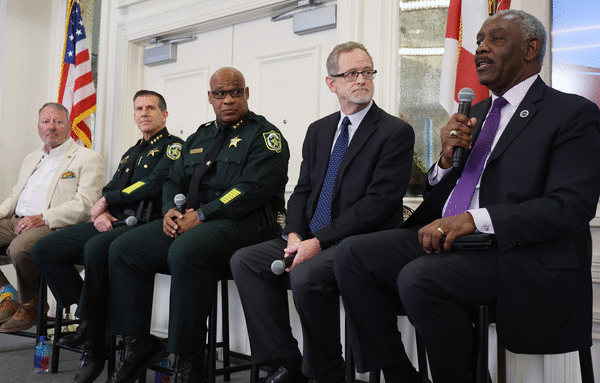
ORLANDO, Fla. — The Pulse nightclub massacre, which will mark its grim 10th anniversary next month, was the nation’s deadliest mass shooting in 2016, and Orlando and Orange County’s top political and law enforcement leaders said Friday they faced unprecedented challenges as they responded to a gunman who attacked the nightclub and then held some patrons hostage for hours.
Orange County Sheriff John Mina, then chief of the Orlando Police Department, said that despite OPD’s mass-incident training nothing could fully prepare first responders for what happened that night, as a three-hour standoff and hostage situation set in with the shooter, Omar Mateen, threatening that he had enough explosives to level the entire block along Orange Avenue.
“We’re dealing with a struggle between saving people who were trapped in there, who were hostages, and also saving everyone else in the immediate area,” Mina said at a meeting of the Tiger Bay Club of Central Florida in Orlando.
Orange County Undersheriff Mark Canty, then Commander of OPD’s SWAT team, said he knows that over the years some residents, and survivors of the massacre, have questioned why law enforcement waited so long to take out the shooter. But Canty said that law enforcement arrived quickly and immediately began extracting people from the building.
“From the very first time that a law enforcement officer showed up on site, they were rescuing people, pulling people out, putting them in trucks, taking them to the fire station,” he said. “We started rescuing people out of dressing rooms, out of offices, out of bathrooms, anywhere in the club.”
Mina said that law enforcement exchanged gunfire with Mateen soon after arriving on scene and ultimately saved dozens of lives. Canty said he helped coordinate the breach of the nightclub, a move involving explosives and a tactical vehicle, that allowed the rescue of 13 people trapped in the club’s bathroom.
Still, 49 perished in the shooting, the country’s deadliest mass shooting until 2017 when that death toll was surpassed by a mass shooting at a concert in Las Vegas that killed 60.
OPD had trained for various mass incident scenarios, Canty said, but hadn’t expected that one might occur at a nightclub.
“We trained it at schools, at malls, at colleges. We thought about sporting events. I will tell you, we never thought about a nightclub in downtown Orlando,” he said, “or just outside of downtown. We didn’t think about that, so it can happen anywhere.”
Orlando Mayor Buddy Dyer, woken up by police around 3 a.m. that morning so he could be briefed about the shooting, said he immediately called his son to make sure he wasn’t at the nightclub. Then he drove to the command center police had set up just south of Pulse on Orange Avenue.
Now, Dyer considers himself an aid of sorts to other mayors across the United States whose cities have suffered mass shootings, which while relatively rare at the time, have now become more common. He said one lasting legacy of Pulse is using Orlando’s tragic experience to help other cities. He sent some city staff who were involved in the Pulse response to aid the City of Las Vegas after the shooting there.
“I think I’ve become the dean of the mass shooting mayors, and there’s a very large club of us now,” he said. “I can’t tell you how many mayors I’ve spoken to…just to help calm them.”
Dr. Michael Cheatham was a trauma surgeon at Orlando Regional Medical Center, which just down the street from Pulse, and treated many of the shooting victims. He remembers the painful moment when hospital staff read a list of victims who had survived to a room crowded with families who couldn’t find their loved ones.
“We got to the end of the list and people started calling out, “Well, where’s the rest of the list? Where’s the second list? You haven’t mentioned my loved one’s name’,” he said.
Hospital staff had to tell them those not on the list had perished.
“We had people who passed out. We had people that were falling on the floor and crying.”
On a positive note, Cheatham said the Orlando community came together to support those devastated by the shooting. At a news conference following the attack, he had asked the community to donate blood — and more than 28,000 people did, more than he’d ever seen.
Every shooting victim who arrived at ORMC alive ultimately survived, Cheatham said, crediting law enforcement who pulled them out and helped transport them to the hospital so quickly.
Orange County Mayor Jerry Demings, then the Orange County’s sheriff, said the response to the attack wasn’t perfect, but “we did the best that we could on that day.”
And since then, the region has worked to improve how they respond to a crisis, he said, “and so I think our community is better because of that.”
©2026 Orlando Sentinel. Visit orlandosentinel.com. Distributed by Tribune Content Agency, LLC.




Comments