Girl Scout, 99, recalls traditions, values of 100-year-old group
Published in Senior Living Features
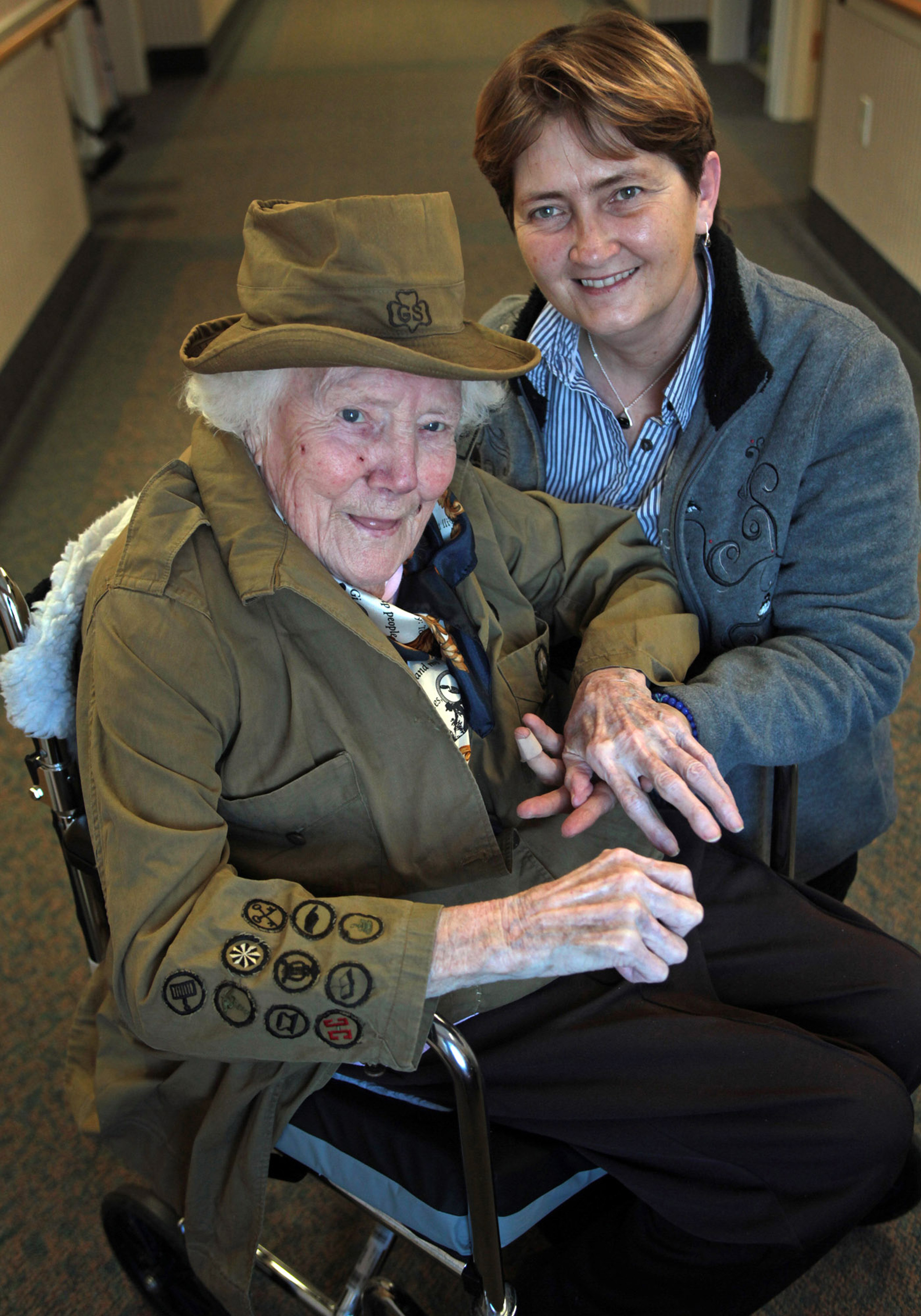
HACKENSACK, N.J. -- Once Libbie Lindsay first put on her Girl Scout uniform in 1925, she never wanted to take it off.
The oldest living Girl Scout in northern New Jersey, Lindsay, 99, of Lyndhurst, still keeps the khaki knee-length jacket and matching ranger hat in pristine condition.
Her mom was homebound with a weak heart, and her father, the town's sewage superintendent, didn't want his daughter out without adult supervision.
Being a Scout was her ticket to a wider world. She could hike nine miles with her troop from Lyndhurst to Garret Mountain Reservation. She landed her first of many jobs with the Scouts as a camp bugler. "You could be strong, and didn't have to depend on anybody," said Lindsay, who was a record-setting track star in high school and competed at the 1936 Olympic Trials in discus.
The Girl Scouts, who marked their 100th anniversary Monday, are still an integral part in the lives of North Jersey girls: One in five girls participate, double the national average.
For Lindsay, who also turns 100 this year, it's a celebration of the 87 years she's been Scouting, the best friends she made and the thousands of girls she influenced as a troop leader.
"On my honor, I will do my best for my country. I never drank, never swore," said Lindsay, as her long, wrinkled fingers gripped a small jewelry box with the collection of Scouting pins she's earned.
In the century since the first group of 18 girls met in Savannah, Ga., the organization's core values and purpose have remained unchanged. Founder Juliette Gordon Low believed that girls should gain life experience in the outdoors and in their communities and have opportunities to lead.
The first Scouts learned how to set a table for four and tie up a robber with an 8-inch cord. Today, in addition to traditional badges such as cooking and baby-sitting, girls can earn badges in website design, entrepreneurial skills and water conservation.
Shanell Pommells, 12, is a member of a troop that meets in the basement of Paterson's Second Baptist Church. Like Lindsay, she became a Scout to try new experiences. Her favorite memories include volunteering in the food pantry at the Father English community center, planting roses and attending camp -- which is like Shangri-La for Girl Scouts.
"You learn how to be independent, work well with others, and later on in life it will be with you," Pommells said.
The Girl Scouts of northern New Jersey have a long tradition. Today's leaders attribute the high participation rate to the variety of programs offered. Recent workshops at their Lake Kinnelon center included classes in forensic science and archaeology, and a Hogwarts Harry Potter weekend.
"We try to make it really relevant to girls today," said Betty Garger, chief operating officer of the council, which serves five counties, including Bergen, Passaic and Morris.
That flexible and pragmatic attitude can be traced to the origins of Girl Scouting.
"Even at the beginning they were quite open, and what I think is most important, they were willing to have a national organization but allow it to have a local flavor," said Susan Miller, a historian at the Rutgers Center for Children and Childhood Studies. Girl Scout troops quickly sprang up in ethnic communities, serving Jewish girls in Philadelphia, and later African-Americans, Mexican-Americans and Native Americans. In 1956, the Rev. Martin Luther King Jr. praised mixed-race Girl Scout troops as a "force for desegregation."
The Northern New Jersey council has recently stepped up efforts to recruit and subsidize volunteer leaders in five target areas -- Paterson, Passaic, Clifton, Hackensack and Teaneck -- where participation rates are lower.
Meetings are offered at flexible times and days, instead of the traditional after-school afternoon activities, to accommodate leaders and Scouts with other obligations. And to attract girls who may not be interested in traditional Scouting activities, the council is spinning off the Girl Scout brand to create short-term programs in activities such as basketball, swimming, Zumba or cheerleading. "They do the (Girl Scout) promise, the laws and the meeting, but their focus is one linked interest," Garger said.
Most of Paterson, N.J.'s 10 troops meet in one of the city's churches, but Nancy Lomax, who has led Troop 95326 out of the Second Baptist Church for more than two decades, emphasizes that girls of all faiths and ethnicities participate.
"With Girl Scouts the idea is global. We have had Muslim girls here," she said.
Her mixed-age troop includes Scouts from Daisies (kindergartners and first-graders) to Seniors (high school students). They work together, with the older girls serving as role models for the younger ones.
"I want the girls to have the opportunity to choose what experiences they'll have in life," Lomax said. "Even the little ones can learn to be self-sufficient and not be afraid to try new things. It's a safe place to be themselves."
From the beginning, Low, the founder, set a strong precedent that girls could do anything that boys can do. She had her girls chopping wood, building fires and erecting tents out of ponchos. The early leaders of the Boy Scouts, founded in 1910, disapproved of their counterpart's unfeminine activities and threatened to sue the organization in the 1920s for trademark violation, including use of the word Scout in the name, according to Miller.
"They very much objected to thinking about Scouting in general as something girls could do," Miller said. Robert Baden-Powell, founder of the worldwide boys Scouting movement, envisioned his Scouts as active, adventurous and possessing the survival skills of a soldier.
Those traits were the exact ones Low wanted for her Girl Scouts. She never backed down, and the Boy Scouts eventually dropped their complaints.
"She wanted to claim this vigorous idea of Scouting for her girls," said Miller.
Lindsay, who lives in the Maywood Center for Health and Rehabilitation, embodies this independent, can-do spirit. She never married, but built a life with friends made in Scouting and the girls she mentored as a troop leader and camp director. She still erupts with laughter recalling all the practical jokes she played at camp. When girls slipped into their sleeping bags, sometimes their bare feet would be tickled by a hairy wig. A mock raccoon tail sticking out of an opened bag of potato chips was surely the work of Lindsay.
Bergen County, N.J., Executive Kathleen Donovan first met Lindsay as a Brownie. Donovan followed her leader in backpacking trips and was in awe of the stories she told from her track-and-field days, including getting to shake the hand of Jesse Owens.
"Libbie set the bar high for all of us," Donovan said. "She was somebody who I thought could do anything. She was going to live her own life, quietly, without saying anything -- that was the Libbie way."
The Girl Scouts continue to be a part of her daily life. One of her former troop members, Rosemary Iannone, visits her every afternoon and takes her to events in the community.
"She was like my second mother," said Iannone, a teacher now in her 50s. "She tried to teach me you didn't have to go out and party. You could have a good life without that."
On a recent afternoon, Iannone carefully folded up Lindsay's uniform and wheeled her toward a 4 p.m. dinner.
"She took me everywhere, now I take her everywhere," she said.
========
(c)2012 The Record (Hackensack, N.J.) Visit The Record (Hackensack, N.J.) at www.NorthJersey.com
(c) The Record (Hackensack N.J.)







Comments